




Human Machine Interface Market Synopsis:
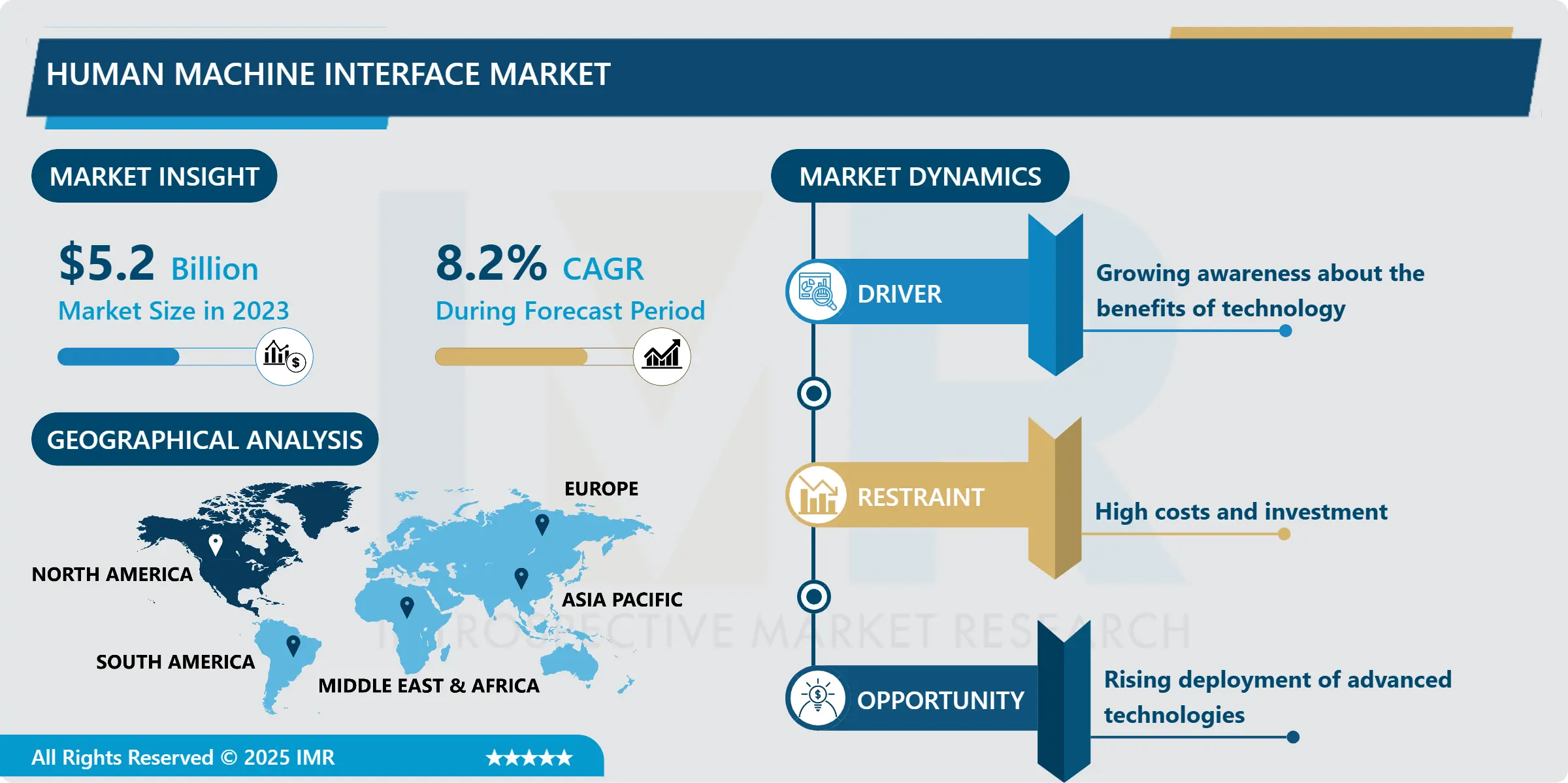
Human Machine Interface Market Size Was Valued at USD 5.20 Billion in 2023, and is Projected to Reach USD 10.57 Billion by 2032, Growing at a CAGR of 8.20% From 2024-2032.
Mostly called as C-H Interface, man-machine interface or human-computer interface, human machine interface is a component of electronic devices through which an operator can communicate with the controller. Human machine interface is a component within a system that provides an effective gateway through which the user of the machine can interactively communicates with the machine using signals generated by the machine in response to user inputs.
Human Machine Interface is a fast growing market , due to the enhancements in automation , augmentation of smart products in production facilities, and the growing interest for effective and easy to use interface in industrial settings. HMIs are central in allowing the human to interface with the machine for control, monitoring and data acquisition with applications across manufacturing, automotive, energy, healthcare and consumer electronics. LATEST development towards Industry 4.0 and the practice of IoT in operations are paramount drivers in the growth of HMI market. Furthermore, rapid growth in advanced interface technologies such as touch interfaces and voice and gesture recognition is changing the market as consumers find new ways to control machines and devices.
With regards to growth, North America and Europe take the leading positions at the parallel kinematic machines market, as these regions were among the first to adopt new technologies, and there is a strong base of major participants. However, the Asia-Pacific region is expected to experience the highest growth rate primarily because of increased industrialization and smart city projects and growing need for automation in countries like China, Japan and India. The HMI market is continuing to grow due to the latest innovations in wearable technology with industries seeking fresh opportunities to incorporate HMI solutions in smartwatches and AR/VR gadgets. Because the market for products with intuitive interfaces is still largely untapped, the HMI market will have room to develop further, in new regions and in new applications such as medicine and cars.
Human Machine Interface Market Trend Analysis:
Driving the Human Machine Interface (HMI) Market
- The research shows that among all the current trends in the field of Human Machine Interface (HMI), the most widely spread is the use of touch-based interfaces. Consumers are familiar with touchscreens as more individuals own smart phones or tablets hence the use of touch sensitive HMI is on the rise in industries such as automotive, manufacturing and health care. In communication with human beings, most of these touch interfaces are much easier and friendly than the button types. The stiffness and sensitivity make touch screens highly adaptable interfaces preferred for use in applications where the operator needs to input less commands and have high efficiency. Such a transition to touch-based interfaces is making HMI interaction even better by increasing the likes of user satisfaction and procedural productivity across various industries.
- Apart from, advanced features like voice recognition and gesture control systems have also got integrated into the HMIs and improved the performances of the touch interfaces. These advances allow users to use voice recognition systems and other touchless ways to interact with machines, which is essential given potential areas of application, such as the car or healthcare, where what the user is doing has to be safe and easy. Voice control means that it is convenient to control systems without using hands, and gesture control provides an even higher level of conveniently performing the commands the user wants. These technologies minimize contact with components of the interface while improving the experience of the users and operational gains. Therefore the integration of the touch technique along with voice and gesture, has been changing the traditional design techniques of HMI of different industries to the next level of advanced and easier solutions.
Advanced Mobile Device Such As Smart Phones And Tablets, Have Popularized Touchscreens
- Touch-based interfaces are one of the most noticeable trends in the Human Machine Interface (HMI) market today. Advanced mobile device such as smart phones and tablets, have popularized touchscreens and are thus presently demanding touch screen HMIs in cars, factories, and hospitals among others. Touch interfaces provide a better compared to button interfaces with buttons that are commonly used in any instrument interface. High responsiveness and tunable touch sensors make the interactions in this type of application more flexible and smoother, so they are widely preferred in this scenario. Transitioning to touch-based interfaces is extending the overall control and performance of HMIs, subsequently, customer satisfaction and organizational productivity across different industries.
- However, the presence of touch interfaces are complemented by the voice recognition and gesture control technologies to add enable additional features to the HMIs. They allow natural, hands-free usage of devices which is especially valuable in such niches as automotive and healthcare due to security needs of such applications. Speech control enables regulation of systems without using hands, whereas gesture control provides the next level of natural interface. Such technologies create friendly environments for the users, and at the same time, eliminate much contact with the interface to increase efficiency. Therefore, touch, voice, and gestures are seen to be radically changing the handling of HMI design across industries and making it more effective and uncomplicated.
Human Machine Interface Market Segment Analysis:
Human Machine Interface Market Segmented on the basis of Components, Configuration Type, End User Industry, Technology Type Sales Channel, and Region
By Components, Hardware segment is expected to dominate the market during the forecast period
- They consist of more fundamental concepts of human machine interfaces to mean, general ordinary interfaces meant for direct and basic interactions with the machinery. These interfaces are most commonly employed in relatively uncomplicated systems that require little or no supervision or management. They are cheaper, quite simple to operate and need little capital investment for their establishment hence suitable for the small scale or limited industrial usage. Some CMMIs are characterized by their rudimentary feature sets and basic human-machine interfaces that are usually screens or buttons; for these applications, they are quite useful for businesses with moderate or limited degrees of computerization.
- There is more flexibility advanced panel-based HMIs today include, high-resolution graphical capabilities, touch screens sensitivity and better visualization compared to conventional HMIs that make them suitable for complicated manufacturing processes. These interfaces are utilized in places that require frequent interactions and monitoring such as the factories and plants that are large. They can connect with other industrial systems and deliver a lot of data on several processes and control them at the same time. The latest design of panel-based HMIs is durable and therefore most preferred in industries requiring high accuracy including automotive industries, pharmaceuticals, and energy where efficiency and integration are vital.
By Sales Channel, Direct Sales Channel segment expected to held the largest share
- Most of the time, the direct sales channel can be described as an organizational arrangement that enables manufacturers and / or service providers to sell HMI systems to end users, without going through other channels. Such an approach is preferred by organizations which need special solutions responding to their specific activity profiles, seen in the case of dedicated software systems. The direct interaction between the manufacturer and the customer minimize communication barriers and facilitates a close examination of the customers needs in order to encompass the HMI system in his processes or structures. The main advantage here is that companies can request highly customized products that meet specific automation requirements such as compatibility with earlier systems or some unique control options.
- Also there are considerable advantages of using direct sales channel in terms of services and support offered after the sale. Manufacturers always have a role to play in how the system is going to be set up and they need to offer help in the installation and configuration of the system in the manner suited for the customer’s situation. In addition to the Commissioning, the direct sales involve technical support, training and maintenance for the inception, stabilization, sustenance and optimization of the HMI system. This high level of customer support is especially crucial to industries where system disruptions can be expensive, thus the direct sales model effectively for companies that need high levels of system reliability, as well as flexibility in their automation systems.
Human Machine Interface Market Regional Insights:
North America is Expected to Dominate the Market Over the Forecast period
- The growth of Human Machine Interface (HMI) market is attributed to the impetus of advanced technologies across North America and by the strong market holding of manufacturers in automation, automotive, and manufacturing departments. Among the countries, the United States is major market with high demand on HMI in various industries, such as automotive, aerospace and healthcare. The shift towards automation together with the call for enhanced intelligent method and execution in these sectors has boosted the use of HMI systems. these systems facilitate the effort to control, monitor or even interact with the machines to increase its productivity and increase operation efficiency of important sectors.
- Moreover, North America has adopted Industry 4.0 concept recently, which has accelerated the demand for advanced HMI solutions in smart manufacturing units. Main Links Of Interest show this integration of connected systems, data analytics, and real-time solution to increase operational efficiency. Consumption expenditure on automation technologies and smart factories also remain high among the manufacturers in their pursuit of cost effectiveness. While these trends continue to gain traction, the North American HMI market is anticipated to report steady progress based on further development of manufacturing methods and advancement of HMI interfaces that enhance automation and industry performance.
Active Key Players in the Human Machine Interface Market:
- ABB (Switzerland)
- Advantech Co., Ltd. (Taiwan)
- Beckhoff Automation (Germany)
- Beijer Electronics Group (Sweden)
- Eaton. (Ireland)
- Emerson Electric Co. (U.S.)
- Exor International (Italy)
- General Electric (U.S.)
- Honeywell International, Inc. (U.S.)
- Kontron (Germany)
- Mitsubishi Electric Corporation (Japan)
- OMRON Corporation (Japan)
- Red Lion (U.S.)
- Robert Bosch Gmbh (Japan)
- Rockwell Automation, Inc. (U.S.)
- Schneider Electric (France)
- Siemens (Germany)
- Texas Instruments Incorporated. (U.S.)
- Weintek Labs., Inc. (Taiwan)
- Other Active Players
|
Human Machine Interface Market |
|||
|
Base Year: |
2023 |
Forecast Period: |
2024-2032 |
|
Historical Data: |
2017 to 2023 |
Market Size in 2023: |
USD 5.20 Billion |
|
Forecast Period 2024-32 CAGR: |
8.20% |
Market Size in 2032: |
USD 10.57 Billion |
|
Segments Covered: |
By Components |
|
|
|
By Configuration Type |
|
||
|
By End User Industry |
|
||
|
By Technology Type |
|
||
|
By Sales Channel |
|
||
|
By Region |
|
||
|
Key Market Drivers: |
|
||
|
Key Market Restraints: |
|
||
|
Key Opportunities: |
|
||
|
Companies Covered in the report: |
|
||
Chapter 1: Introduction
1.1 Scope and Coverage
Chapter 2:Executive Summary
Chapter 3: Market Landscape
3.1 Market Dynamics
3.1.1 Drivers
3.1.2 Restraints
3.1.3 Opportunities
3.1.4 Challenges
3.2 Market Trend Analysis
3.3 PESTLE Analysis
3.4 Porter's Five Forces Analysis
3.5 Industry Value Chain Analysis
3.6 Ecosystem
3.7 Regulatory Landscape
3.8 Price Trend Analysis
3.9 Patent Analysis
3.10 Technology Evolution
3.11 Investment Pockets
3.12 Import-Export Analysis
Chapter 4: Human Machine Interface Market by Component
4.1 Human Machine Interface Market Snapshot and Growth Engine
4.2 Human Machine Interface Market Overview
4.3 Hardware
4.3.1 Introduction and Market Overview
4.3.2 Historic and Forecasted Market Size in Value USD and Volume Units (2017-2032F)
4.3.3 Key Market Trends, Growth Factors and Opportunities
4.3.4 Hardware: Geographic Segmentation Analysis
4.4 Software
4.4.1 Introduction and Market Overview
4.4.2 Historic and Forecasted Market Size in Value USD and Volume Units (2017-2032F)
4.4.3 Key Market Trends, Growth Factors and Opportunities
4.4.4 Software: Geographic Segmentation Analysis
4.5 Services
4.5.1 Introduction and Market Overview
4.5.2 Historic and Forecasted Market Size in Value USD and Volume Units (2017-2032F)
4.5.3 Key Market Trends, Growth Factors and Opportunities
4.5.4 Services: Geographic Segmentation Analysis
Chapter 5: Human Machine Interface Market by Configuration Type
5.1 Human Machine Interface Market Snapshot and Growth Engine
5.2 Human Machine Interface Market Overview
5.3 Standalone
5.3.1 Introduction and Market Overview
5.3.2 Historic and Forecasted Market Size in Value USD and Volume Units (2017-2032F)
5.3.3 Key Market Trends, Growth Factors and Opportunities
5.3.4 Standalone: Geographic Segmentation Analysis
5.4 Embedded
5.4.1 Introduction and Market Overview
5.4.2 Historic and Forecasted Market Size in Value USD and Volume Units (2017-2032F)
5.4.3 Key Market Trends, Growth Factors and Opportunities
5.4.4 Embedded: Geographic Segmentation Analysis
Chapter 6: Human Machine Interface Market by End User Industry
6.1 Human Machine Interface Market Snapshot and Growth Engine
6.2 Human Machine Interface Market Overview
6.3 Process Industry
6.3.1 Introduction and Market Overview
6.3.2 Historic and Forecasted Market Size in Value USD and Volume Units (2017-2032F)
6.3.3 Key Market Trends, Growth Factors and Opportunities
6.3.4 Process Industry: Geographic Segmentation Analysis
6.4 Discreet Industry
6.4.1 Introduction and Market Overview
6.4.2 Historic and Forecasted Market Size in Value USD and Volume Units (2017-2032F)
6.4.3 Key Market Trends, Growth Factors and Opportunities
6.4.4 Discreet Industry: Geographic Segmentation Analysis
Chapter 7: Human Machine Interface Market by Technology Type
7.1 Human Machine Interface Market Snapshot and Growth Engine
7.2 Human Machine Interface Market Overview
7.3 Motion HMI
7.3.1 Introduction and Market Overview
7.3.2 Historic and Forecasted Market Size in Value USD and Volume Units (2017-2032F)
7.3.3 Key Market Trends, Growth Factors and Opportunities
7.3.4 Motion HMI: Geographic Segmentation Analysis
7.4 Bionic HMI
7.4.1 Introduction and Market Overview
7.4.2 Historic and Forecasted Market Size in Value USD and Volume Units (2017-2032F)
7.4.3 Key Market Trends, Growth Factors and Opportunities
7.4.4 Bionic HMI: Geographic Segmentation Analysis
7.5 Tactile HMI
7.5.1 Introduction and Market Overview
7.5.2 Historic and Forecasted Market Size in Value USD and Volume Units (2017-2032F)
7.5.3 Key Market Trends, Growth Factors and Opportunities
7.5.4 Tactile HMI: Geographic Segmentation Analysis
7.6 Acoustic HMI
7.6.1 Introduction and Market Overview
7.6.2 Historic and Forecasted Market Size in Value USD and Volume Units (2017-2032F)
7.6.3 Key Market Trends, Growth Factors and Opportunities
7.6.4 Acoustic HMI: Geographic Segmentation Analysis
Chapter 8: Human Machine Interface Market by Sales Channel,
8.1 Human Machine Interface Market Snapshot and Growth Engine
8.2 Human Machine Interface Market Overview
8.3 Direct Sales Channel
8.3.1 Introduction and Market Overview
8.3.2 Historic and Forecasted Market Size in Value USD and Volume Units (2017-2032F)
8.3.3 Key Market Trends, Growth Factors and Opportunities
8.3.4 Direct Sales Channel: Geographic Segmentation Analysis
8.4 Indirect Sales Channel
8.4.1 Introduction and Market Overview
8.4.2 Historic and Forecasted Market Size in Value USD and Volume Units (2017-2032F)
8.4.3 Key Market Trends, Growth Factors and Opportunities
8.4.4 Indirect Sales Channel: Geographic Segmentation Analysis
Chapter 9: Company Profiles and Competitive Analysis
9.1 Competitive Landscape
9.1.1 Competitive Benchmarking
9.1.2 Human Machine Interface Market Share by Manufacturer (2023)
9.1.3 Industry BCG Matrix
9.1.4 Heat Map Analysis
9.1.5 Mergers and Acquisitions
9.2 BECKHOFF AUTOMATION (GERMANY)
9.2.1 Company Overview
9.2.2 Key Executives
9.2.3 Company Snapshot
9.2.4 Role of the Company in the Market
9.2.5 Sustainability and Social Responsibility
9.2.6 Operating Business Segments
9.2.7 Product Portfolio
9.2.8 Business Performance
9.2.9 Key Strategic Moves and Recent Developments
9.2.10 SWOT Analysis
9.3 BEIJER ELECTRONICS GROUP (SWEDEN)
9.4 EATON. (IRELAND)
9.5 EXOR INTERNATIONAL (ITALY)
9.6 KONTRON (GERMANY)
9.7 OMRON CORPORATION (JAPAN)
9.8 RED LION (U.S.)
9.9 ROBERT BOSCH GMBH (JAPAN)
9.10 TEXAS INSTRUMENTS INCORPORATED. (U.S.)
9.11 WEINTEK LABS. INC. (TAIWAN)
9.12 ROCKWELL AUTOMATION INC. (U.S.)
9.13 SCHNEIDER ELECTRIC (FRANCE)
9.14 ABB (SWITZERLAND)
9.15 SIEMENS (GERMANY)
9.16 MITSUBISHI ELECTRIC CORPORATION (JAPAN)
9.17 ADVANTECH CO. LTD. (TAIWAN)
9.18 EMERSON ELECTRIC CO. (U.S.)
9.19 GENERAL ELECTRIC (U.S.)
9.20 HONEYWELL INTERNATIONAL INC. (U.S.)
9.21 AND YOKOGAWA ELECTRIC CORPORATION (JAPAN)
9.22 OTHER ACTIVE PLAYERS
Chapter 10: Global Human Machine Interface Market By Region
10.1 Overview
10.2. North America Human Machine Interface Market
10.2.1 Key Market Trends, Growth Factors and Opportunities
10.2.2 Top Key Companies
10.2.3 Historic and Forecasted Market Size by Segments
10.2.4 Historic and Forecasted Market Size By Component
10.2.4.1 Hardware
10.2.4.2 Software
10.2.4.3 Services
10.2.5 Historic and Forecasted Market Size By Configuration Type
10.2.5.1 Standalone
10.2.5.2 Embedded
10.2.6 Historic and Forecasted Market Size By End User Industry
10.2.6.1 Process Industry
10.2.6.2 Discreet Industry
10.2.7 Historic and Forecasted Market Size By Technology Type
10.2.7.1 Motion HMI
10.2.7.2 Bionic HMI
10.2.7.3 Tactile HMI
10.2.7.4 Acoustic HMI
10.2.8 Historic and Forecasted Market Size By Sales Channel,
10.2.8.1 Direct Sales Channel
10.2.8.2 Indirect Sales Channel
10.2.9 Historic and Forecast Market Size by Country
10.2.9.1 US
10.2.9.2 Canada
10.2.9.3 Mexico
10.3. Eastern Europe Human Machine Interface Market
10.3.1 Key Market Trends, Growth Factors and Opportunities
10.3.2 Top Key Companies
10.3.3 Historic and Forecasted Market Size by Segments
10.3.4 Historic and Forecasted Market Size By Component
10.3.4.1 Hardware
10.3.4.2 Software
10.3.4.3 Services
10.3.5 Historic and Forecasted Market Size By Configuration Type
10.3.5.1 Standalone
10.3.5.2 Embedded
10.3.6 Historic and Forecasted Market Size By End User Industry
10.3.6.1 Process Industry
10.3.6.2 Discreet Industry
10.3.7 Historic and Forecasted Market Size By Technology Type
10.3.7.1 Motion HMI
10.3.7.2 Bionic HMI
10.3.7.3 Tactile HMI
10.3.7.4 Acoustic HMI
10.3.8 Historic and Forecasted Market Size By Sales Channel,
10.3.8.1 Direct Sales Channel
10.3.8.2 Indirect Sales Channel
10.3.9 Historic and Forecast Market Size by Country
10.3.9.1 Russia
10.3.9.2 Bulgaria
10.3.9.3 The Czech Republic
10.3.9.4 Hungary
10.3.9.5 Poland
10.3.9.6 Romania
10.3.9.7 Rest of Eastern Europe
10.4. Western Europe Human Machine Interface Market
10.4.1 Key Market Trends, Growth Factors and Opportunities
10.4.2 Top Key Companies
10.4.3 Historic and Forecasted Market Size by Segments
10.4.4 Historic and Forecasted Market Size By Component
10.4.4.1 Hardware
10.4.4.2 Software
10.4.4.3 Services
10.4.5 Historic and Forecasted Market Size By Configuration Type
10.4.5.1 Standalone
10.4.5.2 Embedded
10.4.6 Historic and Forecasted Market Size By End User Industry
10.4.6.1 Process Industry
10.4.6.2 Discreet Industry
10.4.7 Historic and Forecasted Market Size By Technology Type
10.4.7.1 Motion HMI
10.4.7.2 Bionic HMI
10.4.7.3 Tactile HMI
10.4.7.4 Acoustic HMI
10.4.8 Historic and Forecasted Market Size By Sales Channel,
10.4.8.1 Direct Sales Channel
10.4.8.2 Indirect Sales Channel
10.4.9 Historic and Forecast Market Size by Country
10.4.9.1 Germany
10.4.9.2 UK
10.4.9.3 France
10.4.9.4 The Netherlands
10.4.9.5 Italy
10.4.9.6 Spain
10.4.9.7 Rest of Western Europe
10.5. Asia Pacific Human Machine Interface Market
10.5.1 Key Market Trends, Growth Factors and Opportunities
10.5.2 Top Key Companies
10.5.3 Historic and Forecasted Market Size by Segments
10.5.4 Historic and Forecasted Market Size By Component
10.5.4.1 Hardware
10.5.4.2 Software
10.5.4.3 Services
10.5.5 Historic and Forecasted Market Size By Configuration Type
10.5.5.1 Standalone
10.5.5.2 Embedded
10.5.6 Historic and Forecasted Market Size By End User Industry
10.5.6.1 Process Industry
10.5.6.2 Discreet Industry
10.5.7 Historic and Forecasted Market Size By Technology Type
10.5.7.1 Motion HMI
10.5.7.2 Bionic HMI
10.5.7.3 Tactile HMI
10.5.7.4 Acoustic HMI
10.5.8 Historic and Forecasted Market Size By Sales Channel,
10.5.8.1 Direct Sales Channel
10.5.8.2 Indirect Sales Channel
10.5.9 Historic and Forecast Market Size by Country
10.5.9.1 China
10.5.9.2 India
10.5.9.3 Japan
10.5.9.4 South Korea
10.5.9.5 Malaysia
10.5.9.6 Thailand
10.5.9.7 Vietnam
10.5.9.8 The Philippines
10.5.9.9 Australia
10.5.9.10 New Zealand
10.5.9.11 Rest of APAC
10.6. Middle East & Africa Human Machine Interface Market
10.6.1 Key Market Trends, Growth Factors and Opportunities
10.6.2 Top Key Companies
10.6.3 Historic and Forecasted Market Size by Segments
10.6.4 Historic and Forecasted Market Size By Component
10.6.4.1 Hardware
10.6.4.2 Software
10.6.4.3 Services
10.6.5 Historic and Forecasted Market Size By Configuration Type
10.6.5.1 Standalone
10.6.5.2 Embedded
10.6.6 Historic and Forecasted Market Size By End User Industry
10.6.6.1 Process Industry
10.6.6.2 Discreet Industry
10.6.7 Historic and Forecasted Market Size By Technology Type
10.6.7.1 Motion HMI
10.6.7.2 Bionic HMI
10.6.7.3 Tactile HMI
10.6.7.4 Acoustic HMI
10.6.8 Historic and Forecasted Market Size By Sales Channel,
10.6.8.1 Direct Sales Channel
10.6.8.2 Indirect Sales Channel
10.6.9 Historic and Forecast Market Size by Country
10.6.9.1 Turkiye
10.6.9.2 Bahrain
10.6.9.3 Kuwait
10.6.9.4 Saudi Arabia
10.6.9.5 Qatar
10.6.9.6 UAE
10.6.9.7 Israel
10.6.9.8 South Africa
10.7. South America Human Machine Interface Market
10.7.1 Key Market Trends, Growth Factors and Opportunities
10.7.2 Top Key Companies
10.7.3 Historic and Forecasted Market Size by Segments
10.7.4 Historic and Forecasted Market Size By Component
10.7.4.1 Hardware
10.7.4.2 Software
10.7.4.3 Services
10.7.5 Historic and Forecasted Market Size By Configuration Type
10.7.5.1 Standalone
10.7.5.2 Embedded
10.7.6 Historic and Forecasted Market Size By End User Industry
10.7.6.1 Process Industry
10.7.6.2 Discreet Industry
10.7.7 Historic and Forecasted Market Size By Technology Type
10.7.7.1 Motion HMI
10.7.7.2 Bionic HMI
10.7.7.3 Tactile HMI
10.7.7.4 Acoustic HMI
10.7.8 Historic and Forecasted Market Size By Sales Channel,
10.7.8.1 Direct Sales Channel
10.7.8.2 Indirect Sales Channel
10.7.9 Historic and Forecast Market Size by Country
10.7.9.1 Brazil
10.7.9.2 Argentina
10.7.9.3 Rest of SA
Chapter 11 Analyst Viewpoint and Conclusion
11.1 Recommendations and Concluding Analysis
11.2 Potential Market Strategies
Chapter 12 Research Methodology
12.1 Research Process
12.2 Primary Research
12.3 Secondary Research
|
Human Machine Interface Market |
|||
|
Base Year: |
2023 |
Forecast Period: |
2024-2032 |
|
Historical Data: |
2017 to 2023 |
Market Size in 2023: |
USD 5.20 Billion |
|
Forecast Period 2024-32 CAGR: |
8.20% |
Market Size in 2032: |
USD 10.57 Billion |
|
Segments Covered: |
By Components |
|
|
|
By Configuration Type |
|
||
|
By End User Industry |
|
||
|
By Technology Type |
|
||
|
By Sales Channel |
|
||
|
By Region |
|
||
|
Key Market Drivers: |
|
||
|
Key Market Restraints: |
|
||
|
Key Opportunities: |
|
||
|
Companies Covered in the report: |
|
||


