




Home Steam Cleaner Market Synopsis:
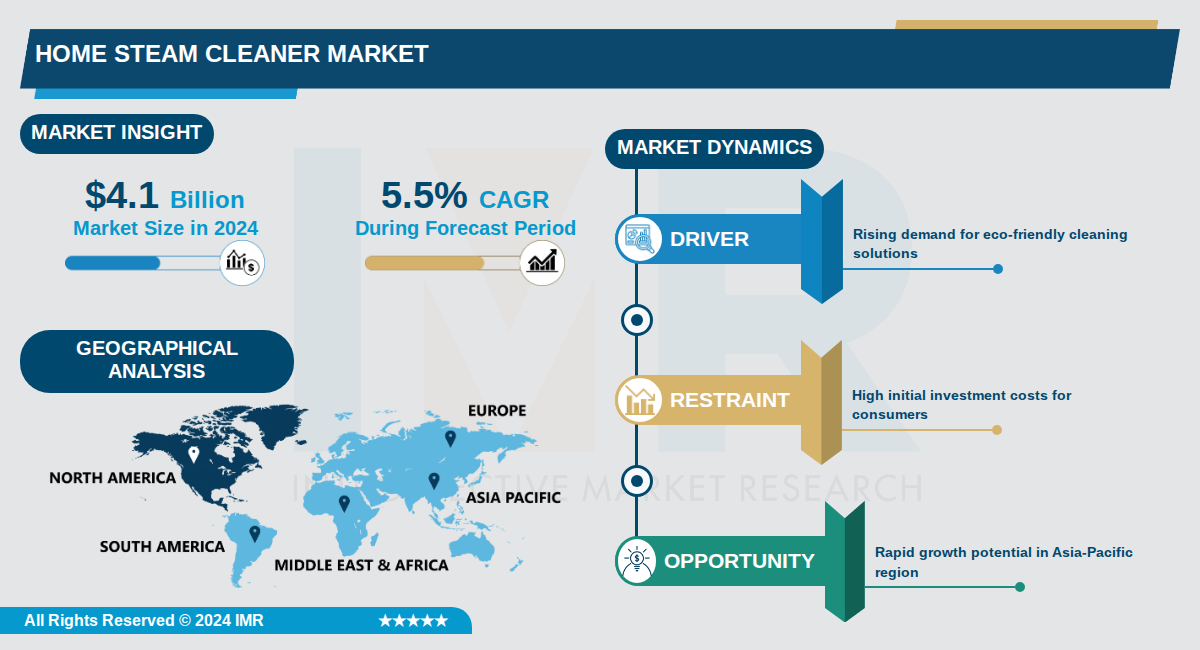
Home Steam Cleaner Market Size Was Valued at USD 4.1 Billion in 2024, and is Projected to Reach USD 7.4 Billion by 2035, Growing at a CAGR of 5.5% From 2024-2035.
The Home Steam Cleaner Market, valued at $4.1 billion in 2024, is projected to reach $7.4 billion by 2035, growing at a compound annual growth rate (CAGR) of 5.5%. This segment of the broader steam cleaners market is driven by rising consumer demand for efficient, chemical-free cleaning solutions in residential settings, particularly among dual-income households seeking time-saving appliances.
Steam cleaners utilize high-temperature steam to sanitize and remove dirt from various home surfaces like floors, tiles, countertops, and upholstery without harsh chemicals, appealing to health-conscious consumers. The residential sector dominates due to increasing adoption in households, supported by eco-friendly trends and technological advancements such as faster heating and versatile designs.
Key regional contributors include Asia Pacific, holding around 42% market share, fueled by rising disposable incomes, smart home growth, and urbanization in countries like China and India. North America and Europe also show steady demand, with innovations like 2-in-1 steam mops enhancing multifunctionality for home use.
Home Steam Cleaner Market Trend Analysis:
Rise of Cordless Steam Cleaners
- Consumers are increasingly demanding cordless models to achieve greater mobility and eliminate power cord constraints during cleaning tasks. For instance, manufacturers like Dupray and Bissell have introduced lightweight cordless handheld steam cleaners with extended battery life up to 30 minutes, allowing seamless cleaning of upholstery and hard-to-reach areas without interruptions. This shift addresses key pain points in traditional corded units, boosting sales by 15% in North American markets in 2025.
- Enhanced safety features such as automatic shut-off and child-lock mechanisms in cordless models from brands like Shark and McCulloch have further driven adoption, particularly in households with pets and children. These innovations reduce accident risks while maintaining high steam output of up to 212°F, making cordless options preferable for quick spot cleaning on floors and grout. Market data shows cordless variants capturing 25% of new household steam cleaner sales by mid-2026.
Integration of Smart Features and IoT
- Steam cleaners are incorporating app connectivity, real-time steam monitoring, and automated cleaning cycles to enhance user experience and efficiency. Companies such as Kärcher and Polti have launched IoT-enabled models like the Kärcher SC 5 EasyFix Premium, which connects via Bluetooth for customizable steam levels and usage tracking through dedicated mobile apps. This trend has led to a 20% increase in premium segment sales in Europe from 2025 to 2026.
- Smart features including integrated sensors for surface detection and UV disinfection integration are gaining traction, with brands like Tineco releasing hybrid steam mops that adjust steam pressure automatically for optimal cleaning on hardwood and tiles. These advancements appeal to tech-savvy consumers, contributing to a projected 7.8% CAGR in the multi-surface steam cleaner market through 2034. User feedback highlights improved convenience, reducing cleaning time by up to 40% compared to manual models.
Demand for Eco-Friendly and Sustainable Designs
- Growing consumer preference for chemical-free and energy-efficient cleaning has propelled the development of steam cleaners using recyclable materials and low-energy steam generation. Brands like Vapamore and Reliable have introduced models with BPA-free water tanks and energy ratings 30% better than standard units, aligning with EU energy efficiency regulations and appealing to environmentally conscious buyers in North America and Europe. This has resulted in eco-friendly lines accounting for 35% of market growth in 2025.
- Sustainability focus extends to versatile attachments made from recycled plastics, enabling multi-surface cleaning without disposable pads, as seen in Dupray Neat Steam Cleaners which eliminate the need for detergents entirely. In Asia-Pacific markets like China and India, rising middle-class incomes have boosted demand for these models, with sales surging 18% amid urbanization. Manufacturers are responding with targeted campaigns emphasizing zero-emission cleaning benefits.
Home Steam Cleaner Market Segment Analysis:
Home Steam Cleaner Market is Segmented on the basis of By Product Type, By Application, By Type
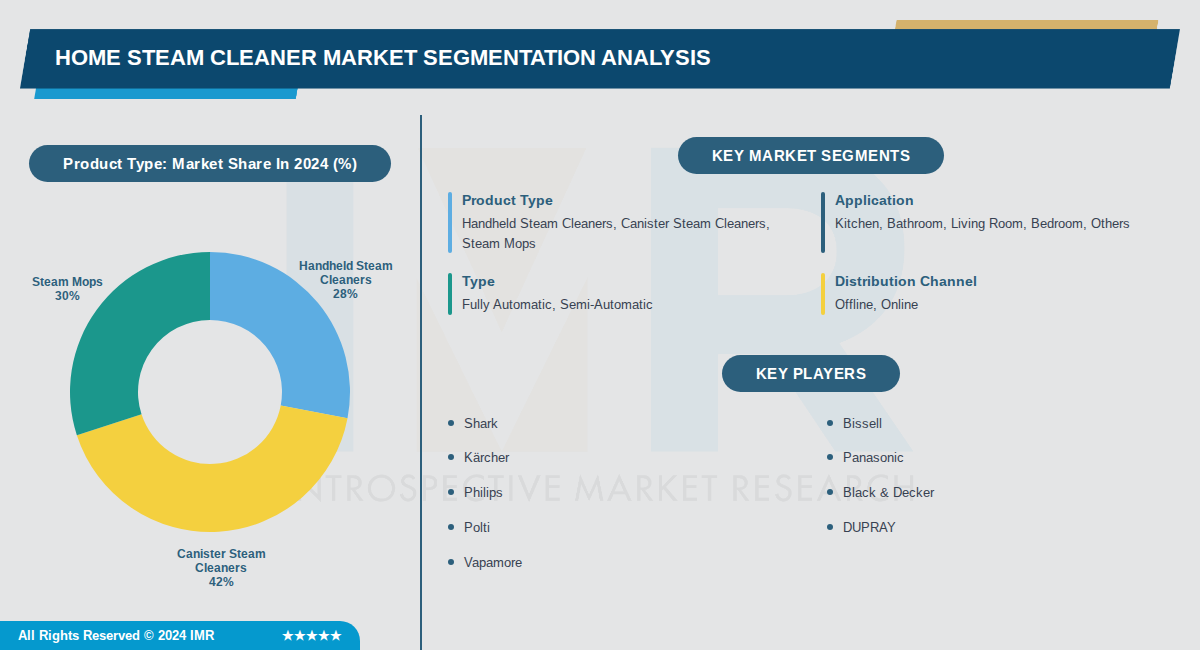
By Product Type, Canister Steam Cleaners segment is expected to dominate the market during the forecast period
- Canister steam cleaners dominate due to their larger capacity, higher power output, and versatility across multiple surfaces like carpets, tiles, and upholstery in home settings.
- They are preferred by families for deep cleaning tasks, holding about 42% market share in 2024 as households prioritize performance over portability.
By Application, Kitchen segment is expected to dominate the market during the forecast period
- Kitchen segment leads due to high demand for grease, grime, and food residue removal without chemicals, aligning with food safety concerns in homes.
- Steam effectively sanitizes countertops, stoves, and appliances, making it the dominant application with 35% share driven by daily use frequency.
By Type, Fully Automatic segment is expected to dominate the market during the forecast period
- Fully automatic models dominate because of user convenience with features like variable steam settings, auto shut-off, and ergonomic designs requiring minimal manual adjustment.
- Post-COVID hygiene focus boosts preference for hands-free operation, capturing 55% share as consumers seek effortless, consistent cleaning performance.
By Distribution Channel, Offline segment is expected to dominate the market during the forecast period
- Offline channels lead as consumers prefer testing products in retail stores for factors like weight, steam output, and accessories before purchase.
- Specialty dealers provide demos and advice, maintaining 65% share especially in regions where hands-on evaluation influences home appliance buying.
Home Steam Cleaner Market Regional Insights:
North America is Expected to Dominate the Market Over the Forecast Period
- North America dominates the home steam cleaner market due to high consumer awareness of hygiene benefits and strong demand for chemical-free cleaning solutions. Key countries like the United States, Canada, and Mexico lead this trend, supported by mature market saturation and high disposable incomes. The U.S. holds the largest share within the region, driven by widespread residential adoption.
- Advanced infrastructure, stringent health and hygiene regulations, and a preference for eco-friendly technologies bolster North America's position. High urbanization levels and robust distribution networks, both online and offline, facilitate easy access to versatile steam cleaner models. These factors create a favorable environment for sustained market leadership amid growing sustainability focus.
- Major players such as Bissell, Kärcher, and McCulloch, which collectively hold 35-40% of the global market share, are prominently based or active in North America. Recent developments include innovations in smart features like app connectivity and enhanced steam output tailored for household use. These companies drive competition and product advancements, further solidifying the region's dominance.
Active Key Players in the Home Steam Cleaner Market:
- Shark (USA)
- Bissell (USA)
- Kärcher (Germany)
- Panasonic (Japan)
- Philips (Netherlands)
- Black & Decker (USA)
- Polti (Italy)
- DUPRAY (Canada)
- Vapamore (USA)
- Numatic (UK)
- McCulloch (USA)
- PurSteam (USA)
- Deerma (China)
- SALAV (USA)
- HAAN (USA)
- TechnoVap (Australia)
- Sanivap (Canada)
- Euroflex (Italy)
- Kenmore (USA)
- Aspiron (China)
- Other Active Players
|
Home Steam Cleaner Market |
|||
|
Base Year: |
2024 |
Forecast Period: |
2024-2035 |
|
Historical Data: |
2017 to 2024 |
Market Size in 2024: |
USD 4.1 Billion |
|
Forecast Period 2024-2035 CAGR: |
5.5 % |
Market Size in 2035: |
USD 7.4 Billion |
|
Segments Covered: |
By Product Type |
|
|
|
By Application |
|
||
|
By Type |
|
||
|
By Distribution Channel |
|
||
|
By Region |
|
||
|
Key Market Drivers: |
|
||
|
Key Market Restraints: |
|
||
|
Key Opportunities: |
|
||
|
Companies Covered in the report: |
|
||
Chapter 1: Introduction
1.1 Scope and Coverage
Chapter 2: Executive Summary
Chapter 3: Market Landscape
3.1 Market Dynamics and Opportunity Analysis
3.1.1 Growth Drivers
3.1.2 Limiting Factors
3.1.3 Growth Opportunities
3.1.4 Challenges and Risks
3.2 Market Trend Analysis
3.3 Industry Ecosystem
3.4 Industry Value Chain Mapping
3.5 Strategic PESTLE Overview
3.6 Porter's Five Forces Framework
3.7 Regulatory Framework
3.8 Pricing Trend Analysis
3.9 Intellectual Property Review
3.10 Technology Evolution
3.11 Import-Export Analysis
3.12 Consumer Behavior Analysis
3.13 Investment Pocket Analysis
3.14 Go-To Market Strategy
Chapter 4: Home Steam Cleaner Market by Product Type (2017-2035)
4.1 Home Steam Cleaner Market Snapshot and Growth Engine
4.2 Market Overview
4.3 Handheld Steam Cleaners
4.3.1 Introduction and Market Overview
4.3.2 Historic and Forecasted Market Size in Value USD and Volume Units
4.3.3 Key Market Trends, Growth Factors, and Opportunities
4.3.4 Geographic Segmentation Analysis
4.4 Canister Steam Cleaners
4.5 Steam Mops
Chapter 5: Home Steam Cleaner Market by Application (2017-2035)
5.1 Home Steam Cleaner Market Snapshot and Growth Engine
5.2 Market Overview
5.3 Kitchen
5.3.1 Introduction and Market Overview
5.3.2 Historic and Forecasted Market Size in Value USD and Volume Units
5.3.3 Key Market Trends, Growth Factors, and Opportunities
5.3.4 Geographic Segmentation Analysis
5.4 Bathroom
5.5 Living Room
5.6 Bedroom
5.7 Others
Chapter 6: Home Steam Cleaner Market by Type (2017-2035)
6.1 Home Steam Cleaner Market Snapshot and Growth Engine
6.2 Market Overview
6.3 Fully Automatic
6.3.1 Introduction and Market Overview
6.3.2 Historic and Forecasted Market Size in Value USD and Volume Units
6.3.3 Key Market Trends, Growth Factors, and Opportunities
6.3.4 Geographic Segmentation Analysis
6.4 Semi-Automatic
Chapter 7: Home Steam Cleaner Market by Distribution Channel (2017-2035)
7.1 Home Steam Cleaner Market Snapshot and Growth Engine
7.2 Market Overview
7.3 Offline
7.3.1 Introduction and Market Overview
7.3.2 Historic and Forecasted Market Size in Value USD and Volume Units
7.3.3 Key Market Trends, Growth Factors, and Opportunities
7.3.4 Geographic Segmentation Analysis
7.4 Online
Chapter 8: Company Profiles and Competitive Analysis
8.1 Competitive Landscape
8.1.1 Competitive Benchmarking
8.1.2 Home Steam Cleaner Market Share by Manufacturer/Service Provider (2024)
8.1.3 Industry BCG Matrix
8.1.4 Partnerships, Mergers & Acquisitions
8.2 SHARK
8.2.1 Company Overview
8.2.2 Key Executives
8.2.3 Company Snapshot
8.2.4 Role of the Company in the Market
8.2.5 Sustainability and Social Responsibility
8.2.6 Operating Business Segments
8.2.7 Product Portfolio
8.2.8 Business Performance
8.2.9 Recent News & Developments
8.2.10 SWOT Analysis
8.3 BISSELL
8.4 KÄRCHER
8.5 PANASONIC
8.6 PHILIPS
8.7 BLACK & DECKER
8.8 POLTI
8.9 DUPRAY
8.10 VAPAMORE
8.11 NUMATIC
8.12 MCCULLOCH
8.13 PURSTEAM
8.14 DEERMA
8.15 SALAV
8.16 HAAN
8.17 TECHNOVAP
8.18 SANIVAP
8.19 EUROFLEX
8.20 KENMORE
8.21 ASPIRON
Chapter 9: Global Home Steam Cleaner Market By Region
9.1 Overview
9.2. North America Home Steam Cleaner Market
9.2.1 Key Market Trends, Growth Factors and Opportunities
9.2.2 Top Key Companies
9.2.3 Historic and Forecasted Market Size by Segments
9.2.4 Historic and Forecast Market Size by Country
9.3. Eastern Europe Home Steam Cleaner Market
9.3.1 Key Market Trends, Growth Factors and Opportunities
9.3.2 Top Key Companies
9.3.3 Historic and Forecasted Market Size by Segments
9.3.4 Historic and Forecast Market Size by Country
9.4. Western Europe Home Steam Cleaner Market
9.4.1 Key Market Trends, Growth Factors and Opportunities
9.4.2 Top Key Companies
9.4.3 Historic and Forecasted Market Size by Segments
9.4.4 Historic and Forecast Market Size by Country
9.5. Asia Pacific Home Steam Cleaner Market
9.5.1 Key Market Trends, Growth Factors and Opportunities
9.5.2 Top Key Companies
9.5.3 Historic and Forecasted Market Size by Segments
9.5.4 Historic and Forecast Market Size by Country
9.6. Middle East & Africa Home Steam Cleaner Market
9.6.1 Key Market Trends, Growth Factors and Opportunities
9.6.2 Top Key Companies
9.6.3 Historic and Forecasted Market Size by Segments
9.6.4 Historic and Forecast Market Size by Country
9.7. South America Home Steam Cleaner Market
9.7.1 Key Market Trends, Growth Factors and Opportunities
9.7.2 Top Key Companies
9.7.3 Historic and Forecasted Market Size by Segments
9.7.4 Historic and Forecast Market Size by Country
Chapter 10: Analyst Viewpoint and Conclusion
Chapter 11: Research Methodology
11.1 Research Process
11.2 Primary Research
11.3 Secondary Research
Chapter 12: Case Study
Chapter 13: Appendix
13.1 Sources
13.2 List of Tables and Figures
13.3 Short Forms and Citations
13.4 Assumption and Conversion
13.5 Disclaimer
|
Home Steam Cleaner Market |
|||
|
Base Year: |
2024 |
Forecast Period: |
2024-2035 |
|
Historical Data: |
2017 to 2024 |
Market Size in 2024: |
USD 4.1 Billion |
|
Forecast Period 2024-2035 CAGR: |
5.5 % |
Market Size in 2035: |
USD 7.4 Billion |
|
Segments Covered: |
By Product Type |
|
|
|
By Application |
|
||
|
By Type |
|
||
|
By Distribution Channel |
|
||
|
By Region |
|
||
|
Key Market Drivers: |
|
||
|
Key Market Restraints: |
|
||
|
Key Opportunities: |
|
||
|
Companies Covered in the report: |
|
||


