




Key Market Highlights
Generative Ai In Healthcare Market Size Was Valued at USD 2.82 Billion in 2024, and is Projected to Reach USD 38.02 Billion by 2035, Growing at a CAGR of 29.71% from 2025-2035.
- Market Size in 2024: USD 2.82 Billion
- Projected Market Size by 2035: USD 38.02 Billion
- CAGR (2025–2035): 29.71%
- Leading Market in 2024: North America
- Fastest-Growing Market: Asia-Pacific
- By Component: The Software Solutions segment is anticipated to lead the market by accounting for 56.73% of the market share throughout the forecast period.
- By Application: The Diagnostics segment is expected to capture 29.42% of the market share, thereby maintaining its dominance over the forecast period.
- By Region: North America region is projected to hold 31.86% of the market share during the forecast period.
- Active Players: Google LLC (USA), IBM Watson (USA), Johnson & Johnson (USA), Microsoft Corporation (USA), Neuralink Corporation (USA), NioyaTech (USA), OpenAI (USA), Oracle (USA), Saxon (USA), Syntegra (USA), Tencent Holdings Ltd (China), Other Active Players
Generative Ai In Healthcare Market Synopsis:
Generative AI in Healthcare refers to advanced AI systems that create clinical insights, predictions, and content from healthcare data to support diagnostics, decision-making, and operational efficiency. The market is in a rapid growth phase, driven by rising diagnostic demand, digital health adoption, and clinician shortages. Healthcare providers increasingly integrate generative AI into diagnostic workflows, EHRs, and clinical support systems.
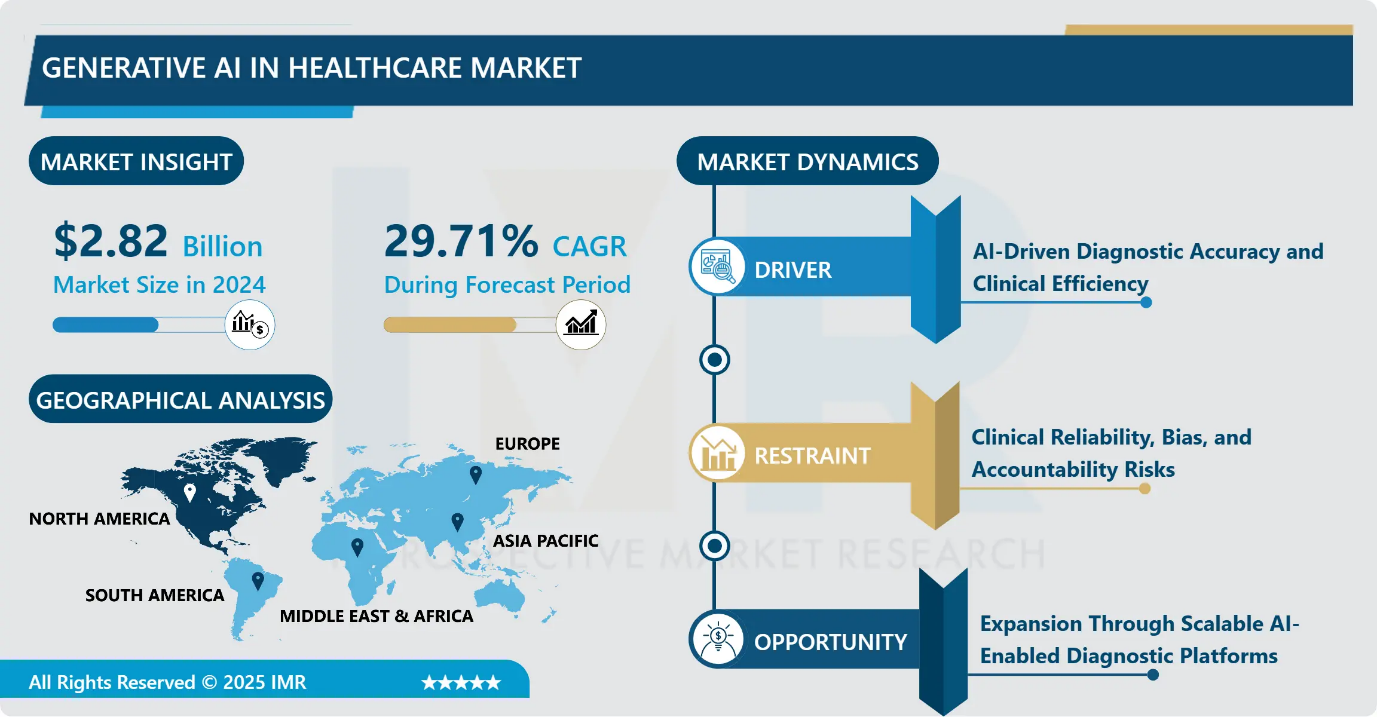
Generative Ai In Healthcare Market Dynamics and Trend Analysis:
Generative Ai In Healthcare Market Growth Driver- AI-Driven Diagnostic Accuracy and Clinical Efficiency
-
One of the key growth drivers of the Generative AI in Healthcare market is its increasing adoption in diagnostics to improve clinical accuracy and efficiency. Healthcare systems worldwide are under pressure to manage growing patient volumes, complex disease profiles, and clinician shortages. Generative AI helps address these challenges by rapidly analyzing large and diverse healthcare datasets, generating diagnostic insights, and supporting clinical decision-making
- . It assists physicians in identifying disease patterns earlier, reducing diagnostic errors, and streamlining clinical workflows. The ability of generative AI to integrate with electronic health records and diagnostic platforms further accelerates adoption. As healthcare providers prioritize faster diagnosis, better patient outcomes, and operational efficiency, demand for generative AI-based diagnostic solutions continues to grow steadily.
Generative Ai In Healthcare Market Limiting Factor- Data Privacy and Regulatory Compliance Challenges
-
A major limiting factor for the Generative AI in Healthcare market is concern around data privacy, security, and regulatory compliance. Generative AI systems rely heavily on large volumes of sensitive patient data, raising risks related to data breaches, misuse, and unauthorized access. Healthcare providers must comply with strict regulations such as HIPAA, GDPR, and other regional data protection laws, which can slow adoption and increase implementation costs.
- Unclear regulatory frameworks for AI-generated clinical outputs also create hesitation among providers, particularly in diagnostic applications where accuracy and accountability are critical. These challenges often lead to longer approval cycles, higher compliance costs, and cautious investment decisions, limiting faster market expansion.
Generative Ai In Healthcare Market Expansion Opportunity- Expansion Through Scalable AI-Enabled Diagnostic Platforms
-
A significant expansion opportunity for the Generative AI in Healthcare market lies in the scaling of AI-enabled diagnostic platforms across emerging and underserved regions. Many healthcare systems in Asia-Pacific, Latin America, and the Middle East face shortages of skilled clinicians and limited diagnostic infrastructure. Generative AI can bridge this gap by enabling faster disease detection, automated clinical reporting, and decision support through cloud-based platforms. As digital health adoption increases and governments invest in healthcare modernization, demand for cost-effective, scalable diagnostic solutions is rising. Partnerships between AI technology providers, hospitals, and public health agencies further support deployment. This creates strong growth potential for generative AI vendors to expand beyond mature markets and drive long-term adoption.
Generative Ai In Healthcare Market Challenge and Risk- Clinical Reliability, Bias, and Accountability Risks
-
A key challenge and risk in the Generative AI in Healthcare market is ensuring clinical reliability, transparency, and accountability, especially in diagnostic applications. Generative AI models can produce inaccurate or biased outputs if trained on incomplete, non-diverse, or low-quality datasets, which may lead to diagnostic errors or inconsistent clinical recommendations.
- This creates risk for healthcare providers, as responsibility for AI-assisted decisions still rests with clinicians and institutions. Limited explainability of complex AI models further reduces trust among physicians and regulators. In addition, continuous model validation and monitoring are required to maintain performance as clinical data evolves. These factors increase operational complexity, liability concerns, and adoption hesitation, posing a meaningful challenge to large-scale deployment
Generative Ai In Healthcare Market Trend- Integration of Large Language Models into Clinical Workflows
-
A major trend in the Generative AI in Healthcare market is the growing integration of large language models (LLMs) into clinical workflows to enhance diagnostics, documentation, and clinician support. Healthcare organizations are increasingly embedding LLM-based tools into electronic health records (EHRs), radiology reporting systems, and virtual assistants. These models help automate clinical documentation, generate more comprehensive patient summaries, and support real-time decision making through natural language understanding.
- This trend is driven by the need to reduce administrative burdens on clinicians, improve patient communication, and enhance diagnostic accuracy by extracting insights from unstructured data such as clinical notes. As model accuracy improves and regulatory confidence grows, LLM integration is expected to broaden across care settings, making AI a routine part of healthcare delivery.
Generative Ai In Healthcare Market Segment Analysis:
Generative Ai In Healthcare Market is segmented based on Component Type, Application, Functions, and Region
By Component Type, solutions (software) segment is expected to dominate the market with around 56.73% share during the forecast period.
-
The solutions (software) segment is currently the fastest-growing and most dominant component in the Generative AI in Healthcare market. Software solutions including diagnostic platforms, imaging tools, EHR integration modules, and AI-enabled clinical decision support systems hold the largest market share because healthcare providers rapidly adopt these tools to improve diagnostic accuracy, streamline workflows, and enhance patient outcomes.
- This demand is driven by the proven ability of solutions to automate complex tasks, process large volumes of clinical data, and provide actionable insights directly within care settings. Meanwhile, services (like implementation, integration, and training) are also growing at a strong pace as organizations require support to deploy and scale generative AI technologies effectively within existing infrastructure
By Application, Diagnostics is expected to dominate with close to 29.42% market share during the forecast period.
-
the diagnostics application segment is the fastest-growing application in the Generative AI in Healthcare market. This growth is driven by the increasing use of generative AI to support early disease detection, risk prediction, and clinical decision-making. Healthcare providers are adopting AI-based diagnostic tools to analyze large volumes of patient data, including clinical records, lab results, and imaging reports, with greater speed and accuracy.
- The rising prevalence of chronic diseases, demand for personalized care, and pressure to reduce diagnostic errors are further accelerating adoption. Additionally, integration of generative AI into existing diagnostic workflows and EHR systems makes implementation practical and scalable, positioning diagnostics as the leading application area.
Generative Ai In Healthcare Market Regional Insights:
North America region is estimated to lead the market with around 31.86% share during the forecast period.
-
North America is currently the leading region in the Generative AI in Healthcare market. The region benefits from a strong digital healthcare ecosystem, early adoption of advanced AI technologies, and high healthcare IT spending. The United States, in particular, leads due to widespread use of AI-driven diagnostic tools, strong presence of major technology companies, and active collaboration between healthcare providers, AI developers, and research institutions.
- Supportive regulatory initiatives, growing use of AI in clinical decision support, and rapid integration of generative AI into diagnostics and imaging workflows further strengthen the region’s position. Additionally, significant investments in healthcare AI startups and strong data availability accelerate innovation and commercial adoption, keeping North America ahead of other regions.
Generative Ai In Healthcare Market Active Players:
- Google LLC (USA)
- IBM Watson (USA)
- Johnson & Johnson (USA)
- Microsoft Corporation (USA)
- Neuralink Corporation (USA)
- NioyaTech (USA)
- OpenAI (USA)
- Oracle (USA)
- Saxon (USA)
- Syntegra (USA)
- Tencent Holdings Ltd (China)
- Other Active Players
Key Industry Developments in the Generative Ai In Healthcare Market:
- In November 2025, Google LLC Launched Gemini 3 a major new advanced AI model embedded directly into search, enhancing reasoning and AI agent capabilities
- In October 2025, Launched additional AI operational tools and infrastructure enhancements at TechXchange 2025.
Transformative Technologies Powering Generative AI in Healthcare
-
Generative AI in healthcare leverages advanced machine learning models, particularly deep learning architectures such as Generative Adversarial Networks (GANs) and large language models (LLMs), to create meaningful insights from complex medical data. These technologies enable the synthesis of new data, such as realistic medical images or clinical notes, that augment existing datasets for better training and analysis.
- Core technical components include natural language processing (NLP) for understanding and generating clinical text, computer vision for interpreting medical images, and multimodal AI that combines diverse data types imaging, genomics, and electronic health records (EHRs).
- The market’s growth is driven by advancements in data processing power, availability of large annotated medical datasets, and improvements in algorithm efficiency. Cloud computing and edge AI deployment enable scalable, real-time applications in clinical environments. Key challenges include ensuring model accuracy, interpretability, and compliance with healthcare regulations to maintain patient safety and data privacy.
- Generative AI solutions improve diagnostic precision, accelerate drug discovery, and automate administrative tasks, making healthcare more efficient and personalized. Continuous innovation in AI algorithms and integration with healthcare IT systems will further drive adoption, positioning generative AI as a transformative force in modern medicine.
|
Generative Ai In Healthcare Market |
|||
|
Base Year: |
2024 |
Forecast Period: |
2025-2035 |
|
Historical Data: |
2018 to 2024 |
Market Size in 2024: |
USD 2.82 Bn. |
|
Forecast Period 2025-35 CAGR: |
29.71% |
Market Size in 2035: |
USD 38.02 Bn. |
|
Segments Covered: |
By Type |
|
|
|
By Application
|
|
||
|
By Function |
|
||
|
By Region |
|
||
|
Growth Driver: |
|
||
|
Limiting Factor |
|
||
|
Expansion Opportunity |
|
||
|
Challenge and Risk |
|
||
|
Companies Covered in the Report: |
|
||
Chapter 1: Introduction
1.1 Scope and Coverage
Chapter 2:Executive Summary
Chapter 3: Market Landscape
3.1 Market Dynamics and Opportunity Analysis
3.1.1 Growth Drivers
3.1.2 Limiting Factors
3.1.3 Growth Opportunities
3.1.4 Challenges and Risks
3.2 Market Trend Analysis
3.3 Industry Ecosystem
3.4 Industry Value Chain Mapping
3.5 Strategic PESTLE Overview
3.6 Porter's Five Forces Framework
3.7 Regulatory Framework
3.8 Pricing Trend Analysis
3.9 Intellectual Property Review
3.10 Technology Evolution
3.11 Import-Export Analysis
3.12 Consumer Behavior Analysis
3.13 Investment Pocket Analysis
3.14 Go-To Market Strategy
Chapter 4: Generative Ai In Healthcare Market by Component (2018-2035)
4.1 Generative Ai In Healthcare Market Snapshot and Growth Engine
4.2 Market Overview
4.3 Solutions
4.3.1 Introduction and Market Overview
4.3.2 Historic and Forecasted Market Size in Value USD and Volume Units
4.3.3 Key Market Trends, Growth Factors, and Opportunities
4.3.4 Geographic Segmentation Analysis
4.4 Service
Chapter 5: Generative Ai In Healthcare Market by Function (2018-2035)
5.1 Generative Ai In Healthcare Market Snapshot and Growth Engine
5.2 Market Overview
5.3 Virtual Nursing Assistants
5.3.1 Introduction and Market Overview
5.3.2 Historic and Forecasted Market Size in Value USD and Volume Units
5.3.3 Key Market Trends, Growth Factors, and Opportunities
5.3.4 Geographic Segmentation Analysis
5.4 Medical Imaging Analysis
Chapter 6: Generative Ai In Healthcare Market by Application (2018-2035)
6.1 Generative Ai In Healthcare Market Snapshot and Growth Engine
6.2 Market Overview
6.3 Clinical Applications
6.3.1 Introduction and Market Overview
6.3.2 Historic and Forecasted Market Size in Value USD and Volume Units
6.3.3 Key Market Trends, Growth Factors, and Opportunities
6.3.4 Geographic Segmentation Analysis
6.4 Diagnostics
6.5 Research & Development
6.6 Operational / System Applications
Chapter 7: Company Profiles and Competitive Analysis
7.1 Competitive Landscape
7.1.1 Competitive Benchmarking
7.1.2 Generative Ai In Healthcare Market Share by Manufacturer/Service Provider(2024)
7.1.3 Industry BCG Matrix
7.1.4 PArtnerships, Mergers & Acquisitions
7.2 GOOGLE LLC (USA)
7.2.1 Company Overview
7.2.2 Key Executives
7.2.3 Company Snapshot
7.2.4 Role of the Company in the Market
7.2.5 Sustainability and Social Responsibility
7.2.6 Operating Business Segments
7.2.7 Product Portfolio
7.2.8 Business Performance
7.2.9 Recent News & Developments
7.2.10 SWOT Analysis
7.3 IBM WATSON (USA)
7.4 JOHNSON & JOHNSON (USA)
7.5 MICROSOFT CORPORATION (USA)
7.6 NEURALINK CORPORATION (USA)
7.7 NIOYATECH (USA)
7.8 OPENAI (USA)
7.9 ORACLE (USA)
7.10 SAXON (USA)
7.11 SYNTEGRA (USA)
7.12 TENCENT HOLDINGS LTD (CHINA)
7.13 OTHER ACTIVE PLAYERS
Chapter 8: Global Generative Ai In Healthcare Market By Region
8.1 Overview
8.2. North America Generative Ai In Healthcare Market
8.2.1 Key Market Trends, Growth Factors and Opportunities
8.2.2 Top Key Companies
8.2.3 Historic and Forecasted Market Size by Segments
8.2.4 Historic and Forecast Market Size by Country
8.2.4.1 US
8.2.4.2 Canada
8.2.4.3 Mexico
8.3. Eastern Europe Generative Ai In Healthcare Market
8.3.1 Key Market Trends, Growth Factors and Opportunities
8.3.2 Top Key Companies
8.3.3 Historic and Forecasted Market Size by Segments
8.3.4 Historic and Forecast Market Size by Country
8.3.4.1 Russia
8.3.4.2 Bulgaria
8.3.4.3 The Czech Republic
8.3.4.4 Hungary
8.3.4.5 Poland
8.3.4.6 Romania
8.3.4.7 Rest of Eastern Europe
8.4. Western Europe Generative Ai In Healthcare Market
8.4.1 Key Market Trends, Growth Factors and Opportunities
8.4.2 Top Key Companies
8.4.3 Historic and Forecasted Market Size by Segments
8.4.4 Historic and Forecast Market Size by Country
8.4.4.1 Germany
8.4.4.2 UK
8.4.4.3 France
8.4.4.4 The Netherlands
8.4.4.5 Italy
8.4.4.6 Spain
8.4.4.7 Rest of Western Europe
8.5. Asia Pacific Generative Ai In Healthcare Market
8.5.1 Key Market Trends, Growth Factors and Opportunities
8.5.2 Top Key Companies
8.5.3 Historic and Forecasted Market Size by Segments
8.5.4 Historic and Forecast Market Size by Country
8.5.4.1 China
8.5.4.2 India
8.5.4.3 Japan
8.5.4.4 South Korea
8.5.4.5 Malaysia
8.5.4.6 Thailand
8.5.4.7 Vietnam
8.5.4.8 The Philippines
8.5.4.9 Australia
8.5.4.10 New Zealand
8.5.4.11 Rest of APAC
8.6. Middle East & Africa Generative Ai In Healthcare Market
8.6.1 Key Market Trends, Growth Factors and Opportunities
8.6.2 Top Key Companies
8.6.3 Historic and Forecasted Market Size by Segments
8.6.4 Historic and Forecast Market Size by Country
8.6.4.1 Turkiye
8.6.4.2 Bahrain
8.6.4.3 Kuwait
8.6.4.4 Saudi Arabia
8.6.4.5 Qatar
8.6.4.6 UAE
8.6.4.7 Israel
8.6.4.8 South Africa
8.7. South America Generative Ai In Healthcare Market
8.7.1 Key Market Trends, Growth Factors and Opportunities
8.7.2 Top Key Companies
8.7.3 Historic and Forecasted Market Size by Segments
8.7.4 Historic and Forecast Market Size by Country
8.7.4.1 Brazil
8.7.4.2 Argentina
8.7.4.3 Rest of SA
Chapter 9 Analyst Viewpoint and Conclusion
Chapter 10 Our Thematic Research Methodology
10.1 Research Process
10.2 Primary Research
10.3 Secondary Research
Chapter 11 Case Study
Chapter 12 Appendix
12.1 Sources
12.2 List of Tables and figures
12.3 Short Forms and Citations
12.4 Assumption and Conversion
12.5 Disclaimer
|
Generative Ai In Healthcare Market |
|||
|
Base Year: |
2024 |
Forecast Period: |
2025-2035 |
|
Historical Data: |
2018 to 2024 |
Market Size in 2024: |
USD 2.82 Bn. |
|
Forecast Period 2025-35 CAGR: |
29.71% |
Market Size in 2035: |
USD 38.02 Bn. |
|
Segments Covered: |
By Type |
|
|
|
By Application
|
|
||
|
By Function |
|
||
|
By Region |
|
||
|
Growth Driver: |
|
||
|
Limiting Factor |
|
||
|
Expansion Opportunity |
|
||
|
Challenge and Risk |
|
||
|
Companies Covered in the Report: |
|
||


