




AI in Healthcare Market Highlights
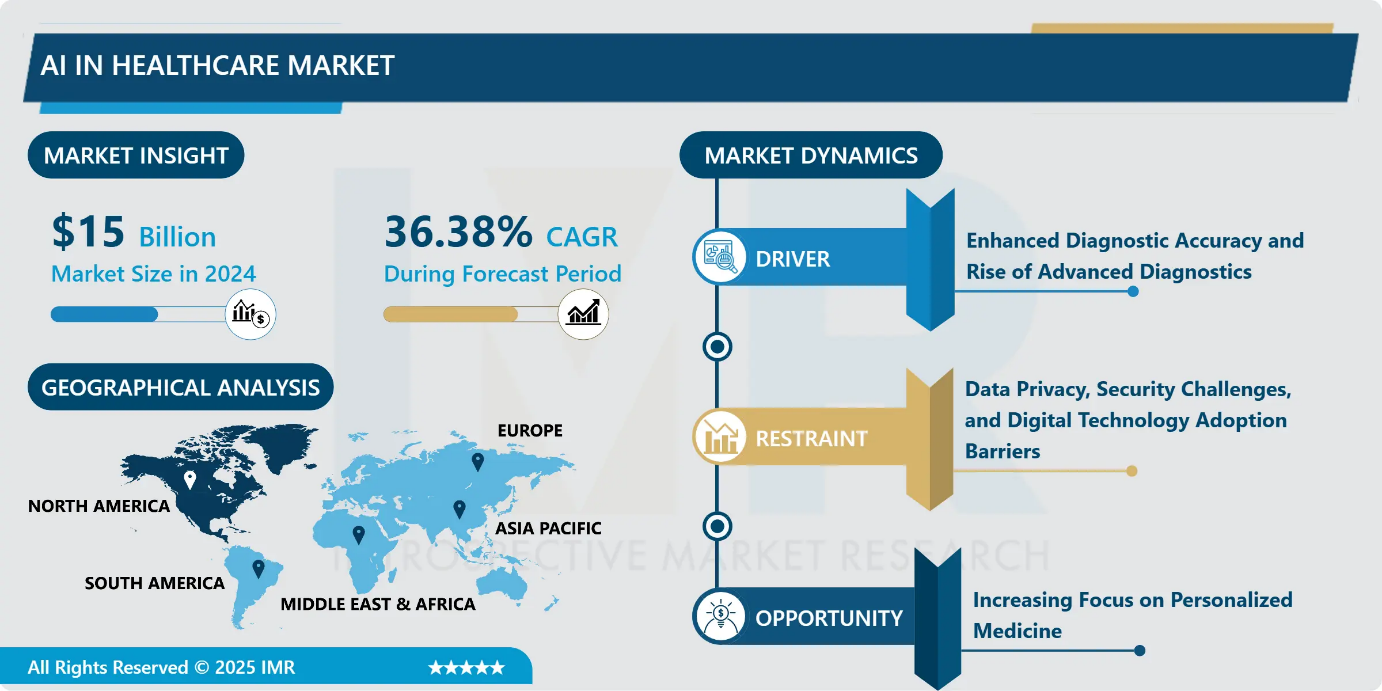
AI in Healthcare Market Size Was Valued at USD 15 Billion in 2024, and is Projected to Reach USD 455.35 Billion by 2035, Growing at a CAGR of 36.38% from 2025-2035.
- AI in Healthcare Market Size in 2024: USD 15 Billion
- Projected AI in Healthcare Market Size by 2035: USD 455.35 Billion
- CAGR (2025–2035): 36.38%
- Leading AI in Healthcare Market in 2024: North America
- Fastest-Growing AI in Healthcare Market: Asia-Pacific
- By Technology: The Machine Learning segment is anticipated to lead the AI in Healthcare Market by accounting for 39% of the AI in Healthcare Market share throughout the forecast period.
- By End-User: The Hospitals and Clinics segment is expected to capture 40.20% of the AI in Healthcare Market share, thereby maintaining its dominance over the forecast period.
- By Region: North America region is projected to hold 32% of the AI in Healthcare Market share during the forecast period.
- Active Players: NVIDIA Corporation (U.S.), Microsoft Corporation (U.S.), Intel Corporation (U.S.), International Business Machines - IBM (U.S.), Amazon Web Services – AWS (U.S.), and Other Active Players.
AI in Healthcare Market Synopsis:
Artificial Intelligence (AI) in healthcare refers to the use of advanced technologies, data analysis, and smart algorithms to improve patient care, streamline hospital operations, and support medical decision-making. The AI in Healthcare Market is rapidly expanding as hospitals, diagnostic labs, pharmaceutical companies, and research institutions adopt AI for early disease detection, personalised treatment, predictive analytics, drug discovery, and remote patient monitoring. AI helps optimise resources, reduce costs, and improve the accuracy and speed of diagnostics, while also supporting public health initiatives and preventive strategies. Increasing healthcare demands, rising costs, technological advancements, and supportive policies are driving the adoption of AI solutions, making them an essential tool for delivering efficient, high-quality, and sustainable healthcare globally.
AI in Healthcare Market Dynamics and Trend Analysis:
AI in Healthcare Market Growth Driver - Enhanced Diagnostic Accuracy and Rise of Advanced Diagnostics
-
Advanced technologies are transforming diagnostics by analyzing medical images such as X-rays, MRIs, CT scans, and mammograms with high precision, detecting subtle abnormalities that might be missed by human professionals. These tools can process large volumes of patient and genetic data quickly, enabling faster diagnoses, reducing wait times, and accelerating treatment plans. They provide consistent, objective results, minimizing human error and fatigue, which lowers the risk of misdiagnosis.
- Applications span radiology, pathology, and genomics, helping identify early disease indicators and supporting preventive care. For example, Kauvery Hospitals launched India’s first AI-driven Advanced Heart Failure Centre in Bengaluru in 2025, integrating early diagnosis, advanced treatments, and real-time monitoring. Adoption of these technologies improves clinical efficiency, patient outcomes, and drives AI in Healthcare Market growth.
AI in Healthcare Market Limiting Factor - Data Privacy, Security Challenges, and Digital Technology Adoption Barriers
-
Modern digital technologies in healthcare depend on large volumes of sensitive patient information, which makes them more exposed to cyber risks. Any breach can reveal confidential medical records, creating serious privacy and security concerns. These systems must also comply with strict regulations such as HIPAA in the U.S., adding complexity to their development and deployment. Another challenge is the lack of standardized data formats health information is often unstructured and scattered across different platforms, reducing the accuracy and reliability of digital tools. Patients may also hesitate to use technology-driven healthcare services if they are uncertain about how their data is stored or shared.
- High implementation costs, resistance to shifting from conventional clinical workflows, and limited interoperability further slowdown the adoption of digital solutions. For instance, a recent incident in which patient records were compromised due to weak security controls highlighted the urgent requirement for stronger data-protection practices. Collectively, these issues act as major restraints for the healthcare technology AI in Healthcare Market.
AI in Healthcare Market Expansion Opportunity - Increasing Focus on Personalized Medicine
-
The rising focus on personalized medicine presents a significant growth opportunity for the artificial intelligence in healthcare AI in Healthcare Market. Intelligent data-driven systems are being utilized to analyze patient-specific information such as genomic profiles, lifestyle patterns, clinical histories, and real-time biometric data, enabling healthcare providers to design highly tailored treatment strategies. These tools help predict disease risks in advance, support early intervention, and improve the effectiveness of preventive care.
- Personalized approaches are also transforming drug discovery, where advanced analytical models can rapidly evaluate biological datasets, identify targeted therapeutic candidates, and shorten development cycles. Continuous health monitoring through connected wearables further allows clinicians to optimize treatment plans for chronic disease patients based on individual responses. The availability of large digital health datasets and rising demand for customized therapies continue to strengthen the shift toward precision healthcare.
AI in Healthcare Market Challenge and Risk - Legacy System Integration and Resource Shortages Hindering Healthcare Technology Adoption
-
The healthcare technology AI in Healthcare Market faces significant barriers that slow widespread adoption. Legacy systems, widely used by providers to manage patient data, are often incompatible with modern digital solutions. These systems store unstructured data in multiple formats, including handwritten records, making integration costly and complex. Compliance with regulatory standards further increases implementation challenges.
- In underdeveloped regions, high development and maintenance costs, limited infrastructure, and a shortage of trained healthcare professionals hinder the deployment of advanced technologies. These factors delay AI in Healthcare Market penetration and reduce the feasibility of digital solutions until basic healthcare services are strengthened. Collectively these challenges restrict growth and slow the integration of innovative healthcare technologies into daily clinical practice.
AI in Healthcare Market Trend - Telemedicine and Virtual Health Assistants Driving AI in Healthcare Market Growth
-
Telemedicine and advanced Virtual Health Assistants (VHAs) are becoming major growth drivers in India’s digital healthcare landscape. Their adoption is rising due to expanding internet access, increasing chronic disease cases, and growing demand for remote medical support. VHAs enhance patient engagement by enabling appointment scheduling, medication reminders, symptom-based guidance, and automated triage. In February 2025, the Helping Hand Foundation in Hyderabad introduced a technology-enabled health app in collaboration with U.S.-based MIDOC, piloted across five centers in urban slums. This initiative strengthened preventive care delivery and improved workflow efficiency by automating routine patient interactions.
- VHAs are especially effective in chronic disease management, supporting treatment adherence, lifestyle tracking, and continuous patient education. When integrated with wearable devices, they enable real-time remote monitoring by evaluating indicators such as heart rate variability and blood glucose patterns, facilitating early identification of potential complications. This convergence of telemedicine, virtual assistance, and connected devices creates strong opportunities for healthcare providers, device manufacturers, and digital health companies in India.
AI in Healthcare Market Segment Analysis:
AI in Healthcare Market is segmented based on Technology, End-Users, and Region
By Technology, Machine learning segment is expected to dominate the AI in Healthcare Market with around 39% share during the forecast period.
-
Machine learning represents the leading technology in the India artificial intelligence in healthcare AI in Healthcare Market, accounting for 39% of the total share in 2024. Its dominance is driven by the technology’s ability to process massive volumes of healthcare data and generate meaningful insights that support diagnostics, treatment planning, and patient management. Machine learning algorithms identify patterns in medical imaging, electronic health records, and genomic data, enabling clinicians to deliver more precise and personalized care. The technology is also widely applied in drug discovery, risk prediction, and workflow optimization.
- Government initiatives promoting digital health, along with rapid advancements in algorithm development, continue to strengthen the adoption of machine learning across the medical sector.
By End-Users, Hospitals and Clinics is expected to dominate with close to 40.20% AI in Healthcare AI in Healthcare Market share during the forecast period.
-
Healthcare providers represent the largest share of the AI in Healthcare Market, accounting for 40.20% in 2024, supported by the rising need to improve diagnostics, patient care, and operational efficiency. Hospitals, clinics, and other care facilities are increasingly adopting digital tools to enhance medical imaging, monitor patients, automate routine tasks, and analyze clinical data.
- Workforce shortages and the shift toward value-based care further strengthen the reliance on digital technologies, as providers look for ways to reduce administrative burdens and improve treatment outcomes. Within this segment, hospitals and clinics remain the largest users, driven by the demand for personalized treatments, accurate surgical planning, minimally invasive procedures, and systems that can integrate smoothly with existing healthcare infrastructure. These digital tools also support better patient engagement, reduce operational costs, and streamline day-to-day clinical activities.
AI in Healthcare Market Regional Insights:
North America region is estimated to lead the AI in Healthcare Market with around 32% share during the forecast period.
-
North America dominated the healthcare technology AI in the Healthcare Market in 2024, accounting for over 32% of total revenue. This strong position is supported by advanced healthcare IT systems, high medical spending, widespread use of digital tools, favorable government initiatives, and strong funding opportunities. Growing demand for value-based care, an expanding elderly population, lifestyle-related health issues, and the rising burden of chronic diseases are further boosting the region’s AI in Healthcare Market growth.
- In the U.S., the AI in Healthcare Market is projected to expand steadily throughout the forecast period. This growth is driven by increasing demand for efficient and personalized healthcare solutions, continuous progress in data-driven research and analytical technologies, and supportive regulatory policies aimed at enhancing the adoption of innovative digital health applications.
AI in Healthcare Market Active Players:
• Amazon Web Services – AWS (U.S.)
• Amgen (U.S.)
• GE Healthcare (U.S.)
• General Vision Inc. (U.S.)
• Intel Corporation (U.S.)
• International Business Machines – IBM (U.S.)
• IQVIA (U.S.)
• Koninklijke Philips N.V. – Philips (Netherlands)
• Medidata – Dassault Systèmes (France)
• Medtronic (Ireland)
• Micron Technology Inc. (U.S.)
• Microsoft Corporation (U.S.)
• NVIDIA Corporation (U.S.)
• Oncora Medical (U.S.)
• Siemens Healthineers AG (Germany)
• Other Active Players
Key Industry Developments in AI in Healthcare Market:
-
In March 2025: Wipro GE Healthcare introduced the Versana Premier R3 ultrasound system, featuring advanced imaging and workflow-enhancing capabilities, manufactured under the Make in India initiative to support improved diagnosis of rising non-communicable diseases.
- In February 2025: Amgen committed USD 200 million to establish a Biotechnology Innovation Center in Hyderabad, aimed at accelerating healthcare innovation and drug development while creating 2,000 new jobs by 2025.
Advanced Healthcare Technologies: Solving Data Complexity and Improving Clinical Efficiency
-
Healthcare systems face major challenges due to the high volume and complexity of medical data generated from imaging, laboratory reports, electronic health records, and clinical documentation. Much of this information is unstructured, making it difficult for providers to interpret quickly and accurately. These limitations can lead to delayed diagnosis, inconsistent decision-making, increased administrative workload, and operational inefficiencies across care settings.
- Advanced digital technologies help address these issues by converting complex datasets into meaningful insights. Pattern-recognition tools improve the interpretation of imaging and diagnostic data, enhancing precision in disease detection. Language-processing systems convert free-text clinical notes into structured formats, easing documentation and improving data accessibility. Image-analysis technologies strengthen medical image evaluation, while context-aware systems combine patient information with real-time workflow conditions to guide timely clinical decisions.
|
AI in Healthcare Market |
|||
|
Base Year: |
2024 |
Forecast Period: |
2025-2035 |
|
Historical Data: |
2018 to 2023 |
AI in Healthcare Market Size in 2024: |
USD 15 BN. |
|
Forecast Period 2025-35 CAGR: |
36.38% |
AI in Healthcare Market Size in 2035: |
USD 455.35 BN. |
|
Segments Covered: |
By Technology |
|
|
|
By End -User
|
|
||
|
By Region |
|
||
|
Growth Driver: |
|
||
|
Limiting Factor |
|
||
|
Expansion Opportunity |
|
||
|
Challenge and Risk |
|
||
|
Companies Covered in the Report: |
|
||
Chapter 1: Introduction
1.1 Scope and Coverage
Chapter 2:Executive Summary
Chapter 3: Market Landscape
3.1 Market Dynamics and Opportunity Analysis
3.1.1 Growth Drivers
3.1.2 Limiting Factors
3.1.3 Growth Opportunities
3.1.4 Challenges and Risks
3.2 Market Trend Analysis
3.3 Industry Ecosystem
3.4 Industry Value Chain Mapping
3.5 Strategic PESTLE Overview
3.6 Porter's Five Forces Framework
3.7 Regulatory Framework
3.8 Pricing Trend Analysis
3.9 Intellectual Property Review
3.10 Technology Evolution
3.11 Import-Export Analysis
3.12 Consumer Behavior Analysis
3.13 Investment Pocket Analysis
3.14 Go-To Market Strategy
Chapter 4: AI in Healthcare Market by Technology (2018-2032)
4.1 AI in Healthcare Market Snapshot and Growth Engine
4.2 Market Overview
4.3 Machine Learning
4.3.1 Introduction and Market Overview
4.3.2 Historic and Forecasted Market Size in Value USD and Volume Units
4.3.3 Key Market Trends, Growth Factors, and Opportunities
4.3.4 Geographic Segmentation Analysis
4.4 Deep Learning
4.5 Natural Language Processing
Chapter 5: AI in Healthcare Market by Product (2018-2032)
5.1 AI in Healthcare Market Snapshot and Growth Engine
5.2 Market Overview
5.3 Software
5.3.1 Introduction and Market Overview
5.3.2 Historic and Forecasted Market Size in Value USD and Volume Units
5.3.3 Key Market Trends, Growth Factors, and Opportunities
5.3.4 Geographic Segmentation Analysis
5.4 Services
5.5 Hardware
Chapter 6: AI in Healthcare Market by Application (2018-2032)
6.1 AI in Healthcare Market Snapshot and Growth Engine
6.2 Market Overview
6.3 Medical Imaging & Diagnostics
6.3.1 Introduction and Market Overview
6.3.2 Historic and Forecasted Market Size in Value USD and Volume Units
6.3.3 Key Market Trends, Growth Factors, and Opportunities
6.3.4 Geographic Segmentation Analysis
6.4 Drug Discovery & Development
6.5 Clinical Decision Support Systems
Chapter 7: AI in Healthcare Market by End-User (2018-2032)
7.1 AI in Healthcare Market Snapshot and Growth Engine
7.2 Market Overview
7.3 Hospitals & Clinics
7.3.1 Introduction and Market Overview
7.3.2 Historic and Forecasted Market Size in Value USD and Volume Units
7.3.3 Key Market Trends, Growth Factors, and Opportunities
7.3.4 Geographic Segmentation Analysis
7.4 Pharmaceutical & Biotechnology Companies
7.5 Diagnostic Laboratories
Chapter 8: Company Profiles and Competitive Analysis
8.1 Competitive Landscape
8.1.1 Competitive Benchmarking
8.1.2 AI in Healthcare Market Share by Manufacturer/Service Provider(2024)
8.1.3 Industry BCG Matrix
8.1.4 PArtnerships, Mergers & Acquisitions
8.2 NVIDIA CORPORATION (U.S.)
8.2.1 Company Overview
8.2.2 Key Executives
8.2.3 Company Snapshot
8.2.4 Role of the Company in the Market
8.2.5 Sustainability and Social Responsibility
8.2.6 Operating Business Segments
8.2.7 Product Portfolio
8.2.8 Business Performance
8.2.9 Recent News & Developments
8.2.10 SWOT Analysis
8.3 MICROSOFT CORPORATION (U.S.)
8.4 INTEL CORPORATION (U.S.)
8.5 INTERNATIONAL BUSINESS MACHINES – IBM (U.S.)
8.6 AMAZON WEB SERVICES – AWS (U.S.)
8.7 SIEMENS HEALTHINEERS AG (GERMANY)
8.8 GE HEALTHCARE (U.S.)
8.9 MEDTRONIC (IRELAND)
8.10 KONINKLIJKE PHILIPS N.V. – PHILIPS (NETHERLANDS)
8.11 MICRON TECHNOLOGY INC. (U.S.)
8.12 IQVIA (U.S.)
8.13 AMGEN (U.S.)
8.14 ONCORA MEDICAL (U.S.)
8.15 GENERAL VISION INC. (U.S.)
8.16 MEDIDATA – DASSAULT SYSTÈMES (FRANCE)
8.17 OTHER ACTIVE PLAYERS
Chapter 9: Global AI in Healthcare Market By Region
9.1 Overview
9.2. North America AI in Healthcare Market
9.2.1 Key Market Trends, Growth Factors and Opportunities
9.2.2 Top Key Companies
9.2.3 Historic and Forecasted Market Size by Segments
9.2.4 Historic and Forecast Market Size by Country
9.2.4.1 US
9.2.4.2 Canada
9.2.4.3 Mexico
9.3. Eastern Europe AI in Healthcare Market
9.3.1 Key Market Trends, Growth Factors and Opportunities
9.3.2 Top Key Companies
9.3.3 Historic and Forecasted Market Size by Segments
9.3.4 Historic and Forecast Market Size by Country
9.3.4.1 Russia
9.3.4.2 Bulgaria
9.3.4.3 The Czech Republic
9.3.4.4 Hungary
9.3.4.5 Poland
9.3.4.6 Romania
9.3.4.7 Rest of Eastern Europe
9.4. Western Europe AI in Healthcare Market
9.4.1 Key Market Trends, Growth Factors and Opportunities
9.4.2 Top Key Companies
9.4.3 Historic and Forecasted Market Size by Segments
9.4.4 Historic and Forecast Market Size by Country
9.4.4.1 Germany
9.4.4.2 UK
9.4.4.3 France
9.4.4.4 The Netherlands
9.4.4.5 Italy
9.4.4.6 Spain
9.4.4.7 Rest of Western Europe
9.5. Asia Pacific AI in Healthcare Market
9.5.1 Key Market Trends, Growth Factors and Opportunities
9.5.2 Top Key Companies
9.5.3 Historic and Forecasted Market Size by Segments
9.5.4 Historic and Forecast Market Size by Country
9.5.4.1 China
9.5.4.2 India
9.5.4.3 Japan
9.5.4.4 South Korea
9.5.4.5 Malaysia
9.5.4.6 Thailand
9.5.4.7 Vietnam
9.5.4.8 The Philippines
9.5.4.9 Australia
9.5.4.10 New Zealand
9.5.4.11 Rest of APAC
9.6. Middle East & Africa AI in Healthcare Market
9.6.1 Key Market Trends, Growth Factors and Opportunities
9.6.2 Top Key Companies
9.6.3 Historic and Forecasted Market Size by Segments
9.6.4 Historic and Forecast Market Size by Country
9.6.4.1 Turkiye
9.6.4.2 Bahrain
9.6.4.3 Kuwait
9.6.4.4 Saudi Arabia
9.6.4.5 Qatar
9.6.4.6 UAE
9.6.4.7 Israel
9.6.4.8 South Africa
9.7. South America AI in Healthcare Market
9.7.1 Key Market Trends, Growth Factors and Opportunities
9.7.2 Top Key Companies
9.7.3 Historic and Forecasted Market Size by Segments
9.7.4 Historic and Forecast Market Size by Country
9.7.4.1 Brazil
9.7.4.2 Argentina
9.7.4.3 Rest of SA
Chapter 10 Analyst Viewpoint and Conclusion
Chapter 11 Our Thematic Research Methodology
11.1 Research Process
11.2 Primary Research
11.3 Secondary Research
Chapter 12 Case Study
Chapter 13 Appendix
11.1 Sources
11.2 List of Tables and figures
11.3 Short Forms and Citations
11.4 Assumption and Conversion
11.5 Disclaimer
|
AI in Healthcare Market |
|||
|
Base Year: |
2024 |
Forecast Period: |
2025-2035 |
|
Historical Data: |
2018 to 2023 |
AI in Healthcare Market Size in 2024: |
USD 15 BN. |
|
Forecast Period 2025-35 CAGR: |
36.38% |
AI in Healthcare Market Size in 2035: |
USD 455.35 BN. |
|
Segments Covered: |
By Technology |
|
|
|
By End -User
|
|
||
|
By Region |
|
||
|
Growth Driver: |
|
||
|
Limiting Factor |
|
||
|
Expansion Opportunity |
|
||
|
Challenge and Risk |
|
||
|
Companies Covered in the Report: |
|
||


