




E-learning Market Synopsis
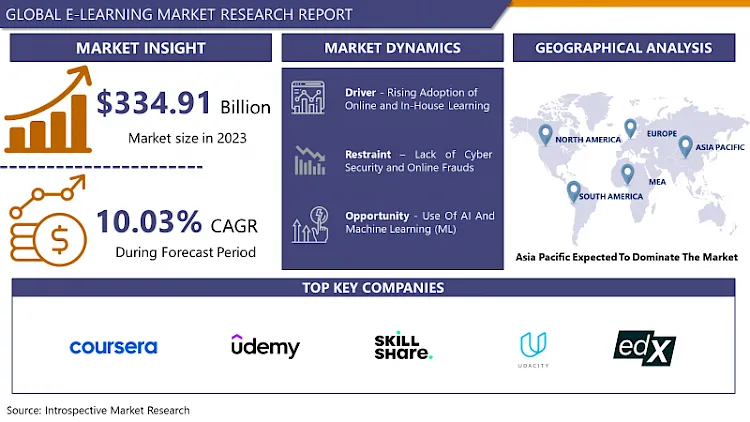
Global E-learning Market size was valued at USD 334.91 Billion in 2023 and is projected to reach USD 791.64 Billion by 2032, growing at a CAGR of 10.03% From 2024-2032.
E-Learning is a learning system that is an advanced built of formalized teaching system but with the help of electronic resources. The Internet and supporting devices form the major component of E-learning system. E-learning serves a large group of people like, engineers, teachers, non-commissioned and military officers, accountants, healthcare professionals and many others in their professional development.
The market witnessed a proliferation of virtual classrooms, online courses, and interactive learning modules. EdTech companies played a pivotal role in shaping the e-learning landscape, introducing innovative technologies such as artificial intelligence, virtual reality, and gamification to enhance the learning experience. This shift towards digital learning not only catered to traditional academic subjects but also addressed professional development needs across various industries.
Key trends included the rise of mobile learning, adaptive learning systems, and microlearning modules, making education more accessible and flexible. The market saw increased investments, collaborations, and partnerships among education providers, tech companies, and investors.
Looking ahead, the e-learning market is poised for sustained growth, driven by ongoing digitalization efforts, the need for upskilling and reskilling, and the recognition of the long-term benefits of online education. As the educational landscape continues to evolve, e-learning is expected to play a central role in shaping the future of learning and training

E-learning Market Trend Analysis
Rising Adoption of Online and In-House Learning
- The E-learning market has witnessed a significant upswing, primarily fueled by the escalating adoption of online and in-house learning methodologies. As technology continues to permeate every aspect of education and training, institutions, corporations, and individuals are increasingly turning to E-learning solutions to enhance skills and knowledge. The convenience of accessing educational resources remotely, coupled with the flexibility of self-paced learning, has catapulted the popularity of online education.
- Corporations are embracing in-house E-learning to streamline employee training, reduce costs, and ensure consistent skill development across their workforce. Moreover, the COVID-19 pandemic has accelerated the shift towards digital learning, with traditional educational institutions transitioning to online platforms to ensure continuity in the face of disruptions.
- The rising demand for personalized learning experiences, the proliferation of mobile devices, and advancements in virtual reality and artificial intelligence further contribute to the robust growth of the E-learning market. As the global landscape becomes increasingly digital, E-learning is poised to play a pivotal role in shaping the future of education and professional development.
Use Of AI, Machine Learning (ML) And Immersive UX To Offer Specialized and Personalized Learning Structure To A Large Population Base creates an Opportunity
- The integration of AI, machine learning (ML), and immersive user experience (UX) in e-learning has revolutionized the education landscape, presenting a significant opportunity for market growth. This innovative combination enables the creation of specialized and personalized learning structures that cater to the diverse needs of a large population.
- AI algorithms analyze user behavior, track progress, and identify individual learning patterns, allowing for the customization of educational content. Machine learning algorithms enhance adaptability by continuously refining recommendations based on user interactions, optimizing the learning experience. Additionally, immersive UX, including virtual reality and augmented reality, brings a new dimension to learning, making it engaging and interactive.
- This convergence addresses the challenges of scalability and personalization in education, making it accessible to a broader audience. The e-learning market benefits from increased efficiency, effectiveness, and learner satisfaction, leading to widespread adoption.
E-learning Market Segment Analysis:
E-learning Market Segmented on the basis of Type, End User, Function, Deployment Mode.
By Type, One-On-One Learning segment is expected to dominate the market during the forecast period
- The prominence of this segment is fueled by its ability to address the diverse learning needs of users, offering a bespoke learning experience that caters to individual strengths and weaknesses. It promotes a direct interaction between the learner and the instructor, fostering a supportive and engaging environment. This model is particularly effective for skill development, as it enables focused attention on specific areas of improvement.
- The rise of technology, including virtual classrooms, video conferencing, and interactive learning platforms, has further amplified the efficacy of one-on-one learning. As the e-learning market continues to expand, the One-On-One Learning segment is anticipated to maintain its dominance, heralding a new era of personalized and efficient education delivery.
By Application, Academic segment held the largest share of 62.3% in 2022
- The Academic segment is poised to dominate the E-learning market, reflecting the significant impact of digital education on traditional learning paradigms. As technology continues to evolve, educational institutions worldwide are increasingly embracing E-learning solutions to enhance the teaching and learning experience. The Academic segment encompasses schools, colleges, and universities, making it a pivotal driver of growth in the E-learning market.
- Several factors contribute to the dominance of the Academic segment. Firstly, the growing demand for flexible and accessible learning options has led educational institutions to adopt E-learning platforms. These platforms offer a diverse range of courses and resources that cater to the varied needs of students and educators. Additionally, the COVID-19 pandemic has accelerated the adoption of online learning, with academic institutions relying on digital solutions to ensure continuity in education during lockdowns and social distancing measures.
E-learning Market Regional Insights:
Asia Pacific is Expected to Dominate the Market Over the Forecast period
- Asia Pacific region was already a significant player in the e-learning market, and it was expected to continue dominating the industry. The region's growth in e-learning can be attributed to several factors.
- The increasing adoption of digital technology and internet penetration has facilitated access to online education across diverse demographics. Governments and businesses in the Asia Pacific have recognized the importance of investing in e-learning solutions to address the growing demand for education and skill development.
- The region's large population, including a sizable youth demographic, has fueled the demand for flexible and accessible learning solutions. E-learning offers a convenient way to reach a wide audience and cater to diverse learning needs.
E-learning Market Top Key Players:
- Coursera (USA)
- Udemy (USA)
- Skillshare (USA)
- LinkedIn Learning (USA)
- Udacity (USA)
- edX (USA)
- FutureLearn (UK)
- Docebo (Canada)
- Cornerstone OnDemand (USA)
- Blackboard (USA)
- D2L (Canada)
- Litmos (USA)
- SAP Litmos (USA)
- McGraw-Hill Education (USA)
- Pearson (UK)
- Cengage Learning (USA)
- Khan Academy (USA)
- Byju's (India)
- Veduca (Brazil)
- New Oriental (China)
Key Industry Developments in the E-learning Market:
In February 2023, Coursera launched Career Paths, a program offering learners personalized mentorship from industry professionals alongside online courses.
In January 2023, 2U, a global leader in online programs, acquired the non-profit online learning platform edX for $800 million. This strategic move aimed to create a powerful network of universities and edtech companies, expanding access to high-quality online education.
In February 2024, Union Education Minister Dharmendra Pradhan launched 'SWAYAM Plus', a new Advanced E-Learning Platform enhancing employability and professional growth through courses developed with industry giants like L&T, Microsoft, and CISCO. Aimed at college students and lifelong learners, SWAYAM Plus merges academic rigor with practical skills, fostering job readiness by integrating real-world expertise. This initiative represents a significant collaboration between academia and leading industry partners, aiming to bridge the gap between education and employment.
|
Global E-learning Market |
|||
|
Base Year: |
2023 |
Forecast Period: |
2024-2032 |
|
Historical Data: |
2017 to 2023 |
Market Size in 2023: |
USD 334.91 Bn. |
|
Forecast Period 2024-32 CAGR: |
10.03 % |
Market Size in 2032: |
USD 791.64 Bn. |
|
Segments Covered: |
By Type |
|
|
|
By Application
|
|
||
|
By Function |
|
||
|
By Deployment Mode |
|
||
|
By Region |
|
||
|
Key Market Drivers: |
|
||
|
Key Market Restraints: |
|
||
|
Key Opportunities: |
|
||
|
Companies Covered in the report: |
|
||
Chapter 1: Introduction
1.1 Scope and Coverage
Chapter 2:Executive Summary
Chapter 3: Market Landscape
3.1 Market Dynamics
3.1.1 Drivers
3.1.2 Restraints
3.1.3 Opportunities
3.1.4 Challenges
3.2 Market Trend Analysis
3.3 PESTLE Analysis
3.4 Porter's Five Forces Analysis
3.5 Industry Value Chain Analysis
3.6 Ecosystem
3.7 Regulatory Landscape
3.8 Price Trend Analysis
3.9 Patent Analysis
3.10 Technology Evolution
3.11 Investment Pockets
3.12 Import-Export Analysis
Chapter 4: E-learning Market by Type (2018-2032)
4.1 E-learning Market Snapshot and Growth Engine
4.2 Market Overview
4.3 One-On-One Learning
4.3.1 Introduction and Market Overview
4.3.2 Historic and Forecasted Market Size in Value USD and Volume Units
4.3.3 Key Market Trends, Growth Factors, and Opportunities
4.3.4 Geographic Segmentation Analysis
4.4 Group Learning
4.5 Course-Based Learning
4.6 Video-Based Learning
Chapter 5: E-learning Market by Application (2018-2032)
5.1 E-learning Market Snapshot and Growth Engine
5.2 Market Overview
5.3 Academic
5.3.1 Introduction and Market Overview
5.3.2 Historic and Forecasted Market Size in Value USD and Volume Units
5.3.3 Key Market Trends, Growth Factors, and Opportunities
5.3.4 Geographic Segmentation Analysis
5.4 Corporate
5.5 Government
Chapter 6: E-learning Market by Function (2018-2032)
6.1 E-learning Market Snapshot and Growth Engine
6.2 Market Overview
6.3 Training
6.3.1 Introduction and Market Overview
6.3.2 Historic and Forecasted Market Size in Value USD and Volume Units
6.3.3 Key Market Trends, Growth Factors, and Opportunities
6.3.4 Geographic Segmentation Analysis
6.4 Testing
Chapter 7: E-learning Market by Deployment Mode (2018-2032)
7.1 E-learning Market Snapshot and Growth Engine
7.2 Market Overview
7.3 Cloud
7.3.1 Introduction and Market Overview
7.3.2 Historic and Forecasted Market Size in Value USD and Volume Units
7.3.3 Key Market Trends, Growth Factors, and Opportunities
7.3.4 Geographic Segmentation Analysis
7.4 On-Premise
Chapter 8: Company Profiles and Competitive Analysis
8.1 Competitive Landscape
8.1.1 Competitive Benchmarking
8.1.2 E-learning Market Share by Manufacturer (2024)
8.1.3 Industry BCG Matrix
8.1.4 Heat Map Analysis
8.1.5 Mergers and Acquisitions
8.2 CORPORATE WELLNESS SOLUTIONS (U.S.)
8.2.1 Company Overview
8.2.2 Key Executives
8.2.3 Company Snapshot
8.2.4 Role of the Company in the Market
8.2.5 Sustainability and Social Responsibility
8.2.6 Operating Business Segments
8.2.7 Product Portfolio
8.2.8 Business Performance
8.2.9 Key Strategic Moves and Recent Developments
8.2.10 SWOT Analysis
8.3 VIRGIN PULSE (U.S.)
8.4 EXOS (U.S.)
8.5 MARINO WELLNESS (U.S.)
8.6 PRIVIA HEALTH (U.S.)
8.7 VITALITY (U.S.) (
8.8 WELLSOURCE INC. (U.S)
8.9 COREHEALTH TECHNOLOGIES (U.S.)
8.10 LIFEWORKS (U.S.)
8.11 INTERNATIONAL WELL BUILDING INSTITUTE (U.S.)
8.12 HEALTHFITNESS (U.S.)
8.13 FITBIT (U.S.)
8.14 WELLTOK (U.S.)
8.15 LIMEADE (U.S.)
8.16 MARATHON HEALTH (U.S.)
8.17 BRAVO WELLNESS (U.S.)
8.18 LIFEDOJO (U.S.)
8.19 TRUWORTH WELLNESS (INDIA)
8.20
Chapter 9: Global E-learning Market By Region
9.1 Overview
9.2. North America E-learning Market
9.2.1 Key Market Trends, Growth Factors and Opportunities
9.2.2 Top Key Companies
9.2.3 Historic and Forecasted Market Size by Segments
9.2.4 Historic and Forecasted Market Size by Type
9.2.4.1 One-On-One Learning
9.2.4.2 Group Learning
9.2.4.3 Course-Based Learning
9.2.4.4 Video-Based Learning
9.2.5 Historic and Forecasted Market Size by Application
9.2.5.1 Academic
9.2.5.2 Corporate
9.2.5.3 Government
9.2.6 Historic and Forecasted Market Size by Function
9.2.6.1 Training
9.2.6.2 Testing
9.2.7 Historic and Forecasted Market Size by Deployment Mode
9.2.7.1 Cloud
9.2.7.2 On-Premise
9.2.8 Historic and Forecast Market Size by Country
9.2.8.1 US
9.2.8.2 Canada
9.2.8.3 Mexico
9.3. Eastern Europe E-learning Market
9.3.1 Key Market Trends, Growth Factors and Opportunities
9.3.2 Top Key Companies
9.3.3 Historic and Forecasted Market Size by Segments
9.3.4 Historic and Forecasted Market Size by Type
9.3.4.1 One-On-One Learning
9.3.4.2 Group Learning
9.3.4.3 Course-Based Learning
9.3.4.4 Video-Based Learning
9.3.5 Historic and Forecasted Market Size by Application
9.3.5.1 Academic
9.3.5.2 Corporate
9.3.5.3 Government
9.3.6 Historic and Forecasted Market Size by Function
9.3.6.1 Training
9.3.6.2 Testing
9.3.7 Historic and Forecasted Market Size by Deployment Mode
9.3.7.1 Cloud
9.3.7.2 On-Premise
9.3.8 Historic and Forecast Market Size by Country
9.3.8.1 Russia
9.3.8.2 Bulgaria
9.3.8.3 The Czech Republic
9.3.8.4 Hungary
9.3.8.5 Poland
9.3.8.6 Romania
9.3.8.7 Rest of Eastern Europe
9.4. Western Europe E-learning Market
9.4.1 Key Market Trends, Growth Factors and Opportunities
9.4.2 Top Key Companies
9.4.3 Historic and Forecasted Market Size by Segments
9.4.4 Historic and Forecasted Market Size by Type
9.4.4.1 One-On-One Learning
9.4.4.2 Group Learning
9.4.4.3 Course-Based Learning
9.4.4.4 Video-Based Learning
9.4.5 Historic and Forecasted Market Size by Application
9.4.5.1 Academic
9.4.5.2 Corporate
9.4.5.3 Government
9.4.6 Historic and Forecasted Market Size by Function
9.4.6.1 Training
9.4.6.2 Testing
9.4.7 Historic and Forecasted Market Size by Deployment Mode
9.4.7.1 Cloud
9.4.7.2 On-Premise
9.4.8 Historic and Forecast Market Size by Country
9.4.8.1 Germany
9.4.8.2 UK
9.4.8.3 France
9.4.8.4 The Netherlands
9.4.8.5 Italy
9.4.8.6 Spain
9.4.8.7 Rest of Western Europe
9.5. Asia Pacific E-learning Market
9.5.1 Key Market Trends, Growth Factors and Opportunities
9.5.2 Top Key Companies
9.5.3 Historic and Forecasted Market Size by Segments
9.5.4 Historic and Forecasted Market Size by Type
9.5.4.1 One-On-One Learning
9.5.4.2 Group Learning
9.5.4.3 Course-Based Learning
9.5.4.4 Video-Based Learning
9.5.5 Historic and Forecasted Market Size by Application
9.5.5.1 Academic
9.5.5.2 Corporate
9.5.5.3 Government
9.5.6 Historic and Forecasted Market Size by Function
9.5.6.1 Training
9.5.6.2 Testing
9.5.7 Historic and Forecasted Market Size by Deployment Mode
9.5.7.1 Cloud
9.5.7.2 On-Premise
9.5.8 Historic and Forecast Market Size by Country
9.5.8.1 China
9.5.8.2 India
9.5.8.3 Japan
9.5.8.4 South Korea
9.5.8.5 Malaysia
9.5.8.6 Thailand
9.5.8.7 Vietnam
9.5.8.8 The Philippines
9.5.8.9 Australia
9.5.8.10 New Zealand
9.5.8.11 Rest of APAC
9.6. Middle East & Africa E-learning Market
9.6.1 Key Market Trends, Growth Factors and Opportunities
9.6.2 Top Key Companies
9.6.3 Historic and Forecasted Market Size by Segments
9.6.4 Historic and Forecasted Market Size by Type
9.6.4.1 One-On-One Learning
9.6.4.2 Group Learning
9.6.4.3 Course-Based Learning
9.6.4.4 Video-Based Learning
9.6.5 Historic and Forecasted Market Size by Application
9.6.5.1 Academic
9.6.5.2 Corporate
9.6.5.3 Government
9.6.6 Historic and Forecasted Market Size by Function
9.6.6.1 Training
9.6.6.2 Testing
9.6.7 Historic and Forecasted Market Size by Deployment Mode
9.6.7.1 Cloud
9.6.7.2 On-Premise
9.6.8 Historic and Forecast Market Size by Country
9.6.8.1 Turkiye
9.6.8.2 Bahrain
9.6.8.3 Kuwait
9.6.8.4 Saudi Arabia
9.6.8.5 Qatar
9.6.8.6 UAE
9.6.8.7 Israel
9.6.8.8 South Africa
9.7. South America E-learning Market
9.7.1 Key Market Trends, Growth Factors and Opportunities
9.7.2 Top Key Companies
9.7.3 Historic and Forecasted Market Size by Segments
9.7.4 Historic and Forecasted Market Size by Type
9.7.4.1 One-On-One Learning
9.7.4.2 Group Learning
9.7.4.3 Course-Based Learning
9.7.4.4 Video-Based Learning
9.7.5 Historic and Forecasted Market Size by Application
9.7.5.1 Academic
9.7.5.2 Corporate
9.7.5.3 Government
9.7.6 Historic and Forecasted Market Size by Function
9.7.6.1 Training
9.7.6.2 Testing
9.7.7 Historic and Forecasted Market Size by Deployment Mode
9.7.7.1 Cloud
9.7.7.2 On-Premise
9.7.8 Historic and Forecast Market Size by Country
9.7.8.1 Brazil
9.7.8.2 Argentina
9.7.8.3 Rest of SA
Chapter 10 Analyst Viewpoint and Conclusion
10.1 Recommendations and Concluding Analysis
10.2 Potential Market Strategies
Chapter 11 Research Methodology
11.1 Research Process
11.2 Primary Research
11.3 Secondary Research
|
Global E-learning Market |
|||
|
Base Year: |
2023 |
Forecast Period: |
2024-2032 |
|
Historical Data: |
2017 to 2023 |
Market Size in 2023: |
USD 334.91 Bn. |
|
Forecast Period 2024-32 CAGR: |
10.03 % |
Market Size in 2032: |
USD 791.64 Bn. |
|
Segments Covered: |
By Type |
|
|
|
By Application
|
|
||
|
By Function |
|
||
|
By Deployment Mode |
|
||
|
By Region |
|
||
|
Key Market Drivers: |
|
||
|
Key Market Restraints: |
|
||
|
Key Opportunities: |
|
||
|
Companies Covered in the report: |
|
||


