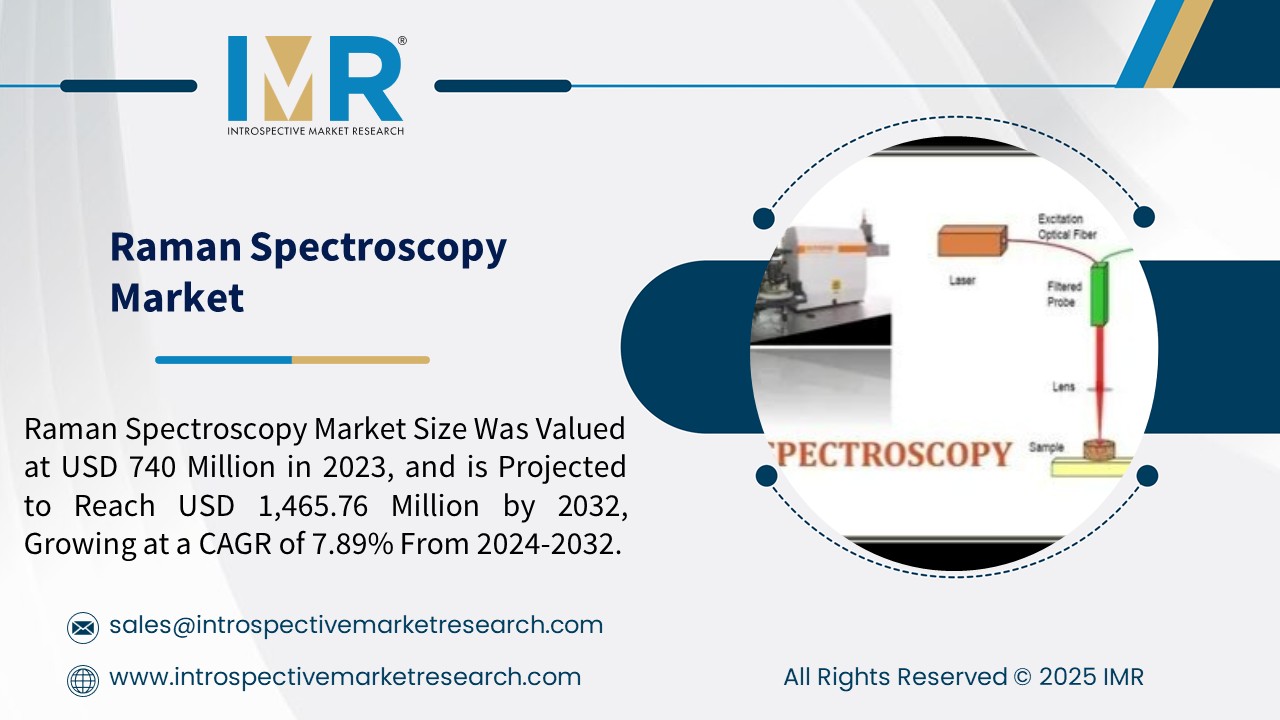
According to a new report published by Introspective Market Research, titled, Raman Spectroscopy Market by Instrument Type, Sampling Technique, and Application, The Global Raman Spectroscopy Market Size Was Valued at USD 740 Million in 2023 and is Projected to Reach USD 1,465.76 Million by 2032, Growing at a CAGR of 7.89%. The Raman Spectroscopy Market is witnessing strong growth, driven by increasing applications across pharmaceuticals, life sciences, materials science, and nanotechnology. Raman spectroscopy is a non-destructive technique that provides detailed molecular and chemical information, making it a preferred analytical tool in laboratories and industries worldwide.
Compared to traditional analytical methods, Raman spectroscopy offers distinct advantages such as rapid analysis, minimal sample preparation, and high specificity in chemical characterization. Its applications span drug development, clinical diagnostics, food safety testing, environmental monitoring, and semiconductor manufacturing, highlighting its diverse use across industries.
The rising adoption of Raman spectroscopy in quality control, forensics, and academic research further boosts its demand. Technological innovations such as portable Raman devices and integration with AI-driven data analysis are expanding accessibility and usability, shaping the future of spectroscopy solutions globally.
key driver fueling the Raman Spectroscopy Market is the rising adoption in the pharmaceutical and biotechnology industries. Raman spectroscopy is increasingly utilized in drug formulation, identification of counterfeit drugs, and real-time quality control. Its non-invasive capabilities allow rapid molecular characterization without damaging the sample. Additionally, regulatory emphasis on quality assurance and stringent compliance in drug manufacturing are accelerating the adoption of Raman techniques, driving steady market growth across global pharma research and development pipelines.
A significant opportunity in the Raman Spectroscopy Market lies in the expansion of portable and handheld Raman devices. Miniaturized instruments, coupled with advancements in data analytics and cloud connectivity, are making spectroscopy more accessible outside traditional laboratories. This opens opportunities for on-site testing in industries such as food safety, mining, and environmental monitoring. As demand grows for real-time, field-based analysis, manufacturers are focusing on integrating Raman devices with AI-powered interpretation tools, creating vast potential for adoption in both developed and emerging economies.
Raman Spectroscopy Market, Segmentation
The Raman Spectroscopy Market is segmented on the basis of Instrument Type, Sampling Technique, and Application.
Instrument Type
- The Instrument Type segment is further classified into Benchtop Instruments, Portable Instruments, and Micro-Raman Systems. Among these, the Benchtop Instruments sub-segment accounted for the highest market share in 2023. Benchtop systems remain the industry standard in research and academic laboratories due to their precision, advanced features, and wide analytical range. They are extensively used in pharmaceutical research and material sciences, where detailed molecular characterization is critical. However, ongoing advancements in miniaturization are expected to gradually increase the market share of portable Raman instruments in the coming years.
Application
- The Application segment is further classified into Pharmaceuticals, Life Sciences, Material Science, Nanotechnology, Food & Beverages, and Others. Among these, the Pharmaceuticals sub-segment accounted for the highest market share in 2023. The use of Raman spectroscopy in drug formulation, counterfeit detection, and real-time process monitoring has positioned it as a critical tool in modern pharmaceutical R&D and manufacturing. The push toward regulatory compliance, coupled with increasing investments in drug discovery, continues to make pharmaceuticals the most dominant application area for Raman spectroscopy worldwide.
Some of The Leading/Active Market Players Are-
- Renishaw plc (UK)
- Horiba Ltd. (Japan)
- Bruker Corporation (USA)
- Thermo Fisher Scientific Inc. (USA)
- Agilent Technologies Inc. (USA)
- JASCO Inc. (Japan)
- B&W Tek Inc. (USA)
- Metrohm AG (Switzerland)
- WITec GmbH (Germany)
- PerkinElmer Inc. (USA)
- Kaiser Optical Systems Inc. (USA)
- Ocean Insight (USA)
- Snowy Range Instruments (USA)
- TSI Incorporated (USA)
- Nanophoton Corporation (Japan)
and other active players.
Key Industry Developments
- In January 2024, Thermo Fisher Scientific introduced an upgraded Raman spectrometer with enhanced imaging capabilities for life sciences.This innovation allows faster acquisition of high-resolution Raman maps, enabling pharmaceutical researchers and material scientists to conduct detailed chemical analyses with greater efficiency and accuracy.
- In March 2024, Renishaw launched a new compact Raman system designed for portability and real-time on-site analysis.The system is targeted toward industries such as food safety, forensics, and environmental monitoring, reflecting the growing demand for miniaturized Raman solutions outside laboratory settings.
Key Findings of the Study
- Benchtop instruments dominate the Raman spectroscopy market in 2023.
- Pharmaceuticals remain the leading application segment globally.
- North America and Europe are the largest regional markets.
- Growth driven by pharmaceutical R&D and counterfeit drug detection.
- Rising demand for portable Raman devices to expand field-based applications.