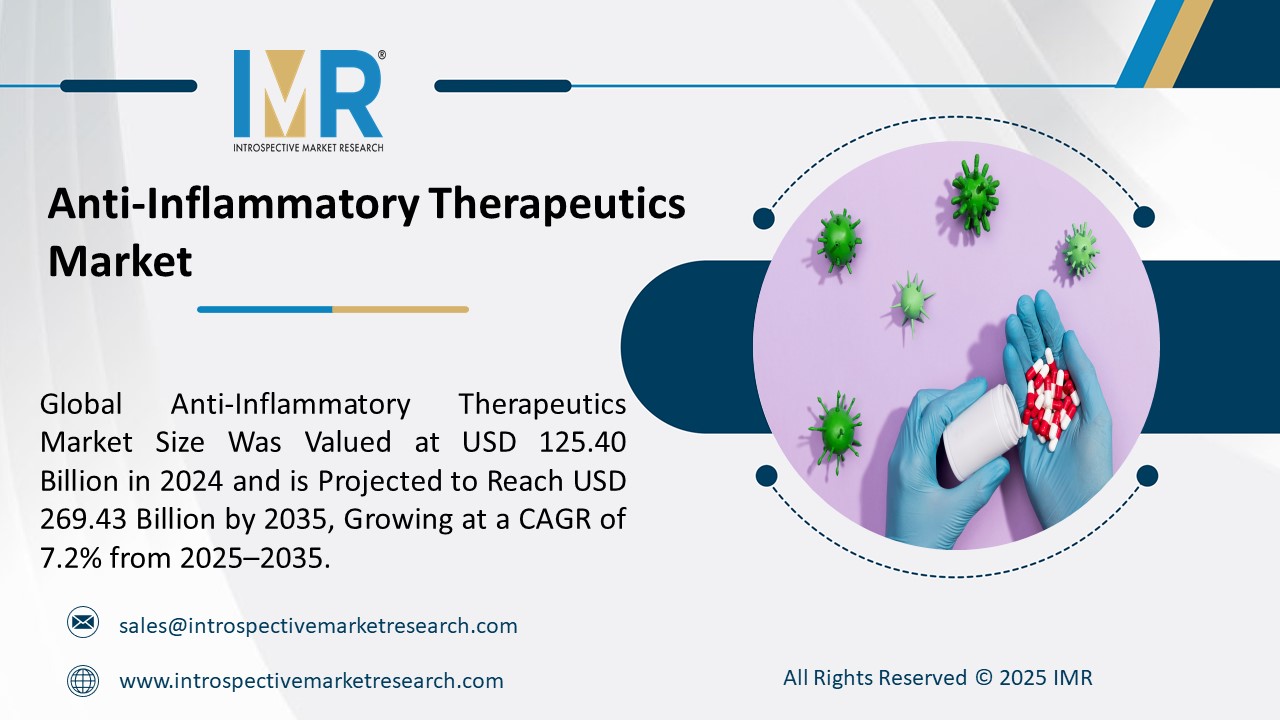
“According to a new report published by Introspective Market Research, titled, Anti-Inflammatory Therapeutics Market by Drug Class, Indication, and Distribution Channel, The Global Anti-Inflammatory Therapeutics Market Size Was Valued at USD 125.40 Billion in 2024 and is Projected to Reach USD 269.43 Billion by 2035, Growing at a CAGR of 7.2% from 2025–2035.”
The anti-inflammatory therapeutics market comprises a wide range of pharmaceutical products designed to reduce inflammation, pain, and swelling associated with acute and chronic conditions. These therapeutics include nonsteroidal anti-inflammatory drugs (NSAIDs), corticosteroids, biologics, and disease-modifying anti-rheumatic drugs (DMARDs). Compared to traditional pain management options, modern anti-inflammatory therapies offer targeted mechanisms of action, improved efficacy, and enhanced safety profiles, particularly in the management of chronic inflammatory disorders.
Anti-inflammatory therapeutics are widely used across major medical fields such as rheumatology, orthopedics, cardiology, dermatology, and gastroenterology. The rising prevalence of autoimmune diseases, arthritis, inflammatory bowel disease, and cardiovascular disorders has significantly increased the demand for effective inflammation control. Additionally, biologic and targeted therapies are transforming treatment paradigms by addressing underlying disease mechanisms rather than merely managing symptoms.
Advancements in drug development, growing healthcare expenditure, and increasing awareness regarding early diagnosis and treatment of inflammatory conditions continue to support market expansion globally. Emerging economies are also contributing to growth due to improving healthcare infrastructure and expanding access to advanced therapeutics.
Market Segmentation
The Anti-Inflammatory Therapeutics Market is segmented into Drug Class, Indication, and Distribution Channel.
- By Drug Class, the market is categorized into NSAIDs, Corticosteroids, Biologics, and DMARDs.
- By Indication, the market is categorized into Arthritis, Autoimmune Diseases, Respiratory Diseases, Cardiovascular Diseases, and Others.
- By Distribution Channel, the market is categorized into Hospital Pharmacies, Retail Pharmacies, and Online Pharmacies.
Growth Driver
The primary growth driver of the anti-inflammatory therapeutics market is the increasing global burden of chronic inflammatory and autoimmune diseases. Conditions such as rheumatoid arthritis, osteoarthritis, psoriasis, asthma, and inflammatory bowel disease are becoming more prevalent due to aging populations, sedentary lifestyles, and environmental factors. This growing patient pool has led to sustained demand for long-term anti-inflammatory treatments. Moreover, continuous innovation in biologics and targeted therapies has improved treatment outcomes, encouraging higher adoption rates among healthcare providers and patients alike.
Market Opportunity
A significant market opportunity lies in the development and commercialization of targeted and biologic anti-inflammatory therapies. Advances in biotechnology and immunology are enabling the creation of drugs with higher specificity and fewer side effects compared to conventional therapies. Additionally, expanding healthcare access in emerging markets, coupled with increasing investments in research and development, presents lucrative opportunities for manufacturers. The growing acceptance of personalized medicine and biosimilars further enhances the potential for cost-effective and scalable treatment solutions.
Detailed Segmentation
Anti-Inflammatory Therapeutics Market, Segmentation
The Anti-Inflammatory Therapeutics Market is segmented on the basis of Drug Class, Indication, and Distribution Channel.
Drug Class
The Drug Class segment is further classified into NSAIDs, Corticosteroids, Biologics, and DMARDs. Among these, the Biologics sub-segment accounted for the highest market share in 2024. Biologics offer targeted action against specific inflammatory pathways, resulting in superior efficacy for chronic and autoimmune conditions. Their ability to modify disease progression rather than provide symptomatic relief has driven strong adoption despite higher costs, particularly in developed healthcare markets.
Indication
The Indication segment is further classified into Arthritis, Autoimmune Diseases, Respiratory Diseases, Cardiovascular Diseases, and Others. Among these, the Arthritis sub-segment accounted for the highest market share in 2024. The high prevalence of osteoarthritis and rheumatoid arthritis, especially among the aging population, has fueled sustained demand for anti-inflammatory therapies. Long-term treatment requirements and continuous product innovation further support segment dominance.
Some of The Leading/Active Market Players Are-
• Pfizer Inc. (U.S.)
• Johnson & Johnson (U.S.)
• AbbVie Inc. (U.S.)
• Novartis AG (Switzerland)
• Roche Holding AG (Switzerland)
• Sanofi (France)
• GlaxoSmithKline plc (UK)
• Merck & Co., Inc. (U.S.)
• Bristol Myers Squibb (U.S.)
• Eli Lilly and Company (U.S.)
• AstraZeneca (UK)
• Takeda Pharmaceutical Company (Japan)
• Bayer AG (Germany)
• Amgen Inc. (U.S.)
and other active players.
Key Industry Developments
In March 2024, a leading pharmaceutical company expanded its biologics portfolio with the approval of a next-generation anti-inflammatory monoclonal antibody.
This development strengthened the company’s position in autoimmune disease treatment and highlighted the industry’s focus on targeted therapies with improved safety and long-term efficacy.
In September 2024, a major market player announced a strategic collaboration to develop biosimilar anti-inflammatory drugs.
The partnership aims to reduce treatment costs and improve accessibility in emerging markets while maintaining therapeutic effectiveness comparable to branded biologics.
Key Findings of the Study
• Biologics dominate the drug class segment due to targeted efficacy
• Arthritis remains the leading indication globally
• North America holds the largest regional market share
• Rising chronic disease prevalence is the primary growth driver
• Increasing focus on biologics and biosimilars is a key market trend