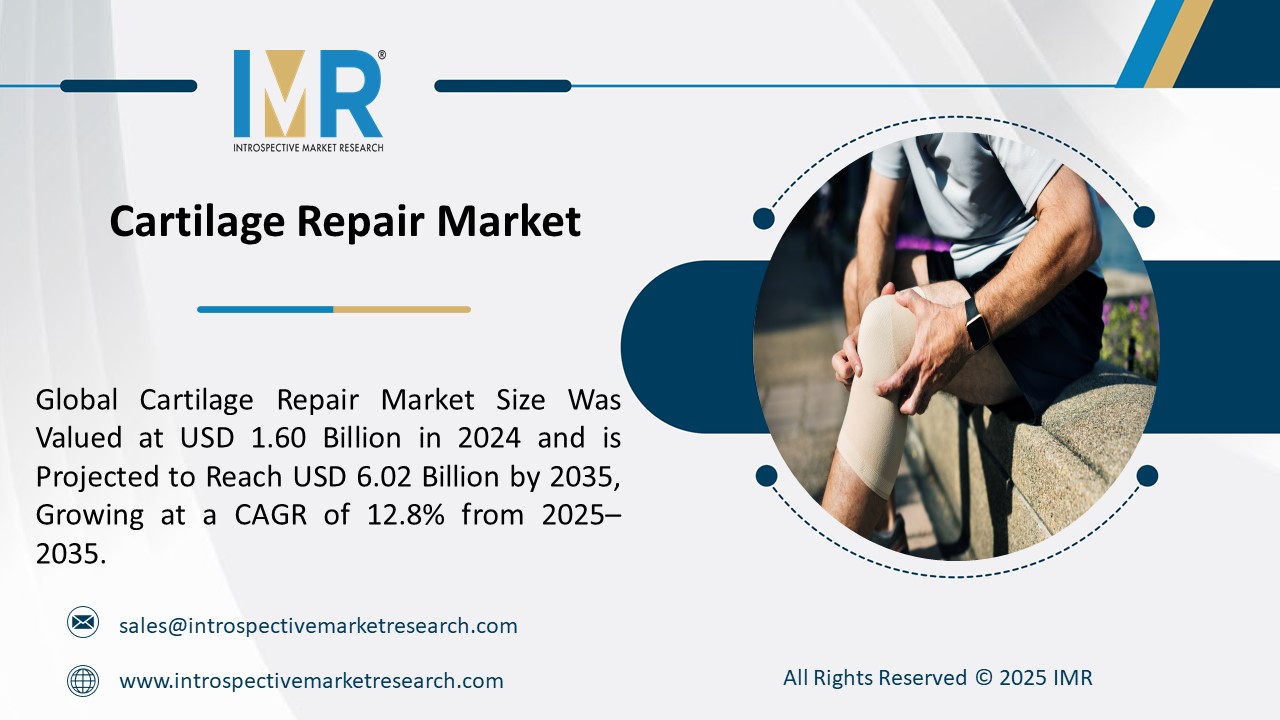
“According to a new report published by Introspective Market Research, titled, Cartilage Repair Market by Treatment Type, Application, and End User, The Global Cartilage Repair Market Size Was Valued at USD 1.60 Billion in 2024 and is Projected to Reach USD 6.02 Billion by 2035, Growing at a CAGR of 12.8% from 2025–2035.”
The cartilage repair market focuses on advanced medical solutions designed to restore damaged articular cartilage caused by trauma, degenerative joint diseases, sports injuries, and age-related conditions. These solutions include cell-based therapies, tissue-engineered products, and biomaterial-based implants that promote cartilage regeneration and functional recovery. Compared to conventional pain management and joint replacement procedures, cartilage repair treatments aim to preserve native joint structures and delay invasive surgical interventions.
Technological advancements in regenerative medicine, particularly in stem cell therapy, autologous chondrocyte implantation, and scaffold-based solutions, have significantly improved treatment outcomes. These innovations offer enhanced biocompatibility, faster recovery times, and long-term joint functionality, making them increasingly preferred by orthopedic specialists and patients alike.
The market serves major industries such as hospitals, orthopedic clinics, ambulatory surgical centers, and sports medicine facilities. Rising awareness about early intervention for joint preservation, combined with increasing healthcare expenditure and growing participation in sports activities globally, continues to drive demand for cartilage repair solutions.
Market Segmentation
The Cartilage Repair Market is segmented into Treatment Type, Application, and End User.
- By Treatment Type, the market is categorized into Cell-Based Therapies, Non-Cell-Based Therapies, and Tissue Scaffold-Based Therapies.
- By Application, the market is categorized into Knee, Hip, Ankle, and Other Joints.
- By End User, the market is categorized into Hospitals, Orthopedic Clinics, and Ambulatory Surgical Centers.
Growth Driver
One of the primary growth drivers of the cartilage repair market is the increasing prevalence of osteoarthritis and sports-related injuries worldwide. Aging populations are more susceptible to cartilage degeneration, while rising participation in high-impact sports has led to a higher incidence of joint injuries among younger demographics. These factors have significantly increased demand for regenerative therapies that restore joint function rather than replace it. Additionally, favorable reimbursement policies in developed regions and growing acceptance of minimally invasive orthopedic procedures further support market growth.
Market Opportunity
A major market opportunity lies in the rapid advancement of regenerative medicine and tissue engineering technologies. Continuous research in stem cell-based therapies and bioengineered scaffolds presents opportunities for more effective and durable cartilage repair solutions. Emerging economies offer untapped potential due to improving healthcare infrastructure, increasing medical tourism, and rising awareness of advanced orthopedic treatments. Strategic collaborations between biotechnology firms and healthcare providers are also expected to accelerate product commercialization and market penetration.
Detailed Segmentation
Cartilage Repair Market, Segmentation
The Cartilage Repair Market is segmented on the basis of Treatment Type, Application, and End User.
Treatment Type
The Treatment Type segment is further classified into Cell-Based Therapies, Non-Cell-Based Therapies, and Tissue Scaffold-Based Therapies. Among these, the Cell-Based Therapies sub-segment accounted for the highest market share in 2024. This dominance is attributed to their superior regenerative potential and long-term clinical outcomes. Autologous chondrocyte implantation and stem cell therapies are widely adopted due to their ability to promote natural cartilage regeneration, reduce pain, and restore joint mobility, making them a preferred choice among orthopedic surgeons.
Application
The Application segment is further classified into Knee, Hip, Ankle, and Other Joints. Among these, the Knee sub-segment accounted for the highest market share in 2024. The knee joint is highly prone to cartilage damage due to sports injuries, obesity, and age-related degeneration. The high volume of knee arthroscopy procedures, combined with strong clinical evidence supporting cartilage repair in knee applications, has driven significant adoption of advanced repair techniques in this segment.
Some of The Leading/Active Market Players Are-
• Zimmer Biomet (United States)
• Smith+Nephew (United Kingdom)
• Stryker Corporation (United States)
• Vericel Corporation (United States)
• Arthrex (United States)
• Anika Therapeutics (United States)
• RTI Surgical (United States)
• Collagen Solutions (United Kingdom)
• B. Braun (Germany)
• Organogenesis (United States)
• and other active players.
Key Industry Developments
In March 2024, a leading regenerative medicine company announced the expansion of its cartilage repair product portfolio to include next-generation cell-based implants.
The development focuses on improving cartilage integration and reducing recovery time, strengthening the company’s position in advanced orthopedic regenerative solutions.
In September 2024, a major orthopedic device manufacturer received regulatory approval for a new scaffold-based cartilage repair system.
This approval enables broader clinical adoption of minimally invasive cartilage repair procedures across hospitals and specialty orthopedic clinics globally.
Key Findings of the Study
• Cell-based therapies dominate the treatment type segment
• Knee applications account for the largest market share
• North America leads due to advanced healthcare infrastructure
• Rising osteoarthritis prevalence is a key growth driver
• Regenerative medicine innovations are shaping market trends