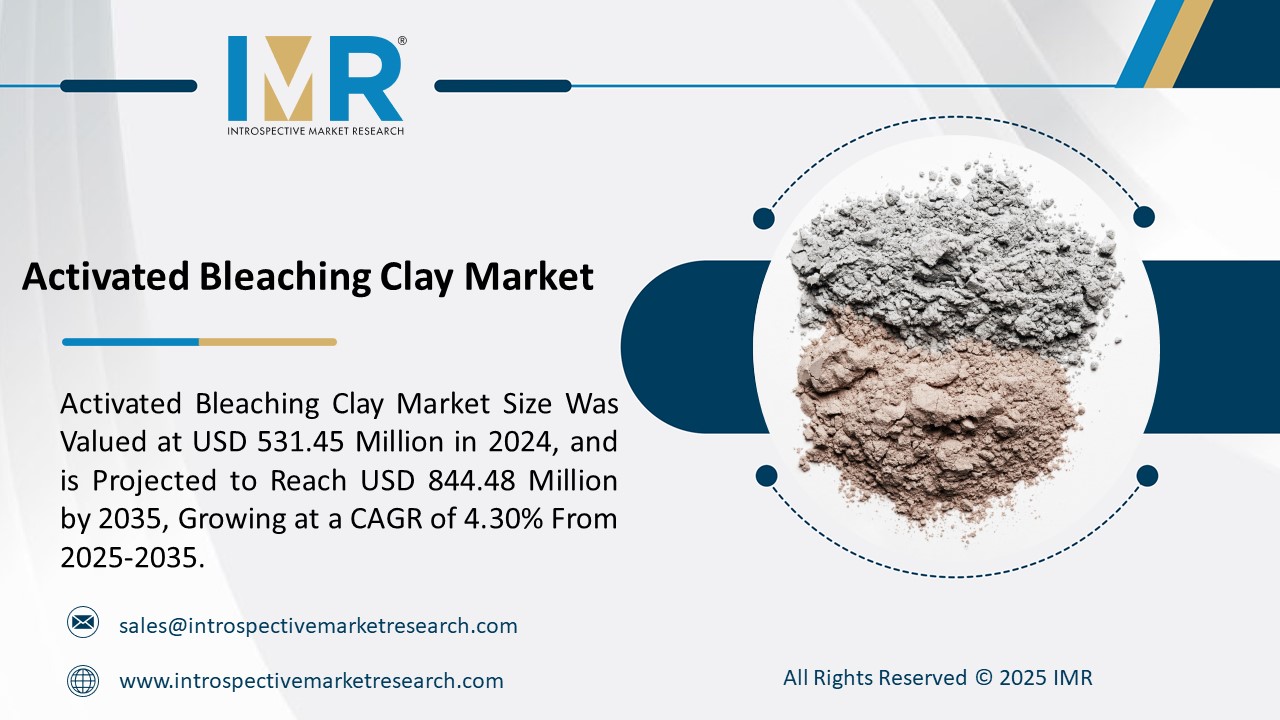
According to a new report published by Introspective Market Research, titled, Activated Bleaching Clay Market by Raw Material, Application, and End-Use Industry, The Global Activated Bleaching Clay Market Size Was Valued at USD 531.45 Million in 2024 and is Projected to Reach USD 844.48 Million by 2035, Growing at a CAGR of 4.30%. Activated bleaching clay, also known as fuller’s earth or activated earth, is a highly absorbent clay material primarily composed of montmorillonite. It undergoes an activation process, typically with mineral acids, to enhance its adsorptive properties, making it exceptionally effective in removing impurities such as pigments, free fatty acids, phospholipids, and other contaminants from various oils and liquids. This natural, eco-friendly solution offers significant advantages over synthetic alternatives due to its cost-effectiveness, high efficiency, and sustainability.
The primary application of activated bleaching clay is in the refining of edible oils and fats, including palm oil, soybean oil, canola oil, and sunflower oil, where it is crucial for decolorization and purification. Beyond edible oils, it also finds extensive use in the purification of mineral oils, such as lubricants and transformers oils, as well as in the treatment of wastewater and in the chemical industry for catalyst support and adsorption processes. Its versatility and critical role in achieving product purity make it an indispensable component across a broad spectrum of industrial applications.
A key growth driver for the activated bleaching clay market is the ever-increasing demand for refined edible oils globally. As the world population grows and dietary patterns shift, the consumption of processed foods and high-quality cooking oils continues to rise. Activated bleaching clay is indispensable in the decolorization and purification process of these oils, ensuring they meet stringent quality and safety standards for human consumption. This sustained expansion in the food and beverage industry, particularly in emerging economies, directly fuels the demand for activated bleaching clay as a critical refining agent.
A significant market opportunity for activated bleaching clay lies in its growing application in the purification and treatment of used lubricating oils and other industrial waste oils. With increasing environmental regulations and a focus on circular economy principles, industries are seeking efficient and sustainable methods to recycle and re-refine used oils. Activated bleaching clay's superior adsorptive properties make it an ideal solution for removing contaminants and restoring the quality of these oils, reducing waste and promoting resource efficiency. This trend towards sustainability and recycling presents a substantial untapped potential for market expansion.
Detailed Segmentation
Raw Material
-
The Raw Material segment is further classified into Bentonite, Attapulgite, Sepiolite, and Others. Among these, the Bentonite sub-segment accounted for the highest market share in 2023. Bentonite-based activated bleaching clay dominates the market primarily due to the abundant availability of bentonite deposits globally and its excellent natural adsorptive properties, which are further enhanced through acid activation. Its lamellar structure and high cation exchange capacity make it highly effective in removing impurities and color bodies from various oils and liquids. The cost-effectiveness of bentonite extraction and processing, combined with its superior performance in decolorization and purification, has established its widespread preference across the edible oil refining and other industrial sectors, ensuring its leading position in the raw material segment.
Application
-
The Application segment is further classified into Edible Oil Refining, Mineral Oil & Lubricants, Chemical & Pharmaceutical, and Others. Among these, the Edible Oil Refining sub-segment accounted for the highest market share in 2023. The edible oil refining application segment holds the largest market share due to the indispensable role of activated bleaching clay in purifying and decolorizing various vegetable oils, such as palm, soybean, sunflower, and canola oil. This process is critical for removing impurities, pigments, and other undesirable compounds, ensuring the oils meet quality, safety, and aesthetic standards for consumer consumption. The continuously growing global demand for refined edible oils, driven by population growth and changing dietary habits, directly translates into high consumption of activated bleaching clay in this sector, solidifying its leading position in the market.
Some of The Leading/Active Market Players Are-
- Clariant AG (Switzerland)
- Oil-Dri Corporation of America (USA)
- Ashapura Group (India)
- Sud-Chemie AG (Germany)
- W Clay Industries Sdn. Bhd. (Malaysia)
- Manek Minerals (India)
- Taiko Bleaching Earth Sdn. Bhd. (Malaysia)
- Mineral Technologies Inc. (USA)
- Gujarat Minechem (India)
- Amcol International Corporation (USA)
- The W Clay Group (USA)
- Indian Clay & Mineral Co. (India)
- HRP Industries (India)
- Jianping County Xiangshun Bleaching Earth Co., Ltd. (China)
- PT Tunas Jaya Sanur (Indonesia)
- other active players.
Key Industry Developments
- In February 2023, Clariant AG announced the launch of new sustainable bleaching earth products, designed to enhance the efficiency of edible oil refining while reducing environmental impact. These innovative solutions aim to minimize oil retention and waste generation, supporting the industry's shift towards greener practices. The development reinforces Clariant's commitment to sustainability and addresses growing customer demand for eco-friendly refining agents.
- In October 2022, Ashapura Group initiated an expansion of its activated bleaching earth production capacity in India to cater to the increasing demand from both domestic and international markets. This expansion is a strategic response to the robust growth in edible oil consumption and processing, particularly in Asian countries. The move aims to strengthen the company's supply chain and ensure timely delivery of high-quality products to its global clientele.
Key Findings of the Study
- Bentonite-based activated bleaching clay holds the dominant market share due to its superior properties and availability.
- Edible Oil Refining is the largest application segment, driven by global demand for refined oils.
- The rising consumption of refined edible oils is a key market growth driver.
- Growth in recycling and re-refining of used oils presents a significant market opportunity.
- The Asia-Pacific region is expected to lead market growth due to its expanding food processing industry.