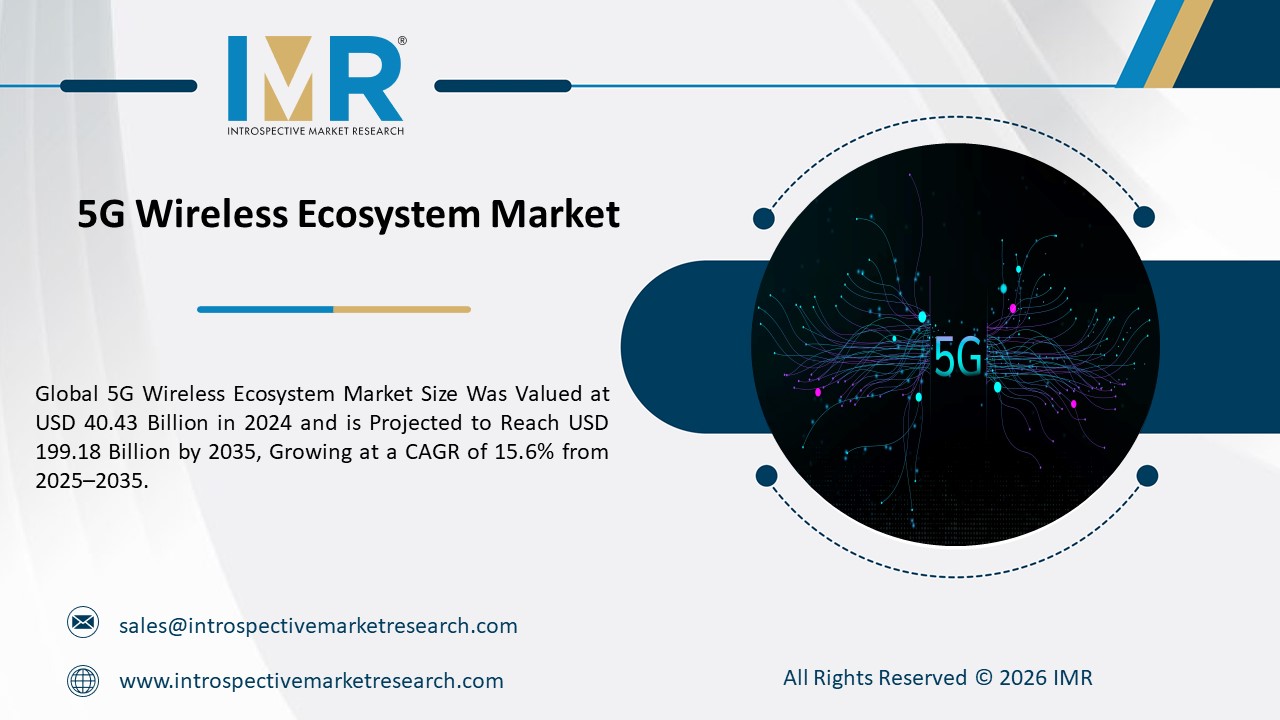
“According to a new report published by Introspective Market Research, titled, 5G Wireless Ecosystem Market by Component, End User, and Geography, The Global 5G Wireless Ecosystem Market Size Was Valued at USD 40.43 Billion in 2024 and is Projected to Reach USD 199.18 Billion by 2035, Growing at a CAGR of 15.6% from 2025–2035.”
The 5G wireless ecosystem market encompasses the complete value chain of next-generation wireless communication, including network infrastructure, devices, software platforms, and services that enable ultra-fast, low-latency connectivity. Compared to traditional 4G/LTE networks, 5G technology offers significantly higher data speeds, massive device connectivity, improved network reliability, and real-time responsiveness, making it a foundation for digital transformation across industries.
The market is witnessing strong adoption driven by increasing mobile data traffic, rapid smartphone penetration, and the deployment of advanced applications such as Internet of Things (IoT), autonomous vehicles, augmented and virtual reality, and smart city solutions. Telecom operators and enterprises are actively investing in 5G infrastructure to support emerging use cases that demand high bandwidth and minimal latency.
Furthermore, government initiatives supporting spectrum allocation, smart infrastructure development, and digitalization are accelerating the rollout of 5G networks globally. As industries transition toward automation and connected ecosystems, the 5G wireless ecosystem market is expected to play a critical role in enabling innovation, efficiency, and new revenue streams.
Market Segmentation
The 5G Wireless Ecosystem Market is segmented into Component, End User, and Geography.
- By Component, the market is categorized into Hardware, Software, and Services.
- By End User, the market is categorized into Telecom Operators, Enterprises, and Consumers.
- By Geography, the market is categorized into North America, Europe, Asia-Pacific, Latin America, and the Middle East & Africa.
Growth Driver
The primary growth driver of the 5G wireless ecosystem market is the exponential rise in data consumption and connected devices worldwide. Increasing adoption of high-definition video streaming, cloud gaming, IoT-enabled devices, and smart applications is placing pressure on existing network infrastructures. 5G technology addresses these challenges by delivering ultra-high-speed connectivity, low latency, and enhanced network capacity. Telecom operators are accelerating 5G deployments to meet evolving consumer and enterprise demands, while governments and private players continue investing heavily in spectrum auctions and network modernization, fueling sustained market growth.
Market Opportunity
A significant market opportunity lies in the expansion of 5G-enabled industrial and enterprise applications. Sectors such as manufacturing, healthcare, transportation, and energy are increasingly leveraging private 5G networks to enable automation, remote monitoring, predictive maintenance, and mission-critical communications. The integration of 5G with technologies like artificial intelligence, edge computing, and cloud platforms presents new revenue opportunities for ecosystem players. As enterprises seek secure, high-performance connectivity solutions, demand for customized 5G services and solutions is expected to grow rapidly.
Detailed Segmentation
5G Wireless Ecosystem Market, Segmentation
The 5G Wireless Ecosystem Market is segmented on the basis of Component, End User, and Geography.
Component
The Component segment is further classified into Hardware, Software, and Services. Among these, the Hardware sub-segment accounted for the highest market share in 2024. This dominance is attributed to large-scale investments in 5G base stations, antennas, small cells, and network equipment by telecom operators worldwide. The continuous rollout of 5G infrastructure, along with upgrades to existing networks, has driven strong demand for hardware components, making it a critical contributor to overall market revenue.
End User
The End User segment is further classified into Telecom Operators, Enterprises, and Consumers. Among these, the Telecom Operators sub-segment accounted for the highest market share in 2024. Telecom operators are at the forefront of 5G deployment, investing heavily in spectrum acquisition, network expansion, and service innovation. Their focus on enhancing network performance and offering value-added 5G services to both enterprises and consumers has positioned this segment as the leading contributor to market growth.
Some of The Leading/Active Market Players Are-
• Qualcomm Incorporated (U.S.)
• Ericsson AB (Sweden)
• Nokia Corporation (Finland)
• Huawei Technologies Co., Ltd. (China)
• Samsung Electronics Co., Ltd. (South Korea)
• Cisco Systems, Inc. (U.S.)
• Intel Corporation (U.S.)
• ZTE Corporation (China)
• AT&T Inc. (U.S.)
• Verizon Communications Inc. (U.S.)
• Deutsche Telekom AG (Germany)
• Vodafone Group Plc (U.K.)
• China Mobile Ltd. (China)
• Orange S.A. (France)
• and other active players.
Key Industry Developments
In March 2024, leading telecom operators accelerated nationwide 5G standalone network deployments to support enterprise and industrial use cases.
These deployments are aimed at enabling ultra-low latency applications, private networks, and advanced IoT solutions, strengthening the overall 5G ecosystem and improving service quality for businesses and consumers.
In September 2024, major technology companies announced strategic collaborations to integrate 5G with edge computing and AI platforms.
These partnerships focus on delivering scalable, intelligent connectivity solutions for smart manufacturing, autonomous systems, and real-time analytics, expanding the commercial potential of 5G-enabled services.
Key Findings of the Study
• Hardware remains the dominant component segment due to extensive 5G infrastructure investments
• Telecom operators are the leading end users of 5G ecosystem solutions
• Asia-Pacific and North America are key revenue-generating regions
• Rising data traffic and IoT adoption are major growth drivers
• Integration of 5G with AI and edge computing is a key market trend