




Key Market Highlights
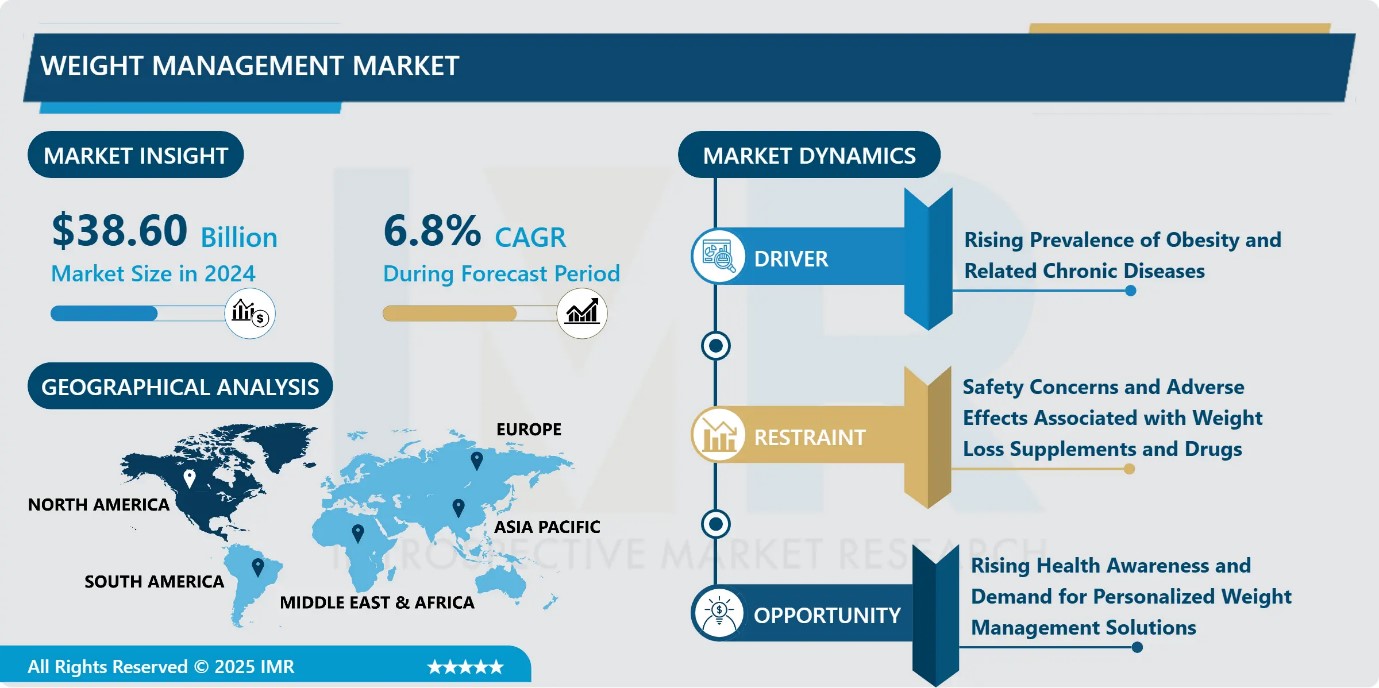
Weight Management Market Size Was Valued at USD 38.60 Billion in 2024, and is Projected to Reach USD 79.59 Billion by 2035, Growing at a CAGR of 6.8% from 2025-2035.
- Market Size in 2024: USD 38.60 Billion
- Projected Market Size by 2035: USD 79.59 Billion
- CAGR (2025–2035): 6.8%
- Leading Market in 2024: North America
- Fastest-Growing Market: Asia-Pacific
- By Equipment Type: The Fitness Equipment segment is anticipated to lead the market by accounting for 62.5% of the market share throughout the forecast period.
- By Product Type: The Dietary Supplements segment is expected to capture 27.7% of the market share, thereby maintaining its dominance over the forecast period.
- By Region: North America region is projected to hold 32.7% of the market share during the forecast period.
- Active Players: Abbott Laboratories (United States), Amway Corp. (United States), Atkins Nutritionals, Inc. (United States), Eli Lilly and Company (United States), Glanbia PLC (Ireland), and Other Active Players.
Weight Management Market Synopsis:
The weight management market encompasses products and services designed to help individuals achieve and maintain healthy body weight through dietary supplements, meal replacements, fitness solutions, medical interventions, and lifestyle management programs. The market is experiencing steady growth due to the rising global prevalence of obesity and chronic diseases such as diabetes, cardiovascular disorders, and cancer. Sedentary lifestyles, unhealthy dietary patterns, and increased screen time have intensified health risks across both developed and emerging economies. Growing health awareness, higher disposable incomes, and increased focus on preventive healthcare are driving demand for sustainable and personalized weight management solutions. The expansion of digital platforms, fitness apps, and online health services has further improved accessibility, positioning weight management as a critical component of global public health and wellness strategies.
Weight Management Market Dynamics and Trend Analysis:
Weight Management Market Growth Driver-Rising Prevalence of Obesity and Related Chronic Diseases
- The increasing global incidence of obesity is a key driver of growth in the weight management market. Sedentary lifestyles, rapid urbanization, and high consumption of calorie-dense processed foods have significantly contributed to rising body mass index (BMI) levels across all age groups. According to the World Health Organization, global obesity rates have nearly tripled since 1975. This surge has led to a higher prevalence of chronic conditions such as type 2 diabetes, cardiovascular diseases, and hypertension, prompting consumers and healthcare systems to seek effective weight loss and management solutions, including diet programs, fitness services, supplements, and medical interventions.
Weight Management Market Limiting Factor-Safety Concerns and Adverse Effects Associated with Weight Loss Supplements and Drugs
- Safety concerns and reports of adverse effects significantly restrain the growth of the weight management market. Instances of hepatotoxicity, cardiovascular risks, and gastrointestinal complications linked to unregulated herbal supplements and certain prescription weight loss drugs have raised caution among consumers and healthcare providers. Regulatory authorities have issued warning letters and product recalls, intensifying scrutiny across the industry. Additionally, misleading marketing claims promising rapid or effortless weight loss have eroded consumer trust, particularly toward smaller or less-validated brands. Growing awareness and stricter retail quality standards are increasing compliance costs and delaying product launches, ultimately limiting adoption and slowing overall market expansion.
Weight Management Market Expansion Opportunity-Rising Health Awareness and Demand for Personalized Weight Management Solutions
- Growing health consciousness and heightened aesthetic awareness present a significant opportunity for the weight management market. Consumers are increasingly prioritizing preventive healthcare, healthy lifestyles, and physical fitness, driven by social media influence, wellness campaigns, and easy access to health information. Alongside this, the rising desire for improved appearance is encouraging spending on structured weight loss programs, fitness services, and supplements. Furthermore, the emerging trend of personalized nutrition based on individual genetic, metabolic, and medical profiles is creating new growth avenues. Companies leveraging DNA testing and data-driven insights to deliver customized weight loss supplements and nutrition plans can effectively address diverse consumer needs and achieve higher engagement and outcomes.
Weight Management Market Challenge and Risk-High Cost of Low-Calorie Diets and Advanced Weight Management Solutions
- The high cost associated with low-calorie foods and advanced weight management solutions poses a significant challenge to market growth. Specialized diet products often involve additional processing and nutrient fortification, increasing their retail prices and limiting affordability for middle- and low-income consumers. Similarly, premium fitness equipment, medically supervised programs, bariatric procedures, and prescription weight loss drugs remain financially inaccessible to a large population, further constrained by limited insurance coverage. As a result, many individuals turn to lower-cost alternative therapies rather than evidence-based solutions. This affordability gap restricts widespread adoption and prevents the market from fully addressing the growing global demand for effective weight management options.
Weight Management Market Trend-Technological Advancements and Shift Toward Digital and Natural Weight Management Solutions
- The weight management market is witnessing a strong shift toward technology-enabled and natural health solutions. Wearable devices such as smartwatches and fitness trackers enable users to monitor physical activity, heart rate, sleep patterns, and calorie expenditure in real time, enhancing motivation and accountability. Additionally, mobile health applications offer personalized diet plans, calorie tracking, and guided workouts, often supported by data analytics and AI-driven insights. Parallelly, rising consumer preference for clean-label and plant-based products is boosting demand for natural and herbal weight loss supplements made from ingredients such as green tea, ginseng, and aloe vera, reflecting a holistic and sustainable approach to weight management.
Weight Management Market Segment Analysis:
Weight Management Market is segmented based on Product Type, Diet Type, Equipment Type, Application, Service, Delivery mode, Distribution Channel, End User and Region.
By Equipment Type, fitness equipment segment is expected to dominate the market with around 62.5% share during the forecast period.
- The fitness equipment segment dominated the global weight management market in 2024 due to its wide adoption across home, commercial, and institutional settings. Equipment such as cardio machines, resistance training systems, and free weights enable structured, goal-oriented workouts and allow users to target specific muscle groups effectively. Rising awareness of physical fitness, preventive healthcare, and active lifestyles has significantly boosted demand for exercise equipment. Additionally, continuous technological innovations including smart features, digital displays, automated resistance, and performance tracking have enhanced user engagement and convenience. These advancements, combined with increasing investments in home gyms and fitness centers, have positioned fitness equipment as a core component of comprehensive weight management solutions.
By Product Type, Dietary supplements is expected to dominate with close to 27.7% market share during the forecast period.
- The dietary supplements is expected to register strong growth during the forecast period, driven by rising concerns over obesity, visceral fat, and weight-related health complications. Obesity, defined by a BMI of 30 or above, is associated with conditions such as diabetes, hypertension, joint disorders, and insulin resistance, prompting greater adoption of diet-focused weight management programs.
- Diet-based foods and beverages continue to dominate due to their sustainable and preventive approach, supported by nutritional counseling and balanced micronutrient intake. Strong demand for portion-controlled foods, low-carbohydrate meals, functional beverages, and dietary supplements supports segment growth. Additionally, expanding retail availability and ongoing product reformulation further enhance consumer adoption.
Weight Management Market Regional Insights:
North America region is estimated to lead the market with around 32.7% share during the forecast period.
- North America dominates the global weight management market, holding the largest regional share, driven by high obesity prevalence and strong awareness of healthy living. The United States and Canada face widespread lifestyle-related health issues, fueled by sedentary habits and high consumption of ultra-processed foods. This has increased demand for weight loss supplements, diet-based foods, fitness programs, and digital health solutions. The region benefits from advanced healthcare infrastructure, broad insurance coverage, employer-sponsored wellness programs, and high adoption of subscription-based weight management apps. Additionally, strong retail presence, on-site nutritional counseling, and rigorous regulatory oversight enhance consumer trust, collectively reinforcing North America’s leading position in the weight management market.
Weight Management Market Active Players:
- Abbott Laboratories (United States)
- Amway Corp. (United States)
- Atkins Nutritionals, Inc. (United States)
- Eli Lilly and Company (United States)
- Glanbia PLC (Ireland)
- Herbalife Nutrition Ltd. (United States)
- Johnson & Johnson Services, Inc. (United States)
- Kellogg Company (United States)
- Medifast, Inc. (United States)
- Nestlé Health Science (Switzerland)
- Noom, Inc. (United States)
- Novo Nordisk (Denmark)
- Nutrisystem, Inc. (United States)
- Technogym S.p.A. (Italy)
- WW International, Inc. (Weight Watchers) (United States)
- Other Active Players
Key Industry Developments in the Weight Management Market:
- In March 2025, Herbalife Nutrition Ltd. acquired assets from Pro2col Health, Pruvit Ventures, and Link BioSciences to strengthen its health and wellness portfolio. The acquisition integrates Pruvit’s patented ketone supplements and Pro2col’s AI-powered nutrition platform. This move supports Herbalife’s strategy to offer more personalized, data-driven health and nutrition solutions.
- In March 2025, Eli Lilly launched Mounjaro in India following approval from the Central Drugs Standard Control Organization (CDSCO). The drug, introduced in single-dose vial packaging, targets type 2 diabetes, obesity, and overweight conditions. Its approval marks a significant advancement in pharmaceutical weight management and metabolic health treatment.
Technical Analysis of Technologies, Digital Platforms, and Medical Solutions in the Global Weight Management Market
- The technical landscape of the weight management market integrates nutrition science, medical devices, digital health platforms, and data-driven personalization. Products range from dietary supplements and functional foods formulated with bioactive compounds to fitness and surgical equipment designed for body composition optimization. Wearable devices and smart trackers enable continuous monitoring of physical activity, caloric expenditure, sleep patterns, and metabolic indicators.
- Advanced mobile applications leverage artificial intelligence and machine learning to deliver personalized diet plans, behavioral coaching, and predictive weight-loss analytics. Cloud-based platforms support remote program delivery, real-time data synchronization, and interoperability with electronic health records. Minimally invasive surgical technologies and wound management solutions further support obesity-related interventions. Secure data management, regulatory compliance, and integration of telehealth services enhance clinical adoption. Collectively, these technologies enable scalable, outcome-driven weight management solutions across clinical, commercial, and consumer settings.
|
Weight Management Market |
|||
|
Base Year: |
2024 |
Forecast Period: |
2025-2035 |
|
Historical Data: |
2018 to 2023 |
Market Size in 2024: |
USD 38.60 Bn. |
|
Forecast Period 2025-35 CAGR: |
6.8 % |
Market Size in 2035: |
USD 79.59 Bn. |
|
Segments Covered: |
By Product Type |
|
|
|
By Diet Type |
|
||
|
By Equipment Type |
|
||
|
By Application |
|
||
|
By Service Type |
|
||
|
By Delivery Mode |
|
||
|
By Distribution Channel |
|
||
|
By End User |
|
||
|
By Region |
|
||
|
Growth Driver: |
|
||
|
Limiting Factor |
|
||
|
Expansion Opportunity |
|
||
|
Challenge and Risk |
|
||
|
Companies Covered in the Report: |
|
||
Chapter 1: Introduction
1.1 Scope and Coverage
Chapter 2:Executive Summary
Chapter 3: Market Landscape
3.1 Market Dynamics and Opportunity Analysis
3.1.1 Growth Drivers
3.1.2 Limiting Factors
3.1.3 Growth Opportunities
3.1.4 Challenges and Risks
3.2 Market Trend Analysis
3.3 Industry Ecosystem
3.4 Industry Value Chain Mapping
3.5 Strategic PESTLE Overview
3.6 Porter's Five Forces Framework
3.7 Regulatory Framework
3.8 Pricing Trend Analysis
3.9 Intellectual Property Review
3.10 Technology Evolution
3.11 Import-Export Analysis
3.12 Consumer Behavior Analysis
3.13 Investment Pocket Analysis
3.14 Go-To Market Strategy
Chapter 4: Weight Management Market by Product Type (2018-2035)
4.1 Weight Management Market Snapshot and Growth Engine
4.2 Market Overview
4.3 Dietary Supplements
4.3.1 Introduction and Market Overview
4.3.2 Historic and Forecasted Market Size in Value USD and Volume Units
4.3.3 Key Market Trends, Growth Factors, and Opportunities
4.3.4 Geographic Segmentation Analysis
4.4 Fitness Equipment
4.5 Surgical Devices
4.6 Wearable Devices & Smart Trackers
4.7 and Services
Chapter 5: Weight Management Market by Diet Type (2018-2035)
5.1 Weight Management Market Snapshot and Growth Engine
5.2 Market Overview
5.3 Meals
5.3.1 Introduction and Market Overview
5.3.2 Historic and Forecasted Market Size in Value USD and Volume Units
5.3.3 Key Market Trends, Growth Factors, and Opportunities
5.3.4 Geographic Segmentation Analysis
5.4 Beverages
5.5 Nutraceuticals
Chapter 6: Weight Management Market by Equipment Type (2018-2035)
6.1 Weight Management Market Snapshot and Growth Engine
6.2 Market Overview
6.3 Fitness Equipment and Surgical Equipment
6.3.1 Introduction and Market Overview
6.3.2 Historic and Forecasted Market Size in Value USD and Volume Units
6.3.3 Key Market Trends, Growth Factors, and Opportunities
6.3.4 Geographic Segmentation Analysis
Chapter 7: Weight Management Market by Application (2018-2035)
7.1 Weight Management Market Snapshot and Growth Engine
7.2 Market Overview
7.3 Weight Maintenance
7.3.1 Introduction and Market Overview
7.3.2 Historic and Forecasted Market Size in Value USD and Volume Units
7.3.3 Key Market Trends, Growth Factors, and Opportunities
7.3.4 Geographic Segmentation Analysis
7.4 Body Shaping
7.5 Sports Injuries
7.6 Aesthetic Procedures
7.7 Chronic Wound Management
7.8 and Others
Chapter 8: Weight Management Market by Service Type (2018-2035)
8.1 Weight Management Market Snapshot and Growth Engine
8.2 Market Overview
8.3 Digital Weight-Loss Programs
8.3.1 Introduction and Market Overview
8.3.2 Historic and Forecasted Market Size in Value USD and Volume Units
8.3.3 Key Market Trends, Growth Factors, and Opportunities
8.3.4 Geographic Segmentation Analysis
8.4 Fitness Centers & Health Clubs
8.5 Slimming/Commercial Weight-Loss Centers
8.6 Consulting & Coaching Services
8.7 and Others
Chapter 9: Weight Management Market by Delivery Mode (2018-2035)
9.1 Weight Management Market Snapshot and Growth Engine
9.2 Market Overview
9.3 On-site/In-Person
9.3.1 Introduction and Market Overview
9.3.2 Historic and Forecasted Market Size in Value USD and Volume Units
9.3.3 Key Market Trends, Growth Factors, and Opportunities
9.3.4 Geographic Segmentation Analysis
9.4 Online/Mobile Applications
9.5 and Hybrid
Chapter 10: Weight Management Market by Distribution Channel (2018-2035)
10.1 Weight Management Market Snapshot and Growth Engine
10.2 Market Overview
10.3 Multi-Level Marketing
10.3.1 Introduction and Market Overview
10.3.2 Historic and Forecasted Market Size in Value USD and Volume Units
10.3.3 Key Market Trends, Growth Factors, and Opportunities
10.3.4 Geographic Segmentation Analysis
10.4 Supermarkets/Hypermarkets
10.5 Pharmacies & Drug Stores
10.6 Health & Beauty Stores
10.7 Online Channels
10.8 and Others
Chapter 11: Weight Management Market by End User (2018-2035)
11.1 Weight Management Market Snapshot and Growth Engine
11.2 Market Overview
11.3 Fitness Centers & Health Clubs
11.3.1 Introduction and Market Overview
11.3.2 Historic and Forecasted Market Size in Value USD and Volume Units
11.3.3 Key Market Trends, Growth Factors, and Opportunities
11.3.4 Geographic Segmentation Analysis
11.4 Consulting Services
11.5 Commercial Weight Loss Centers
11.6 Online Weight Loss Programs
11.7 Slimming Centers
11.8 and Others
Chapter 12: Company Profiles and Competitive Analysis
12.1 Competitive Landscape
12.1.1 Competitive Benchmarking
12.1.2 Weight Management Market Share by Manufacturer/Service Provider(2024)
12.1.3 Industry BCG Matrix
12.1.4 PArtnerships, Mergers & Acquisitions
12.2 ABBOTT LABORATORIES (UNITED STATES)
12.2.1 Company Overview
12.2.2 Key Executives
12.2.3 Company Snapshot
12.2.4 Role of the Company in the Market
12.2.5 Sustainability and Social Responsibility
12.2.6 Operating Business Segments
12.2.7 Product Portfolio
12.2.8 Business Performance
12.2.9 Recent News & Developments
12.2.10 SWOT Analysis
12.3 AMWAY CORP. (UNITED STATES)
12.4 ATKINS NUTRITIONALS
12.5 INC. (UNITED STATES)
12.6 ELI LILLY AND COMPANY (UNITED STATES)
12.7 GLANBIA PLC (IRELAND)
12.8 HERBALIFE NUTRITION LTD. (UNITED STATES)
12.9 JOHNSON & JOHNSON SERVICES
12.10 INC. (UNITED STATES)
12.11 KELLOGG COMPANY (UNITED STATES)
12.12 MEDIFAST
12.13 INC. (UNITED STATES)
12.14 NESTLÉ HEALTH SCIENCE (SWITZERLAND)
12.15 NOOM
12.16 INC. (UNITED STATES)
12.17 NOVO NORDISK (DENMARK)
12.18 NUTRISYSTEM
12.19 INC. (UNITED STATES)
12.20 TECHNOGYM S.P.A. (ITALY)
12.21 WW INTERNATIONAL
12.22 INC. – WEIGHT WATCHERS (UNITED STATES)
12.23 AND OTHER ACTIVE PLAYERS.
Chapter 13: Global Weight Management Market By Region
13.1 Overview
13.2. North America Weight Management Market
13.2.1 Key Market Trends, Growth Factors and Opportunities
13.2.2 Top Key Companies
13.2.3 Historic and Forecasted Market Size by Segments
13.2.4 Historic and Forecast Market Size by Country
13.2.4.1 US
13.2.4.2 Canada
13.2.4.3 Mexico
13.3. Eastern Europe Weight Management Market
13.3.1 Key Market Trends, Growth Factors and Opportunities
13.3.2 Top Key Companies
13.3.3 Historic and Forecasted Market Size by Segments
13.3.4 Historic and Forecast Market Size by Country
13.3.4.1 Russia
13.3.4.2 Bulgaria
13.3.4.3 The Czech Republic
13.3.4.4 Hungary
13.3.4.5 Poland
13.3.4.6 Romania
13.3.4.7 Rest of Eastern Europe
13.4. Western Europe Weight Management Market
13.4.1 Key Market Trends, Growth Factors and Opportunities
13.4.2 Top Key Companies
13.4.3 Historic and Forecasted Market Size by Segments
13.4.4 Historic and Forecast Market Size by Country
13.4.4.1 Germany
13.4.4.2 UK
13.4.4.3 France
13.4.4.4 The Netherlands
13.4.4.5 Italy
13.4.4.6 Spain
13.4.4.7 Rest of Western Europe
13.5. Asia Pacific Weight Management Market
13.5.1 Key Market Trends, Growth Factors and Opportunities
13.5.2 Top Key Companies
13.5.3 Historic and Forecasted Market Size by Segments
13.5.4 Historic and Forecast Market Size by Country
13.5.4.1 China
13.5.4.2 India
13.5.4.3 Japan
13.5.4.4 South Korea
13.5.4.5 Malaysia
13.5.4.6 Thailand
13.5.4.7 Vietnam
13.5.4.8 The Philippines
13.5.4.9 Australia
13.5.4.10 New Zealand
13.5.4.11 Rest of APAC
13.6. Middle East & Africa Weight Management Market
13.6.1 Key Market Trends, Growth Factors and Opportunities
13.6.2 Top Key Companies
13.6.3 Historic and Forecasted Market Size by Segments
13.6.4 Historic and Forecast Market Size by Country
13.6.4.1 Turkiye
13.6.4.2 Bahrain
13.6.4.3 Kuwait
13.6.4.4 Saudi Arabia
13.6.4.5 Qatar
13.6.4.6 UAE
13.6.4.7 Israel
13.6.4.8 South Africa
13.7. South America Weight Management Market
13.7.1 Key Market Trends, Growth Factors and Opportunities
13.7.2 Top Key Companies
13.7.3 Historic and Forecasted Market Size by Segments
13.7.4 Historic and Forecast Market Size by Country
13.7.4.1 Brazil
13.7.4.2 Argentina
13.7.4.3 Rest of SA
Chapter 14 Analyst Viewpoint and Conclusion
Chapter 15 Our Thematic Research Methodology
15.1 Research Process
15.2 Primary Research
15.3 Secondary Research
Chapter 16 Case Study
Chapter 17 Appendix
17.1 Sources
17.2 List of Tables and figures
17.3 Short Forms and Citations
17.4 Assumption and Conversion
17.5 Disclaimer
|
Weight Management Market |
|||
|
Base Year: |
2024 |
Forecast Period: |
2025-2035 |
|
Historical Data: |
2018 to 2023 |
Market Size in 2024: |
USD 38.60 Bn. |
|
Forecast Period 2025-35 CAGR: |
6.8 % |
Market Size in 2035: |
USD 79.59 Bn. |
|
Segments Covered: |
By Product Type |
|
|
|
By Diet Type |
|
||
|
By Equipment Type |
|
||
|
By Application |
|
||
|
By Service Type |
|
||
|
By Delivery Mode |
|
||
|
By Distribution Channel |
|
||
|
By End User |
|
||
|
By Region |
|
||
|
Growth Driver: |
|
||
|
Limiting Factor |
|
||
|
Expansion Opportunity |
|
||
|
Challenge and Risk |
|
||
|
Companies Covered in the Report: |
|
||


