




Pilates & Yoga Studios Market Synopsis:
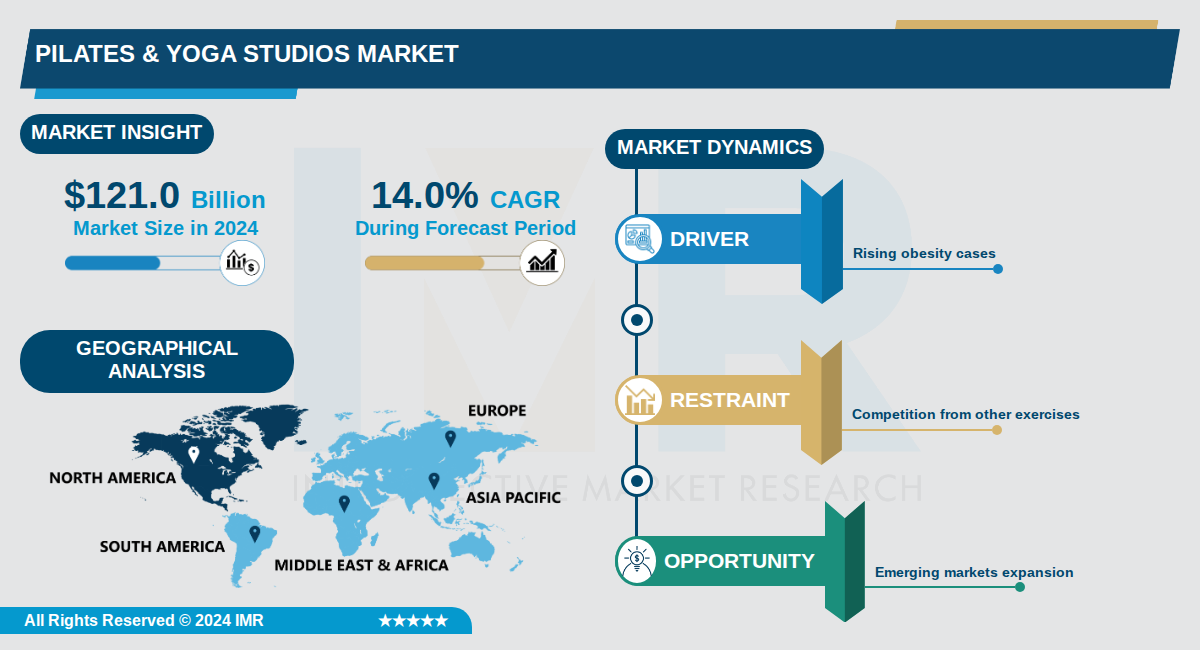
Pilates & Yoga Studios Market Size Was Valued at USD 121.0 Billion in 2024, and is Projected to Reach USD 521.0 Billion by 2035, Growing at a CAGR of 14.0% From 2024-2035.
The global Pilates & Yoga Studios Market was valued at $121.0 billion in 2024 and is projected to reach $521.0 billion by 2035, growing at a compound annual growth rate (CAGR) of 14.0%. This robust expansion reflects surging consumer demand for low-impact exercises that enhance flexibility, strength, and mental well-being, particularly among urban professionals, millennials, and older adults seeking holistic wellness solutions.
North America and Europe currently dominate the market, driven by established fitness infrastructures, high disposable incomes, and a proliferation of boutique studios in major cities like New York, Los Angeles, London, and Paris. Yoga classes held the largest share in 2024 and are expected to maintain leadership, fueled by their popularity in stress relief and fitness routines, while Pilates gains traction for therapeutic and personalized training.
Emerging markets in Asia-Pacific, including India, China, Japan, and Australia, are poised for significant growth due to urbanization, rising health consciousness, and increasing disposable incomes. Innovations such as hybrid studios blending yoga, Pilates, and high-intensity workouts, alongside digital platforms, are broadening accessibility and attracting diverse demographics globally.
Pilates & Yoga Studios Market Trend Analysis:
Rise of Hybrid In-Person and Virtual Studio Models
- Studios are increasingly adopting hybrid models that combine in-person workshops with virtual on-demand classes, allowing global access through streaming platforms like those used by YogaSix and STRONG Pilates Studios. This shift blurs the lines between physical and digital engagement, enabling practitioners to join curated sessions from anywhere. In North America, boutique fitness studios providing Pilates and yoga recorded 10.1% annual growth in 2023 according to the Health and Fitness Association, largely driven by these flexible offerings.
- Hybrid setups foster seamless omnichannel experiences, with app-based scheduling and loyalty programs enhancing member retention. For instance, large studios in urban areas leverage advanced fitness technology to offer varied class types, attracting high-end members and corporate partnerships. This model supports revenue diversification beyond class fees, including merchandise sales of branded apparel.
- The scalability of online components caters to massive global audiences, as seen in Asia-Pacific where technology-enabled studios deploy AI personalization for tech-savvy consumers in India and Southeast Asia.
Expansion into Emerging Markets in Asia-Pacific and Latin America
- Pilates and yoga studios are aggressively entering Asia-Pacific and Latin America, fueled by rising health awareness and disposable incomes, with the Asia-Pacific market projected to reach $89,790.9 million by 2028 at a 10.9% CAGR. In India, cultural affinity drives domestic demand through numerous yoga schools and gurus, while Australia and New Zealand boast high per-capita studio penetration. Studios like Mash Style Lab Co., Ltd and Nami Yoga Studio are capitalizing on this by tailoring offerings to local traditions.
- Southeast Asia sees rapid adoption of digital platforms, with studios forming local partnerships for geographic expansion. This trend intersects with wellness tourism, creating opportunities for joint ventures and complementary services. Investor interest has led to strategic acquisitions, enabling efficient scaling in these high-growth regions.
- Government initiatives promoting active lifestyles in emerging markets further boost presence, contrasting with mature Americas markets focused on boutique tech integrations.
Integration of Health-Tech and Wearable Analytics
- Studios are revolutionizing operations through health-tech convergence, incorporating wearable technology, data analytics, and AI-powered personalization to enhance member journeys. In the Americas, U.S. and Canadian studios use app-based scheduling, advanced analytics for marketing, and gamified experiences to cater to convenience-oriented clients. Companies like CORE PILATES and Studio ONE deploy these tools for optimized class scheduling and loyalty programs.
- Cross-disciplinary integration of mind-body practices with wearables tracks progress in low-impact Pilates strength building and yoga flexibility, boosting engagement. Boutique studios curate specialized communities with studio-exclusive apparatus and tech-infused formats. This drives revenue from high-margin instructor accreditation training using standardized methodologies.
- In East Asia, tech-savvy urban consumers embrace AI-driven wellness, positioning studios for differentiated growth amid competitive pressures from alternatives like Zumba gyms.
Pilates & Yoga Studios Market Segment Analysis:
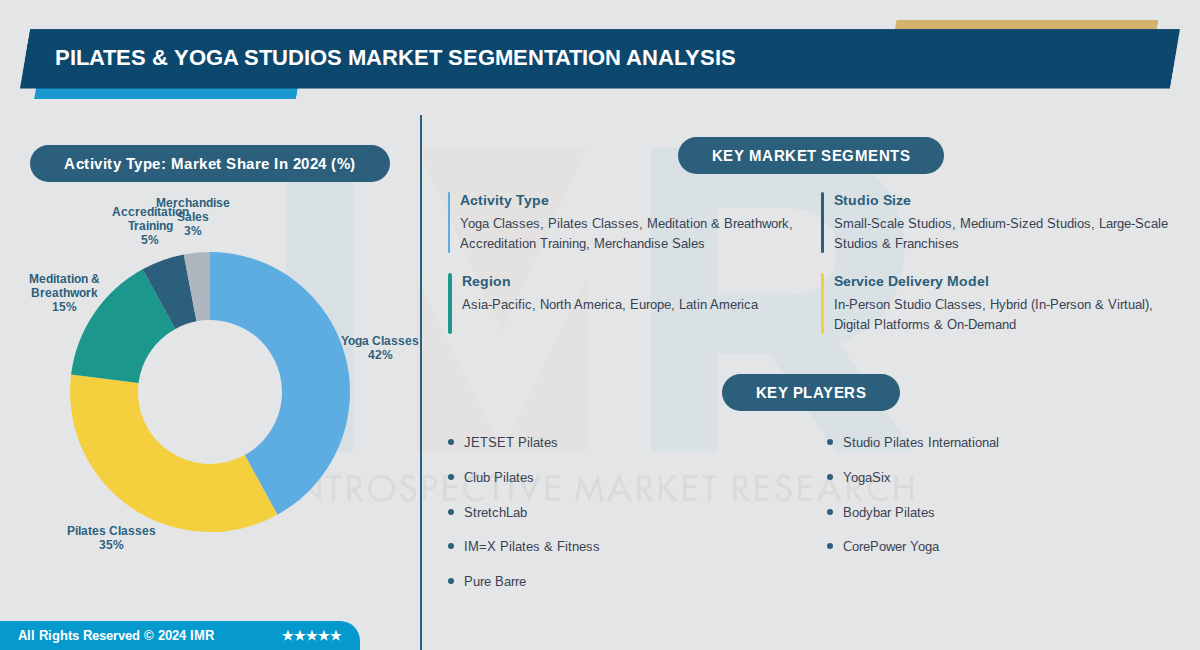
Pilates & Yoga Studios Market is Segmented on the basis of By Activity Type, By Studio Size, By Region
By Activity Type, Yoga Classes segment is expected to dominate the market during the forecast period
- Yoga classes dominate with 42% market share due to their holistic approach to physical, mental, and spiritual wellness, which aligns with WHO's Global Action Plan on Physical Activity 2018-2030 emphasizing 150 minutes of moderate intensity activity per week.
- Yoga attracts a broader demographic seeking stress management and mental health benefits, making it the most accessible and popular activity type across all studio sizes and geographic regions globally.
By Studio Size, Small-Scale Studios segment is expected to dominate the market during the forecast period
- Small-scale studios lead with 45% market share because they offer intimate and customized experiences with personalized attention, smaller group sizes, and certified instructors delivering tailored training that enhances client retention and satisfaction.
- Rising funding from non-profit organizations such as Give Back Yoga Foundation, which provides grants of USD 500-1000 to yoga teachers, supports the proliferation of small studios focused on equity, health, and community inclusiveness.
By Region, Asia-Pacific segment is expected to dominate the market during the forecast period
- Asia-Pacific and North America tie for dominance at 36% each, with Asia-Pacific experiencing the fastest growth driven by increased interest in holistic wellness, rising health consciousness, and rising disposable income in nations like China, Japan, India, and Australia.
- North America maintains its leadership position through the increasing number of yoga practitioners and rising sales of yoga equipment at different studios, supported by strong corporate wellness initiatives and established boutique studio infrastructure.
By Service Delivery Model, In-Person Studio Classes segment is expected to dominate the market during the forecast period
- In-person studio classes dominate with 70% market share because they provide the essential community atmosphere, real-time instructor feedback, and personalized corrections that drive client satisfaction and retention in boutique fitness environments.
- Hybrid and digital models are expanding rapidly as on-demand courses and digital platforms have increased accessibility while wearable fitness technology boosts participation, particularly in emerging markets where studio infrastructure is developing.
Pilates & Yoga Studios Market Regional Insights:
North America is Expected to Dominate the Market Over the Forecast Period
- North America dominates the Pilates & Yoga Studios market with over 36% share by 2035, primarily driven by the United States and Canada where mature markets show strong demand. In the U.S., 16.9% of adults practiced yoga in 2022 according to CDC data, fueling studio growth and equipment sales. This consumer sophistication supports boutique experiences and high participation rates.
- The region benefits from well-developed wellness infrastructure, high health awareness, and corporate wellness programs with insurance incentives. Flexible work routines and higher disposable incomes enable investments in memberships and private instruction. Boutique studios offering hybrid Pilates, yoga, and mobility programs enhance retention in urban fitness-conscious populations.
- Major players leverage strategic acquisitions, joint ventures, and technology integrations like app-based scheduling and analytics for expansion. Investor interest drives data-driven marketing and class optimization. Recent developments include advanced analytics for loyalty programs and hybrid models blending in-person and digital classes.
Active Key Players in the Pilates & Yoga Studios Market:
- JETSET Pilates (USA)
- Studio Pilates International (Australia)
- Club Pilates (USA)
- YogaSix (USA)
- StretchLab (USA)
- Bodybar Pilates (USA)
- IM=X Pilates & Fitness (USA)
- CorePower Yoga (USA)
- Pure Barre (USA)
- The Pilates Place (USA)
- Align Pilates (USA)
- SLT (Strengthen, Lengthen & Tone) (USA)
- Exhale Spa (USA)
- Modo Yoga (Canada)
- Hot Yoga (USA)
- Bikram Yoga (USA)
- Polestar Pilates (USA)
- Merrithew (Canada)
- Other Active Players
|
Pilates & Yoga Studios Market |
|||
|
Base Year: |
2024 |
Forecast Period: |
2024-2035 |
|
Historical Data: |
2017 to 2024 |
Market Size in 2024: |
USD 121.0 Billion |
|
Forecast Period 2024-2035 CAGR: |
14.0 % |
Market Size in 2035: |
USD 521.0 Billion |
|
Segments Covered: |
By Activity Type |
|
|
|
By Studio Size |
|
||
|
By Region |
|
||
|
By Service Delivery Model |
|
||
|
By Region |
|
||
|
Key Market Drivers: |
|
||
|
Key Market Restraints: |
|
||
|
Key Opportunities: |
|
||
|
Companies Covered in the report: |
|
||
Chapter 1: Introduction
1.1 Scope and Coverage
Chapter 2: Executive Summary
Chapter 3: Market Landscape
3.1 Market Dynamics and Opportunity Analysis
3.1.1 Growth Drivers
3.1.2 Limiting Factors
3.1.3 Growth Opportunities
3.1.4 Challenges and Risks
3.2 Market Trend Analysis
3.3 Industry Ecosystem
3.4 Industry Value Chain Mapping
3.5 Strategic PESTLE Overview
3.6 Porter's Five Forces Framework
3.7 Regulatory Framework
3.8 Pricing Trend Analysis
3.9 Intellectual Property Review
3.10 Technology Evolution
3.11 Import-Export Analysis
3.12 Consumer Behavior Analysis
3.13 Investment Pocket Analysis
3.14 Go-To Market Strategy
Chapter 4: Pilates & Yoga Studios Market by Activity Type (2017-2035)
4.1 Pilates & Yoga Studios Market Snapshot and Growth Engine
4.2 Market Overview
4.3 Yoga Classes
4.3.1 Introduction and Market Overview
4.3.2 Historic and Forecasted Market Size in Value USD and Volume Units
4.3.3 Key Market Trends, Growth Factors, and Opportunities
4.3.4 Geographic Segmentation Analysis
4.4 Pilates Classes
4.5 Meditation & Breathwork
4.6 Accreditation Training
4.7 Merchandise Sales
Chapter 5: Pilates & Yoga Studios Market by Studio Size (2017-2035)
5.1 Pilates & Yoga Studios Market Snapshot and Growth Engine
5.2 Market Overview
5.3 Small-Scale Studios
5.3.1 Introduction and Market Overview
5.3.2 Historic and Forecasted Market Size in Value USD and Volume Units
5.3.3 Key Market Trends, Growth Factors, and Opportunities
5.3.4 Geographic Segmentation Analysis
5.4 Medium-Sized Studios
5.5 Large-Scale Studios & Franchises
Chapter 6: Pilates & Yoga Studios Market by Region (2017-2035)
6.1 Pilates & Yoga Studios Market Snapshot and Growth Engine
6.2 Market Overview
6.3 Asia-Pacific
6.3.1 Introduction and Market Overview
6.3.2 Historic and Forecasted Market Size in Value USD and Volume Units
6.3.3 Key Market Trends, Growth Factors, and Opportunities
6.3.4 Geographic Segmentation Analysis
6.4 North America
6.5 Europe
6.6 Latin America
Chapter 7: Pilates & Yoga Studios Market by Service Delivery Model (2017-2035)
7.1 Pilates & Yoga Studios Market Snapshot and Growth Engine
7.2 Market Overview
7.3 In-Person Studio Classes
7.3.1 Introduction and Market Overview
7.3.2 Historic and Forecasted Market Size in Value USD and Volume Units
7.3.3 Key Market Trends, Growth Factors, and Opportunities
7.3.4 Geographic Segmentation Analysis
7.4 Hybrid (In-Person & Virtual)
7.5 Digital Platforms & On-Demand
Chapter 8: Company Profiles and Competitive Analysis
8.1 Competitive Landscape
8.1.1 Competitive Benchmarking
8.1.2 Pilates & Yoga Studios Market Share by Manufacturer/Service Provider (2024)
8.1.3 Industry BCG Matrix
8.1.4 Partnerships, Mergers & Acquisitions
8.2 JETSET PILATES
8.2.1 Company Overview
8.2.2 Key Executives
8.2.3 Company Snapshot
8.2.4 Role of the Company in the Market
8.2.5 Sustainability and Social Responsibility
8.2.6 Operating Business Segments
8.2.7 Product Portfolio
8.2.8 Business Performance
8.2.9 Recent News & Developments
8.2.10 SWOT Analysis
8.3 STUDIO PILATES INTERNATIONAL
8.4 CLUB PILATES
8.5 YOGASIX
8.6 STRETCHLAB
8.7 BODYBAR PILATES
8.8 IM=X PILATES & FITNESS
8.9 COREPOWER YOGA
8.10 PURE BARRE
8.11 THE PILATES PLACE
8.12 ALIGN PILATES
8.13 SLT (STRENGTHEN
8.14 LENGTHEN & TONE)
8.15 EXHALE SPA
8.16 MODO YOGA
8.17 HOT YOGA
8.18 BIKRAM YOGA
8.19 POLESTAR PILATES
8.20 MERRITHEW
Chapter 9: Global Pilates & Yoga Studios Market By Region
9.1 Overview
9.2. North America Pilates & Yoga Studios Market
9.2.1 Key Market Trends, Growth Factors and Opportunities
9.2.2 Top Key Companies
9.2.3 Historic and Forecasted Market Size by Segments
9.2.4 Historic and Forecast Market Size by Country
9.3. Eastern Europe Pilates & Yoga Studios Market
9.3.1 Key Market Trends, Growth Factors and Opportunities
9.3.2 Top Key Companies
9.3.3 Historic and Forecasted Market Size by Segments
9.3.4 Historic and Forecast Market Size by Country
9.4. Western Europe Pilates & Yoga Studios Market
9.4.1 Key Market Trends, Growth Factors and Opportunities
9.4.2 Top Key Companies
9.4.3 Historic and Forecasted Market Size by Segments
9.4.4 Historic and Forecast Market Size by Country
9.5. Asia Pacific Pilates & Yoga Studios Market
9.5.1 Key Market Trends, Growth Factors and Opportunities
9.5.2 Top Key Companies
9.5.3 Historic and Forecasted Market Size by Segments
9.5.4 Historic and Forecast Market Size by Country
9.6. Middle East & Africa Pilates & Yoga Studios Market
9.6.1 Key Market Trends, Growth Factors and Opportunities
9.6.2 Top Key Companies
9.6.3 Historic and Forecasted Market Size by Segments
9.6.4 Historic and Forecast Market Size by Country
9.7. South America Pilates & Yoga Studios Market
9.7.1 Key Market Trends, Growth Factors and Opportunities
9.7.2 Top Key Companies
9.7.3 Historic and Forecasted Market Size by Segments
9.7.4 Historic and Forecast Market Size by Country
Chapter 10: Analyst Viewpoint and Conclusion
Chapter 11: Research Methodology
11.1 Research Process
11.2 Primary Research
11.3 Secondary Research
Chapter 12: Case Study
Chapter 13: Appendix
13.1 Sources
13.2 List of Tables and Figures
13.3 Short Forms and Citations
13.4 Assumption and Conversion
13.5 Disclaimer
|
Pilates & Yoga Studios Market |
|||
|
Base Year: |
2024 |
Forecast Period: |
2024-2035 |
|
Historical Data: |
2017 to 2024 |
Market Size in 2024: |
USD 121.0 Billion |
|
Forecast Period 2024-2035 CAGR: |
14.0 % |
Market Size in 2035: |
USD 521.0 Billion |
|
Segments Covered: |
By Activity Type |
|
|
|
By Studio Size |
|
||
|
By Region |
|
||
|
By Service Delivery Model |
|
||
|
By Region |
|
||
|
Key Market Drivers: |
|
||
|
Key Market Restraints: |
|
||
|
Key Opportunities: |
|
||
|
Companies Covered in the report: |
|
||


