Monofilament Fishing Line Market Synopsis:
Monofilament Fishing Line Market Size Was Valued at USD 383.5 Billion in 2023, and is Projected to Reach USD 594.9 Billion by 2032, Growing at a CAGR of 5% From 2024-2032.
The monofilament fishing line market refers to the industry involved in the production and distribution of single-strand fishing lines, which are widely used in recreational, commercial, and sports fishing. These lines are made from various materials such as nylon, fluorocarbon, and copolymer, and they offer features like flexibility, strength, and resistance to abrasion, making them ideal for different fishing applications.
Monofilament fishing lines are in most cases used in fishing as they prove to be very flexible as well as strong. These lines are made from a single strand of material usually nylon but can be produced as fluorocarbon or copolymer. Monofilament fishing line industry has been on the rise because of the improvement in interest of people in fishing related activities including, fishing tournaments. With the growing trends in lightweight, durable, and low visibility lines, monofilament lines have been found to meet those customer requirements. Also, technological development has enabled the producers of these lines to increase their tensile strength while at the same time, increase their general resistance to abrasion and degradation by UV light.
The need for monofilament fishing lines is trendy because the fishing activity is becoming more popular as a recreation. This is especially a true factor in areas where people go for outing adventures for instance fishing, boating, and camping. However, the another segment of the market is occupied by the commercial fishing that utilizes monofilament lines for all kinds of nets and traps. It is used to catch species especially for sports fishing especially in competitive Continue reading → Growing concern of customer on the effect that the fishing activities are having on the environment also contribute to market trends with companies seeking sustainable materials to use.
Monofilament fishing line new products will undergo improvements due to new materials and better ways to make fishing monofilament lines and hence the market will experience growth. Manufacturers are working on creating lines that are stronger, more sensitive, and less sensitive to the effects of the environment such as the ultra violet radiation and salts. These have resulted in advancement in production of additional fishing lines that comprises different materials within one line. Further, advances in fabrication technology have also made it possible to add new characteristics to the lines including low stretch, high sensitivity, and higher break strength which have made enhanced lines exciting both for recreational as well as the professional fisherman.
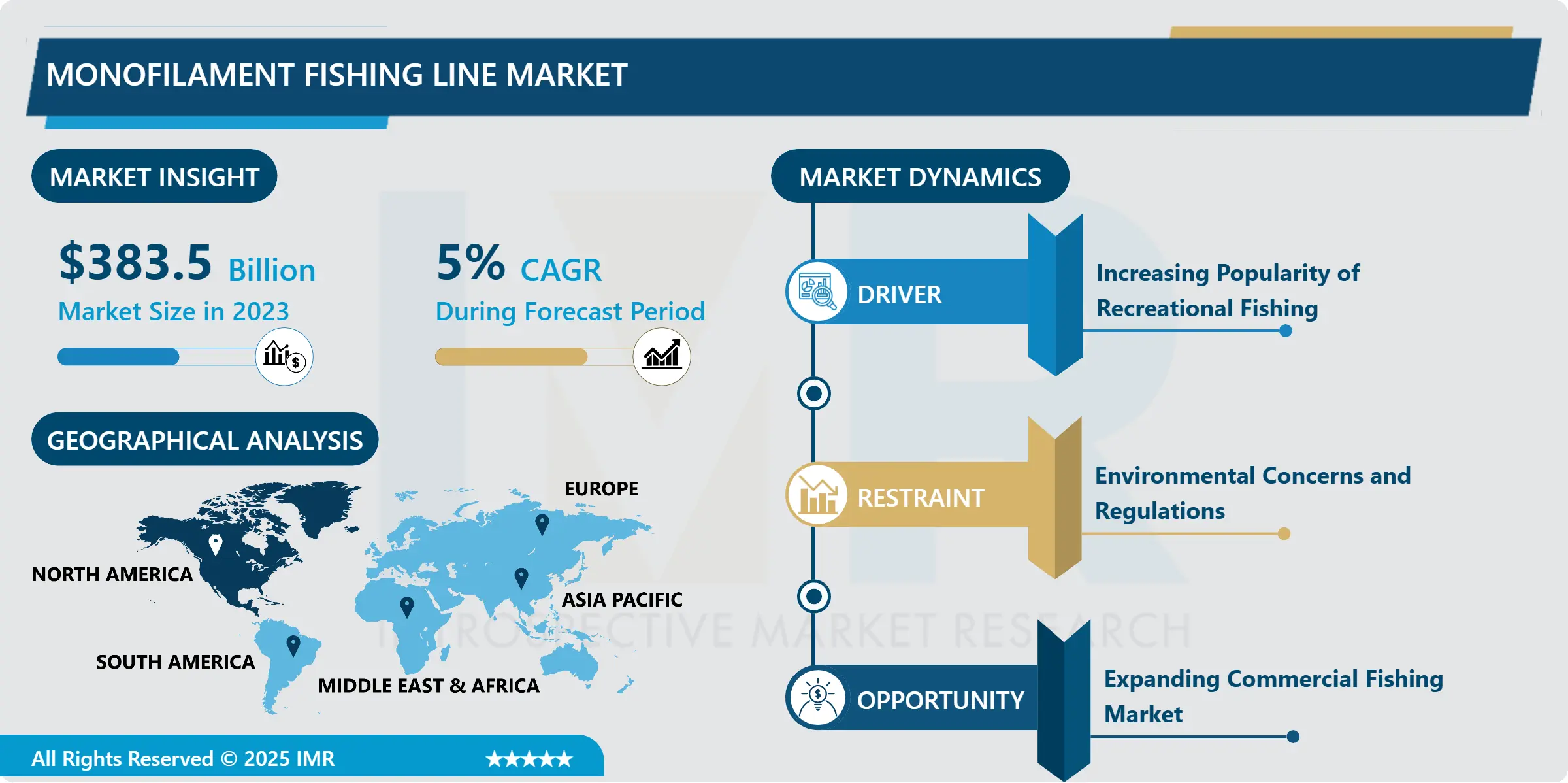
Monofilament Fishing Line Market Trend Analysis:
Technological Advancements in Line Manufacturing
- IImproved technology on the manufacturing process of monofilament fishing line, this is one of the trends in monofilament fishing line market. Major producers are integrating complex technologies and sophisticated materials in improving the fishing line. This include enhancements such as increased UV and abrasive resistance of lines.
- It is possible to meet so called hybrid monofilament lines containing different materials –nylon and fluorocarbon –in the market. These lines are a blend between a floating and a sinking line, being especially strong and not easily seen in water; these lines are ideal for both the hobby and professional fisherman since he requires different performance from his equipment. While fishing enthusiasts have insisted on their fishing lines to be more sensitive, stronger-knotted and to cast more smoothly, manufacturers have begun to employ new technologies like nanotechnology and three-dimensional extrusion techniques.
- Yet another development is the use of environmental and biodegradable monofilament fishing lines. Since more and more people all over the world are becoming conscious about the environmental effects of the use of plastics, the industry is coming up with fishing lines that have a shorter degradation period in the natural world. These sustainable products are in great demand because of the consumer’s interest in using eco-friendly merchandise, and because many parts of the world have stricter laws regarding waste and pollution.
Expanding Commercial Fishing Market
- The large-scale development of commercial fishing could pose excellent potential for growth of the monofilament fishing line business. Since more people consume seafood across the world, industrial fishing is expanding, which means that more premium long-lasting fishing lines are being required. Thanks to the type of polymer, flexibility, combined with high performance and relatively low cost, makes it suitable for use in the fishery industry including in fishing nets, traps and long line fishing gears. Moreover, opportunities in the monoculture fisheries section in aquaculture and fish farming employing monofilament lines also remain open. With these industries developing it becomes even more important to develop high quality fishing line which is suitable for ocean fishing because it is exposed to conditions such as salty air as well as UV rays.
- The increase in utilized of sustainable and responsible method in fishing commercial sectors of the global market seen to use the environmentally friendly monofilament lines. With more commercial fishing companies being pushed to reduce the impact they have on the environment in terms of sustainability, more demand is also being placed on biodegradable and eco-friendly fishing lines that offer little or no harm to the environment. This trend is, in fact, a great opportunity for the manufacturers to provide more sustainable solutions in the market. Thus, businesses can seize upon the demand for alternative, less harmful fishing equipment to increase their sales and support consumers and regulatory demand in sustainability.
Monofilament Fishing Line Market Segment Analysis:
Monofilament Fishing Line Market is Segmented on the basis of Material Type, Breaking Strength, Diameter, Distribution Channel, End User, and Region.
By Material Type, Nylon segment is expected to dominate the market during the forecast period
- The Nylon segment is projected to dominate the Monofilament Fishing Line Market during the forecast period, owing to its exceptional properties and widespread application in both commercial and recreational fishing. Nylon monofilament lines are highly favored due to their superior flexibility, high tensile strength, excellent abrasion resistance, and affordability. These characteristics make them ideal for various fishing conditions, including freshwater and saltwater environments.
- Nylon lines offer good knot strength and shock absorption, which are crucial for catching larger fish species. The ease of handling and casting further adds to their popularity among anglers of all skill levels. Manufacturers continue to innovate in nylon formulations, enhancing UV resistance and durability, thereby increasing the product's appeal and lifespan. With the consistent demand for cost-effective, high-performance fishing gear, the nylon segment is poised to maintain a dominant position in the global market throughout the forecast period.
By Application, Recreational Fishing segment expected to held the largest share
- Recreational fishing is one of the large and broad uses of monofilament fishing lines since many different people are engaged in fishing. Popular monofilament lines in this segment are for recreational fishing occasion, that may cover weekend warrior, family fishing or vacations. These lines are preferred for simplicity, cost effectiveness and reasonable power for most fresh water and salt water application.
- Monofilament lines used in different recreational fishing may vary with the colour, diameter, and strength in order to suit the various fishing situations and the type of fish targeted. It also receives a boost from the increasing fishing inclination in the Global market detailed in the areas where people look forward to engaging themselves in outdoor activities.
Monofilament Fishing Line Market Regional Insights:
North America is Expected to Dominate the Market Over the Forecast period
- North America is the market leading region in the monofilament fishing line market. This is mainly so because recreational fishing has been culture throughout the region and there is well-developed commercial and sports fishing industries in the region. Professionally, especially in the United States it is more of a hobby, where very many people go out on Fishing trips in their lifetime. Also there is active commercial fishing capacity in the U.S. that needs superior quality fishing lines for different uses. North America has been the leading region in the market also due to the high demand of the sports fishing gears especially in regions that have enough water resource of fresh water and salt water. This market is well-supported by a wealth of retail structures, popular brands, and an increasingly important focus on such aspects as sustainable fishing.
- The fishermen and fishing enthusiasts from North American region are relatively the most advanced in terms of technology in the fishing line market niche. Producers in the region are aiming at developing better, stronger, and more sustainable fishing lines which have a positive impact on the competitiveness of the region. Lecturers have also been aware of environment issues, there has been a growing market for environment friendly, biodegradable monofilament lines where manufacturers in North America have put a lot of capital into developing them. This tempered by the fact that the consumer base is large in the region and the per capita expenditure on fishing gear is relatively high in North America Thus, North American has emerged as the leader in the global monofilament fishing line market.
Active Key Players in the Monofilament Fishing Line Market:
- Shimano Inc. (Japan)
- Pure Fishing Inc. (USA)
- Daiwa Corporation (Japan)
- Sufix (USA)
- Berkley Fishing (USA)
- P-Line (USA)
- Maxima Fishing Line (Germany)
- Seaguar (USA)
- Tectan (Germany)
- Sunline Co., Ltd. (Japan)
- Okuma Fishing Tackle Co. (Taiwan)
- Momoi Fishing Line Co. (Japan), and Other Active Players
|
Global Monofilament Fishing Line Market |
|||
|
Base Year: |
2023 |
Forecast Period: |
2024-2032 |
|
Historical Data: |
2017 to 2023 |
Market Size in 2023: |
USD 383.5 Billion |
|
Forecast Period 2024-32 CAGR: |
5% |
Market Size in 2032: |
USD 594.9 Billion |
|
Segments Covered: |
By Material Type |
|
|
|
By Application |
|
||
|
By Breaking Strength |
|
||
|
By Diameter |
|
||
|
By End-User |
|
||
|
By Distribution Channel |
|
||
|
By Region |
|
||
|
Key Market Drivers: |
|
||
|
Key Market Restraints: |
|
||
|
Key Opportunities: |
|
||
|
Companies Covered in the report: |
|
||
Chapter 1: Introduction
1.1 Scope and Coverage
Chapter 2:Executive Summary
Chapter 3: Market Landscape
3.1 Market Dynamics
3.1.1 Drivers
3.1.2 Restraints
3.1.3 Opportunities
3.1.4 Challenges
3.2 Market Trend Analysis
3.3 PESTLE Analysis
3.4 Porter's Five Forces Analysis
3.5 Industry Value Chain Analysis
3.6 Ecosystem
3.7 Regulatory Landscape
3.8 Price Trend Analysis
3.9 Patent Analysis
3.10 Technology Evolution
3.11 Investment Pockets
3.12 Import-Export Analysis
Chapter 4: Monofilament Fishing Line Market by Material Type
4.1 Monofilament Fishing Line Market Snapshot and Growth Engine
4.2 Monofilament Fishing Line Market Overview
4.3 Nylon
4.3.1 Introduction and Market Overview
4.3.2 Historic and Forecasted Market Size in Value USD and Volume Units (2017-2032F)
4.3.3 Key Market Trends, Growth Factors and Opportunities
4.3.4 Nylon: Geographic Segmentation Analysis
4.4 Fluorocarbon
4.4.1 Introduction and Market Overview
4.4.2 Historic and Forecasted Market Size in Value USD and Volume Units (2017-2032F)
4.4.3 Key Market Trends, Growth Factors and Opportunities
4.4.4 Fluorocarbon: Geographic Segmentation Analysis
4.5 Copolymer
4.5.1 Introduction and Market Overview
4.5.2 Historic and Forecasted Market Size in Value USD and Volume Units (2017-2032F)
4.5.3 Key Market Trends, Growth Factors and Opportunities
4.5.4 Copolymer: Geographic Segmentation Analysis
Chapter 5: Monofilament Fishing Line Market by Application
5.1 Monofilament Fishing Line Market Snapshot and Growth Engine
5.2 Monofilament Fishing Line Market Overview
5.3 Recreational Fishing
5.3.1 Introduction and Market Overview
5.3.2 Historic and Forecasted Market Size in Value USD and Volume Units (2017-2032F)
5.3.3 Key Market Trends, Growth Factors and Opportunities
5.3.4 Recreational Fishing: Geographic Segmentation Analysis
5.4 Commercial Fishing
5.4.1 Introduction and Market Overview
5.4.2 Historic and Forecasted Market Size in Value USD and Volume Units (2017-2032F)
5.4.3 Key Market Trends, Growth Factors and Opportunities
5.4.4 Commercial Fishing: Geographic Segmentation Analysis
5.5 Sports Fishing
5.5.1 Introduction and Market Overview
5.5.2 Historic and Forecasted Market Size in Value USD and Volume Units (2017-2032F)
5.5.3 Key Market Trends, Growth Factors and Opportunities
5.5.4 Sports Fishing: Geographic Segmentation Analysis
Chapter 6: Monofilament Fishing Line Market by Breaking Strength
6.1 Monofilament Fishing Line Market Snapshot and Growth Engine
6.2 Monofilament Fishing Line Market Overview
6.3 Light
6.3.1 Introduction and Market Overview
6.3.2 Historic and Forecasted Market Size in Value USD and Volume Units (2017-2032F)
6.3.3 Key Market Trends, Growth Factors and Opportunities
6.3.4 Light: Geographic Segmentation Analysis
6.4 Medium
6.4.1 Introduction and Market Overview
6.4.2 Historic and Forecasted Market Size in Value USD and Volume Units (2017-2032F)
6.4.3 Key Market Trends, Growth Factors and Opportunities
6.4.4 Medium: Geographic Segmentation Analysis
6.5 Heavy
6.5.1 Introduction and Market Overview
6.5.2 Historic and Forecasted Market Size in Value USD and Volume Units (2017-2032F)
6.5.3 Key Market Trends, Growth Factors and Opportunities
6.5.4 Heavy: Geographic Segmentation Analysis
Chapter 7: Monofilament Fishing Line Market by Diameter
7.1 Monofilament Fishing Line Market Snapshot and Growth Engine
7.2 Monofilament Fishing Line Market Overview
7.3 Thin
7.3.1 Introduction and Market Overview
7.3.2 Historic and Forecasted Market Size in Value USD and Volume Units (2017-2032F)
7.3.3 Key Market Trends, Growth Factors and Opportunities
7.3.4 Thin: Geographic Segmentation Analysis
7.4 Medium
7.4.1 Introduction and Market Overview
7.4.2 Historic and Forecasted Market Size in Value USD and Volume Units (2017-2032F)
7.4.3 Key Market Trends, Growth Factors and Opportunities
7.4.4 Medium: Geographic Segmentation Analysis
7.5 Thick
7.5.1 Introduction and Market Overview
7.5.2 Historic and Forecasted Market Size in Value USD and Volume Units (2017-2032F)
7.5.3 Key Market Trends, Growth Factors and Opportunities
7.5.4 Thick: Geographic Segmentation Analysis
Chapter 8: Monofilament Fishing Line Market by End-User
8.1 Monofilament Fishing Line Market Snapshot and Growth Engine
8.2 Monofilament Fishing Line Market Overview
8.3 Individual Consumers
8.3.1 Introduction and Market Overview
8.3.2 Historic and Forecasted Market Size in Value USD and Volume Units (2017-2032F)
8.3.3 Key Market Trends, Growth Factors and Opportunities
8.3.4 Individual Consumers: Geographic Segmentation Analysis
8.4 Professional Fishermen
8.4.1 Introduction and Market Overview
8.4.2 Historic and Forecasted Market Size in Value USD and Volume Units (2017-2032F)
8.4.3 Key Market Trends, Growth Factors and Opportunities
8.4.4 Professional Fishermen: Geographic Segmentation Analysis
8.5 Fishing Companies
8.5.1 Introduction and Market Overview
8.5.2 Historic and Forecasted Market Size in Value USD and Volume Units (2017-2032F)
8.5.3 Key Market Trends, Growth Factors and Opportunities
8.5.4 Fishing Companies: Geographic Segmentation Analysis
Chapter 9: Monofilament Fishing Line Market by Distribution Channel
9.1 Monofilament Fishing Line Market Snapshot and Growth Engine
9.2 Monofilament Fishing Line Market Overview
9.3 Online Retail
9.3.1 Introduction and Market Overview
9.3.2 Historic and Forecasted Market Size in Value USD and Volume Units (2017-2032F)
9.3.3 Key Market Trends, Growth Factors and Opportunities
9.3.4 Online Retail: Geographic Segmentation Analysis
9.4 Offline Retail
9.4.1 Introduction and Market Overview
9.4.2 Historic and Forecasted Market Size in Value USD and Volume Units (2017-2032F)
9.4.3 Key Market Trends, Growth Factors and Opportunities
9.4.4 Offline Retail: Geographic Segmentation Analysis
Chapter 10: Company Profiles and Competitive Analysis
10.1 Competitive Landscape
10.1.1 Competitive Benchmarking
10.1.2 Monofilament Fishing Line Market Share by Manufacturer (2023)
10.1.3 Industry BCG Matrix
10.1.4 Heat Map Analysis
10.1.5 Mergers and Acquisitions
10.2 SHIMANO INC. (JAPAN)
10.2.1 Company Overview
10.2.2 Key Executives
10.2.3 Company Snapshot
10.2.4 Role of the Company in the Market
10.2.5 Sustainability and Social Responsibility
10.2.6 Operating Business Segments
10.2.7 Product Portfolio
10.2.8 Business Performance
10.2.9 Key Strategic Moves and Recent Developments
10.2.10 SWOT Analysis
10.3 PURE FISHING INC. (USA)
10.4 DAIWA CORPORATION (JAPAN)
10.5 SUFIX (USA)
10.6 BERKLEY FISHING (USA)
10.7 P-LINE (USA)
10.8 MAXIMA FISHING LINE (GERMANY)
10.9 SEAGUAR (USA)
10.10 TECTAN (GERMANY)
10.11 SUNLINE CO. LTD. (JAPAN)
10.12 OKUMA FISHING TACKLE CO. (TAIWAN)
10.13 MOMOI FISHING LINE CO. (JAPAN)
10.14 OTHER ACTIVE PLAYERS
Chapter 11: Global Monofilament Fishing Line Market By Region
11.1 Overview
11.2. North America Monofilament Fishing Line Market
11.2.1 Key Market Trends, Growth Factors and Opportunities
11.2.2 Top Key Companies
11.2.3 Historic and Forecasted Market Size by Segments
11.2.4 Historic and Forecasted Market Size By Material Type
11.2.4.1 Nylon
11.2.4.2 Fluorocarbon
11.2.4.3 Copolymer
11.2.5 Historic and Forecasted Market Size By Application
11.2.5.1 Recreational Fishing
11.2.5.2 Commercial Fishing
11.2.5.3 Sports Fishing
11.2.6 Historic and Forecasted Market Size By Breaking Strength
11.2.6.1 Light
11.2.6.2 Medium
11.2.6.3 Heavy
11.2.7 Historic and Forecasted Market Size By Diameter
11.2.7.1 Thin
11.2.7.2 Medium
11.2.7.3 Thick
11.2.8 Historic and Forecasted Market Size By End-User
11.2.8.1 Individual Consumers
11.2.8.2 Professional Fishermen
11.2.8.3 Fishing Companies
11.2.9 Historic and Forecasted Market Size By Distribution Channel
11.2.9.1 Online Retail
11.2.9.2 Offline Retail
11.2.10 Historic and Forecast Market Size by Country
11.2.10.1 US
11.2.10.2 Canada
11.2.10.3 Mexico
11.3. Eastern Europe Monofilament Fishing Line Market
11.3.1 Key Market Trends, Growth Factors and Opportunities
11.3.2 Top Key Companies
11.3.3 Historic and Forecasted Market Size by Segments
11.3.4 Historic and Forecasted Market Size By Material Type
11.3.4.1 Nylon
11.3.4.2 Fluorocarbon
11.3.4.3 Copolymer
11.3.5 Historic and Forecasted Market Size By Application
11.3.5.1 Recreational Fishing
11.3.5.2 Commercial Fishing
11.3.5.3 Sports Fishing
11.3.6 Historic and Forecasted Market Size By Breaking Strength
11.3.6.1 Light
11.3.6.2 Medium
11.3.6.3 Heavy
11.3.7 Historic and Forecasted Market Size By Diameter
11.3.7.1 Thin
11.3.7.2 Medium
11.3.7.3 Thick
11.3.8 Historic and Forecasted Market Size By End-User
11.3.8.1 Individual Consumers
11.3.8.2 Professional Fishermen
11.3.8.3 Fishing Companies
11.3.9 Historic and Forecasted Market Size By Distribution Channel
11.3.9.1 Online Retail
11.3.9.2 Offline Retail
11.3.10 Historic and Forecast Market Size by Country
11.3.10.1 Russia
11.3.10.2 Bulgaria
11.3.10.3 The Czech Republic
11.3.10.4 Hungary
11.3.10.5 Poland
11.3.10.6 Romania
11.3.10.7 Rest of Eastern Europe
11.4. Western Europe Monofilament Fishing Line Market
11.4.1 Key Market Trends, Growth Factors and Opportunities
11.4.2 Top Key Companies
11.4.3 Historic and Forecasted Market Size by Segments
11.4.4 Historic and Forecasted Market Size By Material Type
11.4.4.1 Nylon
11.4.4.2 Fluorocarbon
11.4.4.3 Copolymer
11.4.5 Historic and Forecasted Market Size By Application
11.4.5.1 Recreational Fishing
11.4.5.2 Commercial Fishing
11.4.5.3 Sports Fishing
11.4.6 Historic and Forecasted Market Size By Breaking Strength
11.4.6.1 Light
11.4.6.2 Medium
11.4.6.3 Heavy
11.4.7 Historic and Forecasted Market Size By Diameter
11.4.7.1 Thin
11.4.7.2 Medium
11.4.7.3 Thick
11.4.8 Historic and Forecasted Market Size By End-User
11.4.8.1 Individual Consumers
11.4.8.2 Professional Fishermen
11.4.8.3 Fishing Companies
11.4.9 Historic and Forecasted Market Size By Distribution Channel
11.4.9.1 Online Retail
11.4.9.2 Offline Retail
11.4.10 Historic and Forecast Market Size by Country
11.4.10.1 Germany
11.4.10.2 UK
11.4.10.3 France
11.4.10.4 The Netherlands
11.4.10.5 Italy
11.4.10.6 Spain
11.4.10.7 Rest of Western Europe
11.5. Asia Pacific Monofilament Fishing Line Market
11.5.1 Key Market Trends, Growth Factors and Opportunities
11.5.2 Top Key Companies
11.5.3 Historic and Forecasted Market Size by Segments
11.5.4 Historic and Forecasted Market Size By Material Type
11.5.4.1 Nylon
11.5.4.2 Fluorocarbon
11.5.4.3 Copolymer
11.5.5 Historic and Forecasted Market Size By Application
11.5.5.1 Recreational Fishing
11.5.5.2 Commercial Fishing
11.5.5.3 Sports Fishing
11.5.6 Historic and Forecasted Market Size By Breaking Strength
11.5.6.1 Light
11.5.6.2 Medium
11.5.6.3 Heavy
11.5.7 Historic and Forecasted Market Size By Diameter
11.5.7.1 Thin
11.5.7.2 Medium
11.5.7.3 Thick
11.5.8 Historic and Forecasted Market Size By End-User
11.5.8.1 Individual Consumers
11.5.8.2 Professional Fishermen
11.5.8.3 Fishing Companies
11.5.9 Historic and Forecasted Market Size By Distribution Channel
11.5.9.1 Online Retail
11.5.9.2 Offline Retail
11.5.10 Historic and Forecast Market Size by Country
11.5.10.1 China
11.5.10.2 India
11.5.10.3 Japan
11.5.10.4 South Korea
11.5.10.5 Malaysia
11.5.10.6 Thailand
11.5.10.7 Vietnam
11.5.10.8 The Philippines
11.5.10.9 Australia
11.5.10.10 New Zealand
11.5.10.11 Rest of APAC
11.6. Middle East & Africa Monofilament Fishing Line Market
11.6.1 Key Market Trends, Growth Factors and Opportunities
11.6.2 Top Key Companies
11.6.3 Historic and Forecasted Market Size by Segments
11.6.4 Historic and Forecasted Market Size By Material Type
11.6.4.1 Nylon
11.6.4.2 Fluorocarbon
11.6.4.3 Copolymer
11.6.5 Historic and Forecasted Market Size By Application
11.6.5.1 Recreational Fishing
11.6.5.2 Commercial Fishing
11.6.5.3 Sports Fishing
11.6.6 Historic and Forecasted Market Size By Breaking Strength
11.6.6.1 Light
11.6.6.2 Medium
11.6.6.3 Heavy
11.6.7 Historic and Forecasted Market Size By Diameter
11.6.7.1 Thin
11.6.7.2 Medium
11.6.7.3 Thick
11.6.8 Historic and Forecasted Market Size By End-User
11.6.8.1 Individual Consumers
11.6.8.2 Professional Fishermen
11.6.8.3 Fishing Companies
11.6.9 Historic and Forecasted Market Size By Distribution Channel
11.6.9.1 Online Retail
11.6.9.2 Offline Retail
11.6.10 Historic and Forecast Market Size by Country
11.6.10.1 Turkiye
11.6.10.2 Bahrain
11.6.10.3 Kuwait
11.6.10.4 Saudi Arabia
11.6.10.5 Qatar
11.6.10.6 UAE
11.6.10.7 Israel
11.6.10.8 South Africa
11.7. South America Monofilament Fishing Line Market
11.7.1 Key Market Trends, Growth Factors and Opportunities
11.7.2 Top Key Companies
11.7.3 Historic and Forecasted Market Size by Segments
11.7.4 Historic and Forecasted Market Size By Material Type
11.7.4.1 Nylon
11.7.4.2 Fluorocarbon
11.7.4.3 Copolymer
11.7.5 Historic and Forecasted Market Size By Application
11.7.5.1 Recreational Fishing
11.7.5.2 Commercial Fishing
11.7.5.3 Sports Fishing
11.7.6 Historic and Forecasted Market Size By Breaking Strength
11.7.6.1 Light
11.7.6.2 Medium
11.7.6.3 Heavy
11.7.7 Historic and Forecasted Market Size By Diameter
11.7.7.1 Thin
11.7.7.2 Medium
11.7.7.3 Thick
11.7.8 Historic and Forecasted Market Size By End-User
11.7.8.1 Individual Consumers
11.7.8.2 Professional Fishermen
11.7.8.3 Fishing Companies
11.7.9 Historic and Forecasted Market Size By Distribution Channel
11.7.9.1 Online Retail
11.7.9.2 Offline Retail
11.7.10 Historic and Forecast Market Size by Country
11.7.10.1 Brazil
11.7.10.2 Argentina
11.7.10.3 Rest of SA
Chapter 12 Analyst Viewpoint and Conclusion
12.1 Recommendations and Concluding Analysis
12.2 Potential Market Strategies
Chapter 13 Research Methodology
13.1 Research Process
13.2 Primary Research
13.3 Secondary Research
|
Global Monofilament Fishing Line Market |
|||
|
Base Year: |
2023 |
Forecast Period: |
2024-2032 |
|
Historical Data: |
2017 to 2023 |
Market Size in 2023: |
USD 383.5 Billion |
|
Forecast Period 2024-32 CAGR: |
5% |
Market Size in 2032: |
USD 594.9 Billion |
|
Segments Covered: |
By Material Type |
|
|
|
By Application |
|
||
|
By Breaking Strength |
|
||
|
By Diameter |
|
||
|
By End-User |
|
||
|
By Distribution Channel |
|
||
|
By Region |
|
||
|
Key Market Drivers: |
|
||
|
Key Market Restraints: |
|
||
|
Key Opportunities: |
|
||
|
Companies Covered in the report: |
|
||