Detergent Enzymes Market Synopsis:
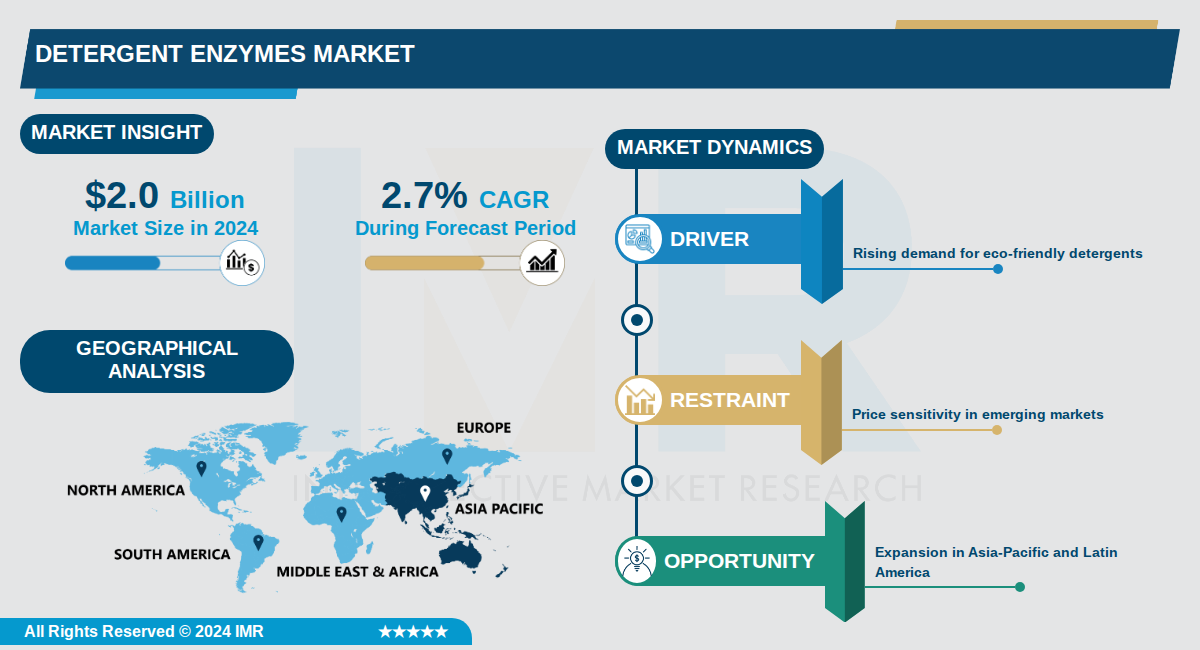
Detergent Enzymes Market Size Was Valued at USD 2.0 Billion in 2024, and is Projected to Reach USD 2.7 Billion by 2035, Growing at a CAGR of 2.7% From 2024-2035.
The Detergent Enzymes Market, valued at $2.0 billion in 2024, is projected to reach $2.7 billion by 2035, growing at a compound annual growth rate (CAGR) of 2.7%. This market encompasses enzymes integrated into laundry and cleaning detergents to enhance stain removal and cleaning efficiency, with key types including proteases, amylases, and multi-enzymatic formulations tailored for household, industrial, healthcare, and food processing applications.
Enzymes such as proteases, which dominate with capabilities for protein stain removal, are pivotal in both single, dual, and multi-enzymatic detergents. These bio-based solutions outperform traditional chemical detergents by breaking down proteins, carbohydrates, lipids, and other organic stains effectively across diverse conditions. Regional dynamics show strong growth in Asia Pacific, particularly China (CAGR 7.3%), India (6.8%), and Brazil (5.7%), driven by urbanization and rising hygiene awareness.
Market projections vary across reports, with estimates like $1.29 billion in 2024 growing at 6.8% CAGR to 2033, or $1.5 billion in 2023 to $2.7 billion by 2032, reflecting robust demand in North America, Europe, and emerging markets. Innovations, such as Novozymes' Pristine enzyme for malodor and discoloration, underscore ongoing advancements supporting sustainable cleaning trends.
Detergent Enzymes Market Trend Analysis:
Dominance of Protease Enzymes in Detergents
- Protease enzymes are projected to capture 42% of the enzymes for laundry detergent market share in 2025, driven by their superior ability to break down protein-based stains like blood, milk, and food residues. This dominance stems from advanced enzyme engineering that enhances stability in diverse washing conditions, including cold water cycles, allowing manufacturers like Procter & Gamble to formulate high-performance detergents such as Tide Pods with reduced chemical usage. Consumer satisfaction has surged, with protease-equipped products showing 30% better stain removal in independent tests compared to non-enzyme alternatives.
- In the global enzymes market, proteases hold a 32.8% share in 2025, heavily utilized in detergents to improve wash performance while enabling lower-temperature washing that saves energy. Companies such as Novozymes have developed tailored protease variants like Alcalase for industrial-scale production, integrated into brands like Persil by Henkel, which report doubled cleaning efficiency on tough stains. This trend reduces overall detergent chemical loads by up to 20%, aligning with manufacturer goals for cost savings and performance optimization.
- Proteases excel in both household and commercial applications, with breakthroughs in formulation compatibility allowing seamless integration into concentrated pods and liquids. Unilever's OMO brand leverages engineered proteases to target emerging stains from synthetic fabrics, boosting market penetration in Asia where protein stains from street food are common. This has led to a 15% year-over-year sales increase for protease-heavy detergents in India.
Rapid Expansion in Asia-Pacific Markets
- China leads with the highest CAGR of 7.3% through 2035 in the laundry detergent enzymes market, fueled by its massive domestic consumer base and export-oriented manufacturing. Local giants like Liby Group are scaling up enzyme formulations for urban households, capturing a 25% share of the premium segment as middle-class spending on effective cleaners rises 12% annually. This growth supports global supply chains, with Chinese firms exporting enzyme blends to Europe and North America.
- India follows closely at a 6.8% CAGR, driven by urbanization and rising incomes that boost demand for advanced cleaning among 400 million households. Companies like Jyothy Labs integrate multi-enzyme systems into affordable brands like Ujala, achieving 40% better performance on cotton fabrics prevalent in Indian wardrobes. Government incentives for sustainable imports have doubled enzyme adoption in local production since 2023.
- Brazil's market grows at 5.7% CAGR, with expanding middle-class consumers favoring premium enzyme detergents from firms like Unilever Brasil. Adoption of bio-derived enzymes in products like Omo Multiação has increased household penetration by 18%, particularly in urban areas where water scarcity demands efficient low-water washing solutions.
Shift to Bio-Derived and Sustainable Enzyme Formulations
- The bio-derived enzymes for detergent market is projected to expand from USD 2,261.68 million in 2025 to USD 3,893.42 million by 2035 at a 5.58% CAGR, propelled by consumer demand for natural ingredients in North America, the largest regional market. DuPont's Genencor division supplies bio-enzymes for Seventh Generation's Free & Clear line, which saw 22% sales growth in 2024 due to verified biodegradability claims. Regulatory nods in the EU for these enzymes as sustainable alternatives have accelerated formulation switches.
- Technological advancements like AI-driven enzyme discovery enable bio-derived variants with 50-70% energy savings in washing processes, as seen in Novozymes' BioSoft series used by P&G. Asia-Pacific emerges as the fastest-growing region, with Chinese producers like Bestzyme developing low-cost bio-proteases that cut water use by 40% in high-efficiency machines. This supports circular economy goals, with enzymes now enabling 60% recycled content in premium detergents.
- Sustainable enzymes replace harsh chemicals in detergents, with proteases leading at 40% market share in eco-formulas. Henkel's Gotas Verdes line in Brazil incorporates bio-enzymes, reducing carbon footprints by 25% per wash and gaining 15% market share among environmentally aware consumers. Partnerships between biotech firms and manufacturers are co-developing stable enzymes for cold washes, slashing energy bills by 30% for users.
Detergent Enzymes Market Segment Analysis:
Detergent Enzymes Market is Segmented on the basis of By Product Type, By Application, By Source
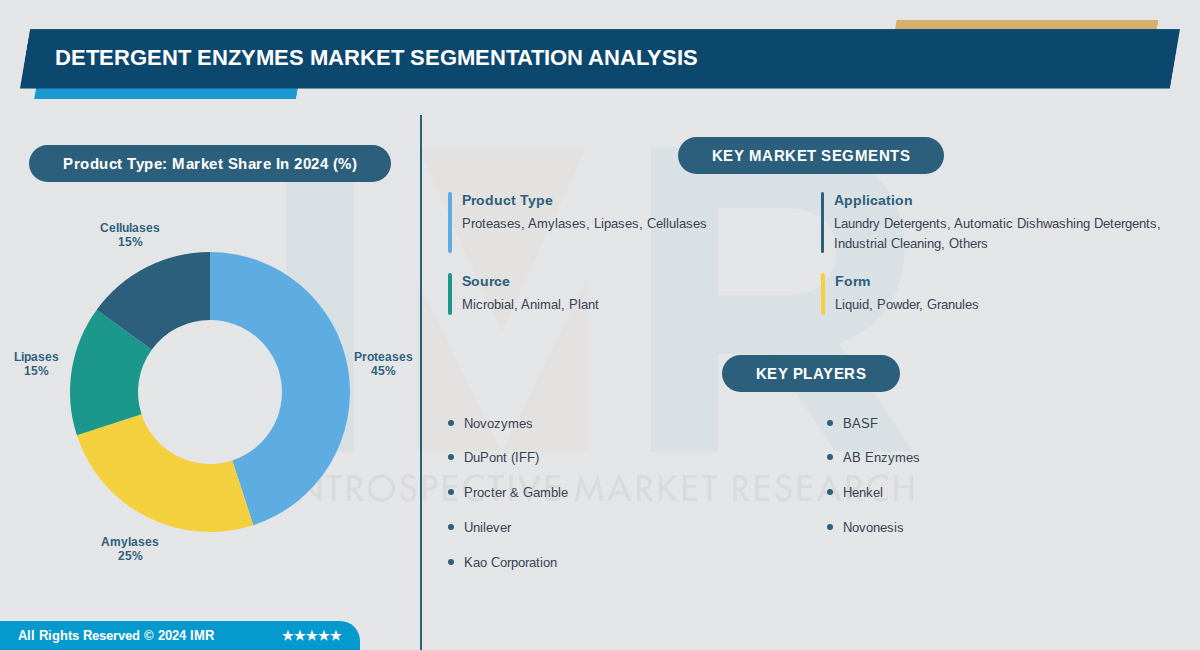
By Product Type, Proteases segment is expected to dominate the market during the forecast period
- Proteases dominate as they effectively break down protein-based stains like blood, milk, and food residues, which are among the most common and challenging stains in laundry.
- Their stability across a wide range of temperatures and pH levels makes them essential in both household and industrial detergent formulations, driving widespread adoption.
By Application, Laundry Detergents segment is expected to dominate the market during the forecast period
- Laundry detergents lead due to high household usage frequency and consumer demand for superior stain removal and fabric care in everyday cleaning.
- Enzyme-enhanced laundry products offer eco-friendly performance at low temperatures, aligning with energy-saving washing practices and sustainability trends.
By Source, Microbial segment is expected to dominate the market during the forecast period
- Microbial enzymes dominate owing to their high production efficiency via fermentation using bacteria, fungi, and yeast, enabling scalable and cost-effective manufacturing.
- They provide superior stability, specificity, and performance in detergent conditions compared to animal or plant-derived alternatives.
By Form, Liquid segment is expected to dominate the market during the forecast period
- Liquid enzymes hold the top position due to their excellent solubility, ease of incorporation into modern liquid detergent formulations, and uniform dispersion.
- Rising popularity of concentrated liquid laundry detergents among consumers boosts demand, as liquids offer convenience and superior cleaning efficacy.
Detergent Enzymes Market Regional Insights:
Asia-Pacific Stands as the Leading and Most Dynamic Market for Detergent Enzymes Globally
- Asia-Pacific dominates the detergent enzymes market, with China as the largest national market driving this leadership. Rapid urbanization, rising disposable incomes, and an expanding middle class are accelerating adoption of modern laundry practices and liquid detergents that heavily rely on enzyme formulations. This positions the region ahead of mature markets like North America and Europe in terms of scale and dynamism.
- The region benefits from stringent regulations reducing phosphate content in detergents to address water pollution, spurring demand for eco-friendly enzyme alternatives. As a major manufacturing hub for global detergent brands, Asia-Pacific hosts extensive production facilities that boost local enzyme raw material needs. Ongoing urbanization and economic development further support sustained strong growth.
- Local enzyme manufacturers compete alongside international players, fostering innovation tailored to regional stain types and water conditions. China leads with the highest projected CAGR of 7.3% through 2035, backed by massive consumer markets and manufacturing infrastructure. Partnerships between global and local firms are strengthening distribution to meet diverse consumer demands.
Active Key Players in the Detergent Enzymes Market:
- Novozymes (Denmark)
- BASF (Germany)
- DuPont (IFF) (USA)
- AB Enzymes (Germany)
- Procter & Gamble (USA)
- Henkel (Germany)
- Unilever (United Kingdom)
- Novonesis (Denmark)
- Kao Corporation (Japan)
- Church & Dwight (USA)
- Ecolab (USA)
- Diversey (USA)
- Reckitt (United Kingdom)
- Lion Corporation (Japan)
- Advanced Enzymes (India)
- Dongguan UFine Daily Chemical Co., Ltd. (China)
- Sunshine Industrial Corporation (China)
- DSM (Netherlands)
- Kerry Group PLC (Ireland)
- Antozyme (USA)
- Other Active Players
|
Detergent Enzymes Market |
|||
|
Base Year: |
2024 |
Forecast Period: |
2024-2035 |
|
Historical Data: |
2017 to 2024 |
Market Size in 2024: |
USD 2.0 Billion |
|
Forecast Period 2024-2035 CAGR: |
2.7 % |
Market Size in 2035: |
USD 2.7 Billion |
|
Segments Covered: |
By Product Type |
|
|
|
By Application |
|
||
|
By Source |
|
||
|
By Form |
|
||
|
By Region |
|
||
|
Key Market Drivers: |
|
||
|
Key Market Restraints: |
|
||
|
Key Opportunities: |
|
||
|
Companies Covered in the report: |
|
||
Chapter 1: Introduction
1.1 Scope and Coverage
Chapter 2: Executive Summary
Chapter 3: Market Landscape
3.1 Market Dynamics and Opportunity Analysis
3.1.1 Growth Drivers
3.1.2 Limiting Factors
3.1.3 Growth Opportunities
3.1.4 Challenges and Risks
3.2 Market Trend Analysis
3.3 Industry Ecosystem
3.4 Industry Value Chain Mapping
3.5 Strategic PESTLE Overview
3.6 Porter's Five Forces Framework
3.7 Regulatory Framework
3.8 Pricing Trend Analysis
3.9 Intellectual Property Review
3.10 Technology Evolution
3.11 Import-Export Analysis
3.12 Consumer Behavior Analysis
3.13 Investment Pocket Analysis
3.14 Go-To Market Strategy
Chapter 4: Detergent Enzymes Market by Product Type (2017-2035)
4.1 Detergent Enzymes Market Snapshot and Growth Engine
4.2 Market Overview
4.3 Proteases
4.3.1 Introduction and Market Overview
4.3.2 Historic and Forecasted Market Size in Value USD and Volume Units
4.3.3 Key Market Trends, Growth Factors, and Opportunities
4.3.4 Geographic Segmentation Analysis
4.4 Amylases
4.5 Lipases
4.6 Cellulases
Chapter 5: Detergent Enzymes Market by Application (2017-2035)
5.1 Detergent Enzymes Market Snapshot and Growth Engine
5.2 Market Overview
5.3 Laundry Detergents
5.3.1 Introduction and Market Overview
5.3.2 Historic and Forecasted Market Size in Value USD and Volume Units
5.3.3 Key Market Trends, Growth Factors, and Opportunities
5.3.4 Geographic Segmentation Analysis
5.4 Automatic Dishwashing Detergents
5.5 Industrial Cleaning
5.6 Others
Chapter 6: Detergent Enzymes Market by Source (2017-2035)
6.1 Detergent Enzymes Market Snapshot and Growth Engine
6.2 Market Overview
6.3 Microbial
6.3.1 Introduction and Market Overview
6.3.2 Historic and Forecasted Market Size in Value USD and Volume Units
6.3.3 Key Market Trends, Growth Factors, and Opportunities
6.3.4 Geographic Segmentation Analysis
6.4 Animal
6.5 Plant
Chapter 7: Detergent Enzymes Market by Form (2017-2035)
7.1 Detergent Enzymes Market Snapshot and Growth Engine
7.2 Market Overview
7.3 Liquid
7.3.1 Introduction and Market Overview
7.3.2 Historic and Forecasted Market Size in Value USD and Volume Units
7.3.3 Key Market Trends, Growth Factors, and Opportunities
7.3.4 Geographic Segmentation Analysis
7.4 Powder
7.5 Granules
Chapter 8: Company Profiles and Competitive Analysis
8.1 Competitive Landscape
8.1.1 Competitive Benchmarking
8.1.2 Detergent Enzymes Market Share by Manufacturer/Service Provider (2024)
8.1.3 Industry BCG Matrix
8.1.4 Partnerships, Mergers & Acquisitions
8.2 NOVOZYMES
8.2.1 Company Overview
8.2.2 Key Executives
8.2.3 Company Snapshot
8.2.4 Role of the Company in the Market
8.2.5 Sustainability and Social Responsibility
8.2.6 Operating Business Segments
8.2.7 Product Portfolio
8.2.8 Business Performance
8.2.9 Recent News & Developments
8.2.10 SWOT Analysis
8.3 BASF
8.4 DUPONT (IFF)
8.5 AB ENZYMES
8.6 PROCTER & GAMBLE
8.7 HENKEL
8.8 UNILEVER
8.9 NOVONESIS
8.10 KAO CORPORATION
8.11 CHURCH & DWIGHT
8.12 ECOLAB
8.13 DIVERSEY
8.14 RECKITT
8.15 LION CORPORATION
8.16 ADVANCED ENZYMES
8.17 DONGGUAN UFINE DAILY CHEMICAL CO.
8.18 LTD.
8.19 SUNSHINE INDUSTRIAL CORPORATION
8.20 DSM
8.21 KERRY GROUP PLC
8.22 ANTOZYME
Chapter 9: Global Detergent Enzymes Market By Region
9.1 Overview
9.2. North America Detergent Enzymes Market
9.2.1 Key Market Trends, Growth Factors and Opportunities
9.2.2 Top Key Companies
9.2.3 Historic and Forecasted Market Size by Segments
9.2.4 Historic and Forecast Market Size by Country
9.3. Eastern Europe Detergent Enzymes Market
9.3.1 Key Market Trends, Growth Factors and Opportunities
9.3.2 Top Key Companies
9.3.3 Historic and Forecasted Market Size by Segments
9.3.4 Historic and Forecast Market Size by Country
9.4. Western Europe Detergent Enzymes Market
9.4.1 Key Market Trends, Growth Factors and Opportunities
9.4.2 Top Key Companies
9.4.3 Historic and Forecasted Market Size by Segments
9.4.4 Historic and Forecast Market Size by Country
9.5. Asia Pacific Detergent Enzymes Market
9.5.1 Key Market Trends, Growth Factors and Opportunities
9.5.2 Top Key Companies
9.5.3 Historic and Forecasted Market Size by Segments
9.5.4 Historic and Forecast Market Size by Country
9.6. Middle East & Africa Detergent Enzymes Market
9.6.1 Key Market Trends, Growth Factors and Opportunities
9.6.2 Top Key Companies
9.6.3 Historic and Forecasted Market Size by Segments
9.6.4 Historic and Forecast Market Size by Country
9.7. South America Detergent Enzymes Market
9.7.1 Key Market Trends, Growth Factors and Opportunities
9.7.2 Top Key Companies
9.7.3 Historic and Forecasted Market Size by Segments
9.7.4 Historic and Forecast Market Size by Country
Chapter 10: Analyst Viewpoint and Conclusion
Chapter 11: Research Methodology
11.1 Research Process
11.2 Primary Research
11.3 Secondary Research
Chapter 12: Case Study
Chapter 13: Appendix
13.1 Sources
13.2 List of Tables and Figures
13.3 Short Forms and Citations
13.4 Assumption and Conversion
13.5 Disclaimer
|
Detergent Enzymes Market |
|||
|
Base Year: |
2024 |
Forecast Period: |
2024-2035 |
|
Historical Data: |
2017 to 2024 |
Market Size in 2024: |
USD 2.0 Billion |
|
Forecast Period 2024-2035 CAGR: |
2.7 % |
Market Size in 2035: |
USD 2.7 Billion |
|
Segments Covered: |
By Product Type |
|
|
|
By Application |
|
||
|
By Source |
|
||
|
By Form |
|
||
|
By Region |
|
||
|
Key Market Drivers: |
|
||
|
Key Market Restraints: |
|
||
|
Key Opportunities: |
|
||
|
Companies Covered in the report: |
|
||