




Key Market Highlights
Dental Sterilization Market Size was valued at USD 1.63 billion in 2024, and is projected to reach USD 4.12 billion by 2035, growing at a CAGR of 8.8% from 2025–2035
-
Market Size in 2024: USD 1.63 billion
- Projected Market Size by 2035: USD 4.12 billion
- CAGR (2025–2035): 8.8%
- Leading Market in 2024: North America
- Fastest-Growing Market: Asia-Pacific
- By Type: The instruments segment is anticipated to lead the market by accounting for 35% of the market share throughout the forecast period.
- By Application: The Heat/Steam sterilization segment is expected to capture 38% of the market share, thereby maintaining its dominance over the forecast period.
- By Region: North America region is projected to hold 34% of the market share during the forecast period.
- Active Players: A-dec Inc. (United States), Ancar Dental (Spain), Beyes Dental Canada Inc. (Canada), Careclave (by Melag) (Germany), Denstar Co., Ltd. (South Korea) Other Active Players
Dental Sterilization Market Synopsis:
The Dental Sterilization Market focuses on the tools, equipment, and processes used to clean, disinfect, and sterilize dental instruments and environments. The goal is to prevent cross-contamination and infection during dental procedures, ensuring both patient and staff safety.
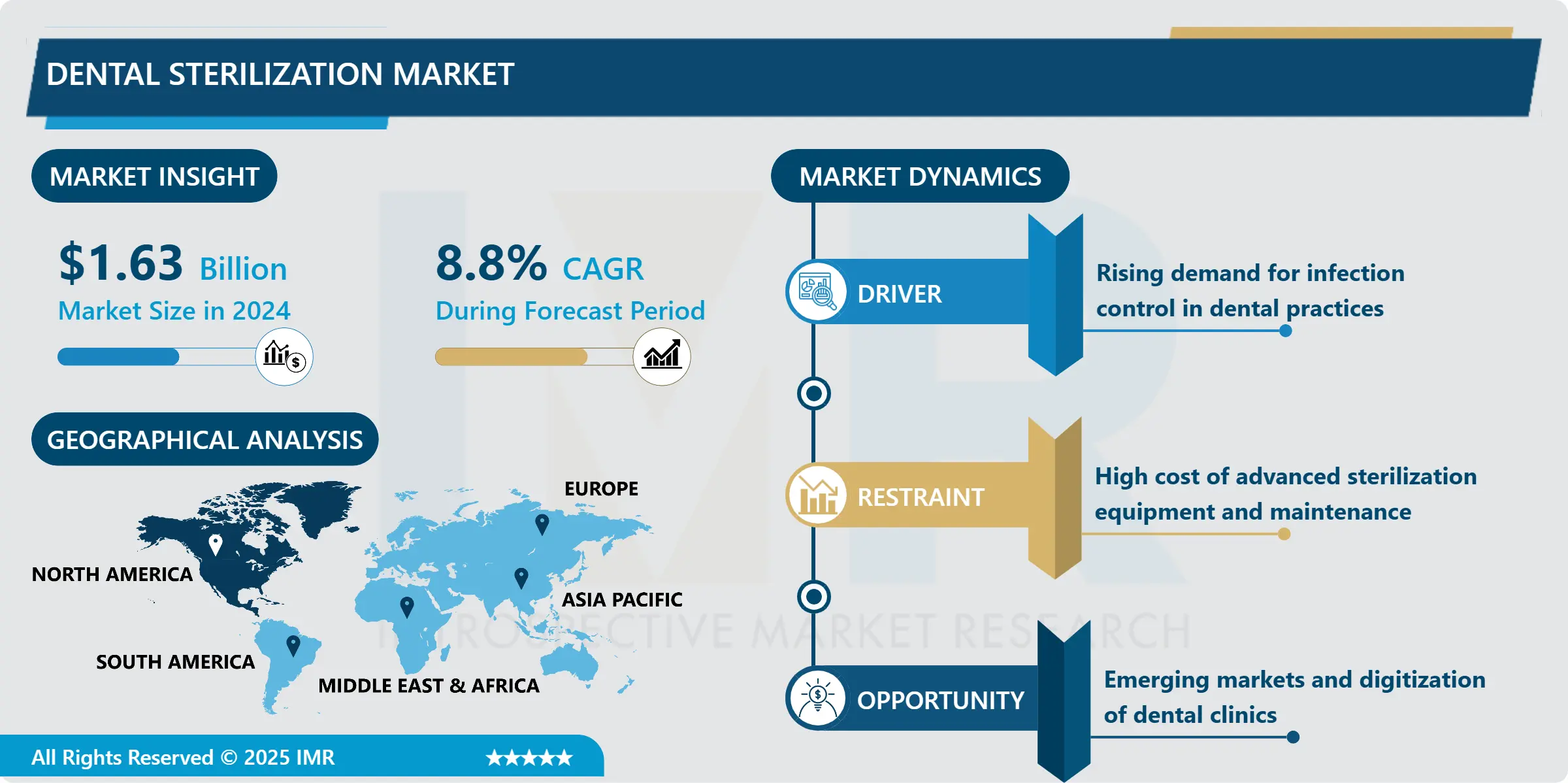
Dental Sterilization Market Dynamics and Trend Analysis:
Dental Sterilization Market Growth Driver - Rising demand for infection control in dental practices
-
In recent years, there has been a strong rise in the demand for better infection control in dental clinics. This is mainly because both patients and dental professionals are becoming more aware of the risks related to cross-contamination. Cross-contamination happens when germs or bacteria are passed from one patient to another through unclean tools, surfaces, or hands. This can lead to serious health problems, so proper cleaning and sterilization of dental equipment is now more important than ever.
- To prevent such risks, many dental clinics are adopting advanced sterilization technologies. These include modern autoclaves, ultrasonic cleaners, and chemical disinfectants that kill bacteria and viruses quickly and effectively. Along with this, global health authorities such as OSHA, CDC, and the American Dental Association (ADA) have set strict rules and standards for dental clinics to follow. These rules make it necessary for clinics to clean and sterilize tools after every use, which has pushed the demand for high-quality sterilization equipment even higher.
- Another reason for this rising demand is the growing popularity of dental tourism and cosmetic dentistry. More people are traveling to other countries for affordable dental care, and they expect safe and hygienic treatment. To meet these expectations and build trust, dental clinics must follow strict infection control protocols, creating more need for sterilization products and systems.
Dental Sterilization Market Limiting Factor - High cost of advanced sterilization equipment and maintenance
-
One of the main challenges in the dental sterilization market is the high cost of modern equipment. Advanced machines like autoclaves, ultrasonic cleaners, and automated disinfection systems are often very expensive. These devices are important for making sure dental tools are properly cleaned and safe to use, but buying them requires a large investment.
- For big hospitals or well-funded dental chains, the cost may not be a major issue. However, small or rural dental clinics often have limited budgets. For these practices, purchasing high-end sterilization tools can be difficult. This can lead to slower adoption of proper sterilization technologies in some areas, especially in developing regions where resources are limited.
- In addition to the initial cost, ongoing expenses are another concern. Sterilization machines need regular maintenance, cleaning, and professional calibration to work effectively. If a machine breaks down or doesn’t meet safety standards, it can pose risks to patients and may require costly repairs or replacement.
- Staff must also be properly trained to use the equipment correctly, which adds to operational costs. All of these expenses buying the machines, maintaining them, and training staff make advanced sterilization technology less accessible for smaller clinics. As a result, some may continue using outdated or less effective methods, which increases the risk of infection.
Dental Sterilization Market Expansion Opportunity - emerging markets and digitization of dental clinics
-
The dental sterilization market is seeing big opportunities in emerging markets such as Asia-Pacific, Latin America, and Africa. In these regions, the demand for dental care is growing quickly. More people now have access to dental services thanks to improving healthcare systems, rising incomes, and greater awareness about oral health. As new dental clinics open and expand in these areas, there is also a growing need for reliable sterilization equipment to ensure patient safety.
- Alongside this growth, many dental clinics are becoming more digital and automated. New technologies, such as IoT-enabled (Internet of Things) sterilization systems, are being introduced. These smart devices can track sterilization cycles, alert staff when maintenance is needed, and even store data for quality control. This kind of automation helps clinics improve their efficiency and maintain higher hygiene standards with less human error. It also creates new business opportunities for companies that develop and sell these technologies.
- Governments in many emerging countries are also playing an important role. Through public health campaigns and safety regulations, they are encouraging or even requiring dental clinics to follow strict hygiene practices. These policies are helping raise the standard of dental care and increasing the demand for modern sterilization tools. Together, these trends make emerging markets an important area for future growth and innovation in the dental sterilization industry.
Dental Sterilization Market Challenge and Risk - compliance variability and counterfeit equipment risks
-
One of the major challenges in the dental sterilization market is the lack of consistent rules and enforcement across different countries. In some places, governments have strong regulations that require dental clinics to use certified sterilization equipment and follow strict hygiene practices. But in other regions, the rules are weak, outdated, or not enforced properly. This inconsistency makes it hard for sterilization companies to expand their products into new markets, as the demand and standards vary widely.
- Another serious issue is the presence of counterfeit or low-quality sterilization equipment, especially in markets with little regulation. These fake or poorly made devices may be cheaper, but they often do not meet safety standards. Using such equipment can put patients at risk of infection and harm the reputation of clinics. It also damages brand trust for manufacturers who sell genuine, high-quality products, making it difficult for them to compete.
- In addition, some dental professionals are still resistant to change. They may be used to older methods or unwilling to invest time and money into learning how to use new technologies. This slows down the adoption of modern sterilization systems, even when they are available and beneficial.
- Together, these factors create risks and barriers that can limit the growth of the dental sterilization market, especially in developing regions.
Dental Sterilization Market Segment Analysis:
Dental Sterilization Market is segmented based on Type, Application, End-Users, and Region
By Type, Dental Sterilization Segment is Expected to Dominate the Market During the Forecast Period
-
In the dental sterilization market, instruments make up around 45% of the total market share. This segment mainly includes essential equipment such as autoclaves, ultrasonic cleaners, and washer-disinfectors. These machines play a vital role in ensuring all dental tools are free from harmful microorganisms before being reused on patients.
- Autoclaves are the most common sterilization machines used in dental clinics. They use high-pressure steam to kill bacteria, viruses, and spores on dental instruments. Their reliability, efficiency, and compliance with safety standards make them a preferred choice worldwide.
- Ultrasonic cleaners are used before sterilization to remove debris, saliva, or blood from instruments. These machines use high-frequency sound waves to create microscopic bubbles in a cleaning solution. These bubbles scrub the instruments gently and thoroughly, reaching areas that are difficult to clean manually.
- Washer-disinfectors are automated machines that clean and disinfect instruments in a controlled and consistent way. They help reduce the risk of human error, lower the chances of cross-contamination, and improve workflow in busy dental clinics.
- Overall, these instruments form the foundation of infection control in dentistry. As awareness of hygiene and patient safety grows, dental clinics across the world are investing in modern, automated, and eco-friendly sterilization equipment driving continued growth in this market segment.
By Application, Dental Sterilization Market Segment Held the Largest Share in 2024
-
Heat/Steam sterilization, primarily done using autoclaves, accounts for approximately 60% of the dental sterilization market. This method is the most widely used across dental practices worldwide because it is highly effective in killing bacteria, viruses, fungi, and even resistant spores.
- Autoclaves work by using high-pressure steam at elevated temperatures (usually around 121°C to 134°C) for a specific period of time. This ensures that all microorganisms on dental instruments are destroyed, making the tools completely safe for reuse. Because it is a well-established and proven method, it is accepted by global health and safety organizations like the CDC, ADA, and WHO.
- One of the main reasons for the popularity of heat/steam sterilization is its cost-efficiency. Autoclaves are relatively affordable compared to other advanced sterilization technologies, and they have low operating costs. They are also available in a range of sizes, making them suitable for both small dental clinics and large hospital-based dental units.
- Moreover, autoclaves are easy to use, require minimal training, and are compatible with most types of reusable dental tools. Their reliability, speed, and regulatory acceptance make them the preferred choice for infection control in dentistry. As a result, the demand for heat/steam sterilization continues to grow, especially in regions with high standards for hygiene and patient safety.
Dental Sterilization Market Regional Insights:
North America is Expected to Dominate the Market Over the Forecast Period
-
North America holds the leading position in the global dental sterilization market, driven by stringent infection control regulations, a highly developed healthcare infrastructure, and increased awareness among both dental professionals and patients. The United States and Canada are the key contributors to the region’s market share, with government agencies such as OSHA, CDC, and ADA enforcing strict sterilization protocols in dental practices. This regulatory environment has led to widespread adoption of advanced sterilization technologies, including autoclaves, ultrasonic cleaners, and IoT-enabled disinfection systems. The presence of major players such as Dentsply Sirona, Midmark Corporation, and Steris plc further strengthens the region’s market leadership by offering a wide range of innovative and reliable sterilization solutions.
- In recent years, there has been a growing trend toward automation and digitalization in dental clinics across North America. Practices are increasingly investing in smart sterilization units that offer better efficiency, tracking, and compliance reporting. Additionally, the demand for eco-friendly and energy-efficient sterilization devices is rising, reflecting a broader shift toward sustainable healthcare practices. Large dental chains and group practices are also centralizing their sterilization processes to improve operational efficiency and ensure consistent hygiene standards. Given the strong regulatory support, technological advancements, and a mature dental care ecosystem, the North American dental sterilization market is expected to maintain robust growth in the coming years.
Dental Sterilization Market Active Players:
- A-dec Inc. (United States)
- Ancar Dental (Spain)
- Beyes Dental Canada Inc. (Canada)
- Careclave (by Melag) (Germany)
- Denstar Co., Ltd. (South Korea)
- Dentsply Sirona (United States)
- DÜRR Dental SE (Germany)
- Envista Holdings (KaVo Kerr) (United States)
- FONA Dental (Slovakia)
- Getinge AB (Sweden)
- Gnatus Equipamentos Odontológicos (Brazil)
- Hefei MYCO Medical Technology (China)
- Heka Dental A/S (Denmark)
- Hu-Friedy (now part of Cantel Medical/Steris) (United States)
- IC Medical GmbH (Germany)
- Laoken Medical Technology Co., Ltd. (China)
- Midmark Corporation (United States)
- Miele Group (Professional Division) (Germany)
- Mocom (Cefla Group) (Italy)
- NSK Nakanishi Inc. (Japan)
- Prestige Medical Ltd. (United Kingdom)
- Runyes Medical Instrument Co., Ltd. (China)
- SciCan Ltd. (A Division of Coltene) (Canada)
- Sinol Dental Limited (China)
- Steris plc (United States / United Kingdom)
- Tuttnauer Co. Ltd. (Israel)
- W&H Dentalwerk Bürmoos GmbH (Austria)
- Woson Medical (China)
- YOUNG Innovations, Inc. (United States)
- Zhermack SpA (Italy)
- Other Active Players
|
Dental Sterilization Market |
|||
|
Base Year: |
2024 |
Forecast Period: |
2025-2035 |
|
Historical Data: |
2018 to 2024 |
Market Size in 2024: |
USD 1.63 billion
|
|
Forecast Period 2025-35 CAGR: |
8.8% |
Market Size in 2035: |
USD 4.12 billion |
|
Segments Covered: |
By Product Type |
|
|
|
By Sterilization Method
|
|
||
|
By End User |
|
||
|
By Region |
|
||
|
Growth Driver: |
|
||
|
Limiting Factor |
|
||
|
Expansion Opportunity |
|
||
|
Challenge and Risk |
|
||
|
Companies Covered in the Report: |
|
||
Chapter 1: Introduction
1.1 Scope and Coverage
Chapter 2:Executive Summary
Chapter 3: Market Landscape
3.1 Market Dynamics and Opportunity Analysis
3.1.1 Growth Drivers
3.1.2 Limiting Factors
3.1.3 Growth Opportunities
3.1.4 Challenges and Risks
3.2 Market Trend Analysis
3.3 Industry Ecosystem
3.4 Industry Value Chain Mapping
3.5 Strategic PESTLE Overview
3.6 Porter's Five Forces Framework
3.7 Regulatory Framework
3.8 Pricing Trend Analysis
3.9 Intellectual Property Review
3.10 Technology Evolution
3.11 Import-Export Analysis
3.12 Consumer Behavior Analysis
3.13 Investment Pocket Analysis
3.14 Go-To Market Strategy
Chapter 4: Dental Sterilization Market by Product (2018-2035)
4.1 Dental Sterilization Market Snapshot and Growth Engine
4.2 Market Overview
4.3 Instruments
4.3.1 Introduction and Market Overview
4.3.2 Historic and Forecasted Market Size in Value USD and Volume Units
4.3.3 Key Market Trends, Growth Factors, and Opportunities
4.3.4 Geographic Segmentation Analysis
4.4 Consumables & Accessories
Chapter 5: Dental Sterilization Market by Sterilization Method (2018-2035)
5.1 Dental Sterilization Market Snapshot and Growth Engine
5.2 Market Overview
5.3 Heat/Steam
5.3.1 Introduction and Market Overview
5.3.2 Historic and Forecasted Market Size in Value USD and Volume Units
5.3.3 Key Market Trends, Growth Factors, and Opportunities
5.3.4 Geographic Segmentation Analysis
5.4 Hydrogen-Peroxide Plasma
5.5 Ethylene Oxide
5.6 and More
Chapter 6: Dental Sterilization Market by End User (2018-2035)
6.1 Dental Sterilization Market Snapshot and Growth Engine
6.2 Market Overview
6.3 Hospitals
6.3.1 Introduction and Market Overview
6.3.2 Historic and Forecasted Market Size in Value USD and Volume Units
6.3.3 Key Market Trends, Growth Factors, and Opportunities
6.3.4 Geographic Segmentation Analysis
6.4 Clinics
6.5 Dental Laboratories
6.6 Academic & Research Institutes
Chapter 7: Company Profiles and Competitive Analysis
7.1 Competitive Landscape
7.1.1 Competitive Benchmarking
7.1.2 Dental Sterilization Market Share by Manufacturer/Service Provider(2024)
7.1.3 Industry BCG Matrix
7.1.4 PArtnerships, Mergers & Acquisitions
7.2 A-DEC INC. (UNITED STATES)
7.2.1 Company Overview
7.2.2 Key Executives
7.2.3 Company Snapshot
7.2.4 Role of the Company in the Market
7.2.5 Sustainability and Social Responsibility
7.2.6 Operating Business Segments
7.2.7 Product Portfolio
7.2.8 Business Performance
7.2.9 Recent News & Developments
7.2.10 SWOT Analysis
7.3 ANCAR DENTAL (SPAIN)
7.4 BEYES DENTAL CANADA INC. (CANADA)
7.5 CARECLAVE (BY MELAG) (GERMANY)
7.6 DENSTAR CO.
7.7 LTD. (SOUTH KOREA)
7.8 DENTSPLY SIRONA (UNITED STATES)
7.9 DÜRR DENTAL SE (GERMANY)
7.10 ENVISTA HOLDINGS (KAVO KERR) (UNITED STATES)
7.11 FONA DENTAL (SLOVAKIA)
7.12 GETINGE AB (SWEDEN)
7.13 GNATUS EQUIPAMENTOS ODONTOLÓGICOS (BRAZIL)
7.14 HEFEI MYCO MEDICAL TECHNOLOGY (CHINA)
7.15 HEKA DENTAL A/S (DENMARK)
7.16 HU-FRIEDY (NOW PART OF CANTEL MEDICAL/STERIS) (UNITED STATES)
7.17 IC MEDICAL GMBH (GERMANY)
7.18 LAOKEN MEDICAL TECHNOLOGY CO.
7.19 LTD. (CHINA)
7.20 MIDMARK CORPORATION (UNITED STATES)
7.21 MIELE GROUP (PROFESSIONAL DIVISION) (GERMANY)
7.22 MOCOM (CEFLA GROUP) (ITALY)
7.23 NSK NAKANISHI INC. (JAPAN)
7.24 PRESTIGE MEDICAL LTD. (UNITED KINGDOM)
7.25 RUNYES MEDICAL INSTRUMENT CO.
7.26 LTD. (CHINA)
7.27 SCICAN LTD. (A DIVISION OF COLTENE) (CANADA)
7.28 SINOL DENTAL LIMITED (CHINA)
7.29 STERIS PLC (UNITED STATES / UNITED KINGDOM)
7.30 TUTTNAUER CO. LTD. (ISRAEL)
7.31 W&H DENTALWERK BÜRMOOS GMBH (AUSTRIA)
7.32 WOSON MEDICAL (CHINA)
7.33 YOUNG INNOVATIONS
7.34 INC. (UNITED STATES)
7.35 ZHERMACK SPA (ITALY)
7.36 AND OTHER ACTIVE PLAYERS.
Chapter 8: Global Dental Sterilization Market By Region
8.1 Overview
8.2. North America Dental Sterilization Market
8.2.1 Key Market Trends, Growth Factors and Opportunities
8.2.2 Top Key Companies
8.2.3 Historic and Forecasted Market Size by Segments
8.2.4 Historic and Forecast Market Size by Country
8.2.4.1 US
8.2.4.2 Canada
8.2.4.3 Mexico
8.3. Eastern Europe Dental Sterilization Market
8.3.1 Key Market Trends, Growth Factors and Opportunities
8.3.2 Top Key Companies
8.3.3 Historic and Forecasted Market Size by Segments
8.3.4 Historic and Forecast Market Size by Country
8.3.4.1 Russia
8.3.4.2 Bulgaria
8.3.4.3 The Czech Republic
8.3.4.4 Hungary
8.3.4.5 Poland
8.3.4.6 Romania
8.3.4.7 Rest of Eastern Europe
8.4. Western Europe Dental Sterilization Market
8.4.1 Key Market Trends, Growth Factors and Opportunities
8.4.2 Top Key Companies
8.4.3 Historic and Forecasted Market Size by Segments
8.4.4 Historic and Forecast Market Size by Country
8.4.4.1 Germany
8.4.4.2 UK
8.4.4.3 France
8.4.4.4 The Netherlands
8.4.4.5 Italy
8.4.4.6 Spain
8.4.4.7 Rest of Western Europe
8.5. Asia Pacific Dental Sterilization Market
8.5.1 Key Market Trends, Growth Factors and Opportunities
8.5.2 Top Key Companies
8.5.3 Historic and Forecasted Market Size by Segments
8.5.4 Historic and Forecast Market Size by Country
8.5.4.1 China
8.5.4.2 India
8.5.4.3 Japan
8.5.4.4 South Korea
8.5.4.5 Malaysia
8.5.4.6 Thailand
8.5.4.7 Vietnam
8.5.4.8 The Philippines
8.5.4.9 Australia
8.5.4.10 New Zealand
8.5.4.11 Rest of APAC
8.6. Middle East & Africa Dental Sterilization Market
8.6.1 Key Market Trends, Growth Factors and Opportunities
8.6.2 Top Key Companies
8.6.3 Historic and Forecasted Market Size by Segments
8.6.4 Historic and Forecast Market Size by Country
8.6.4.1 Turkiye
8.6.4.2 Bahrain
8.6.4.3 Kuwait
8.6.4.4 Saudi Arabia
8.6.4.5 Qatar
8.6.4.6 UAE
8.6.4.7 Israel
8.6.4.8 South Africa
8.7. South America Dental Sterilization Market
8.7.1 Key Market Trends, Growth Factors and Opportunities
8.7.2 Top Key Companies
8.7.3 Historic and Forecasted Market Size by Segments
8.7.4 Historic and Forecast Market Size by Country
8.7.4.1 Brazil
8.7.4.2 Argentina
8.7.4.3 Rest of SA
Chapter 9 Analyst Viewpoint and Conclusion
Chapter 10 Our Thematic Research Methodology
10.1 Research Process
10.2 Primary Research
10.3 Secondary Research
Chapter 11 Case Study
Chapter 12 Appendix
12.1 Sources
12.2 List of Tables and figures
12.3 Short Forms and Citations
12.4 Assumption and Conversion
12.5 Disclaimer
|
Dental Sterilization Market |
|||
|
Base Year: |
2024 |
Forecast Period: |
2025-2035 |
|
Historical Data: |
2018 to 2024 |
Market Size in 2024: |
USD 1.63 billion
|
|
Forecast Period 2025-35 CAGR: |
8.8% |
Market Size in 2035: |
USD 4.12 billion |
|
Segments Covered: |
By Product Type |
|
|
|
By Sterilization Method
|
|
||
|
By End User |
|
||
|
By Region |
|
||
|
Growth Driver: |
|
||
|
Limiting Factor |
|
||
|
Expansion Opportunity |
|
||
|
Challenge and Risk |
|
||
|
Companies Covered in the Report: |
|
||


