




Carbon Fiber Bicycle Market Synopsis:
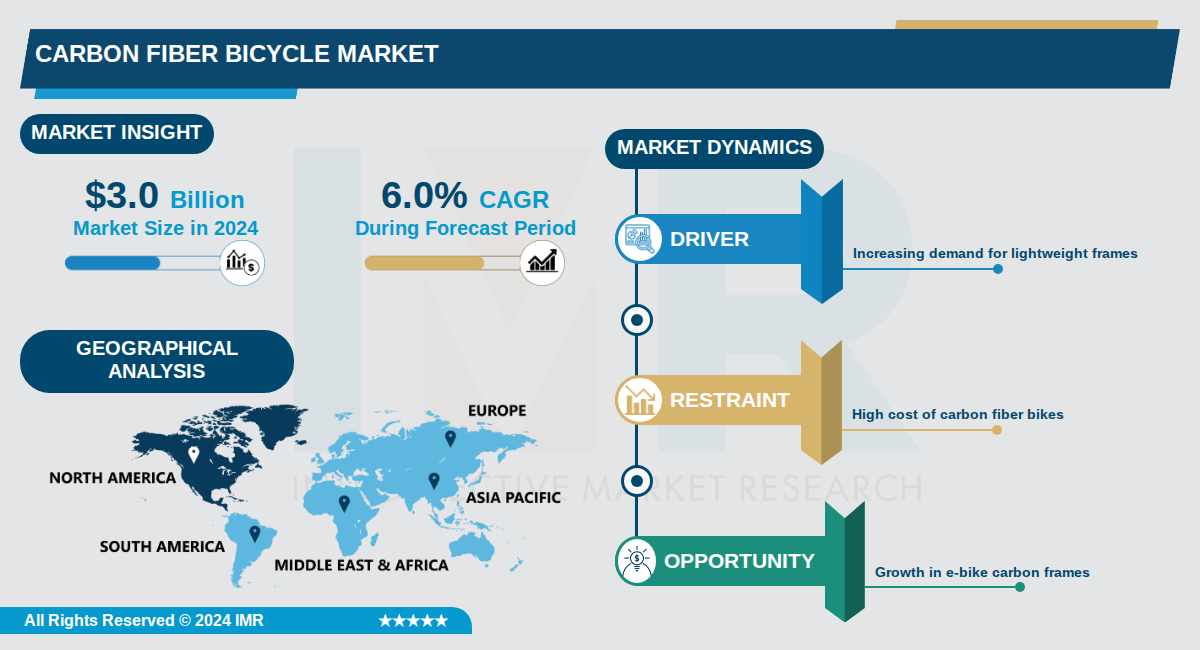
Carbon Fiber Bicycle Market Size Was Valued at USD 3.0 Billion in 2024, and is Projected to Reach USD 6.0 Billion by 2035, Growing at a CAGR of 6.0% From 2024-2035.
The Carbon Fiber Bicycle Market is valued at $3.0 billion in 2024 and is projected to reach $6.0 billion by 2035, growing at a compound annual growth rate (CAGR) of 6.0%. This expansion reflects surging demand for lightweight, high-performance bikes driven by advancements in composite materials and rising participation in cycling sports. Key players like Giant Manufacturing, Trek Bicycle, and Specialized lead innovation in frame engineering and production efficiency.
Asia-Pacific dominates with a 41% market share in 2024, fueled by high production volumes in China and Japan exceeding 3.2 million units annually, supported by advanced manufacturing clusters. North America and Europe follow with 27% and 28% shares respectively, driven by premium bike adoption in competitive racing, recreational riding, and urban commuting. Emerging regions like South America and Middle East & Africa contribute growing volumes through expanding sports culture and infrastructure investments.
End-user segments highlight professional cyclists at 40% adoption for ultra-light frames with superior stiffness-to-weight ratios, followed by recreational riders at 27%. Fastest growth occurs in adventure riders participating in gravel events and endurance touring. Regional leaders include China for manufacturing, Germany for active cyclists, and the US for premium penetration, with technologies like graphene-reinforced composites and AI-optimized designs shaping future trends.
Carbon Fiber Bicycle Market Trend Analysis:
Integration of High-Modulus Carbon Fiber and Aero Designs
- Major brands like Specialized, Scott, and Trek are driving the 2026 carbon road bike frame market with higher modulus T1100/T1000 grade carbon fiber, enabling lighter yet more durable frames that balance aerodynamics and comfort through wind tunnel optimized geometry and CFD-optimized aero profiles. This shift is forcing smaller manufacturers to upgrade molds and layup techniques to match full-integration trends including hidden cable routing and integrated cockpits. Global supply chains are being reshuffled as these innovations become standard across mid-to-high-end models, improving speed and handling for cyclists.
- Trek and Giant are leading with UD layup techniques and large-section downtubes that enhance rigidity while reducing weight by up to 15% compared to previous generations. Scott's adoption of enlarged BB structures supports wider tires, catering to demands for higher impact resistance in road bikes. These advancements are projected to boost the high-performance segment, which already commands premium pricing and significant revenue in the $3012.1 million global carbon fiber bike market in 2025.
Rise of Carbon Fiber E-Bikes
- The electric-assist bike segment is experiencing rapid growth with manufacturers launching carbon fiber framed e-bikes as early as 2020, integrating lightweight frames that maintain high performance despite added battery weight. This trend is fueled by the overall e-bike market expansion, with carbon fiber adoption contributing significantly to the projected 3.2% CAGR from 2025 to 2033. Brands like Merida Bike are capitalizing on this by offering e-road and e-mountain bikes that appeal to both recreational and commuting users.
- In 2023, innovations in carbon composites led to stronger e-bike frames capable of handling higher torque from electric motors, addressing previous durability concerns. The road bike segment, dominant in carbon fiber usage, is diversifying into gravel and mountain e-bikes, driving market penetration in North America and Asia-Pacific regions. This integration is expected to play a crucial role in shaping market dynamics, with cumulative sales opportunities reaching $4916 million from 2025-2030.
Focus on Sustainable Carbon Fiber Production
- Manufacturers are adopting eco-friendly practices like recycled carbon fiber, environmentally friendly resins, and bio-composite materials in mid-to-high-end frames, termed 'green layup' in the industry, to meet consumer environmental consciousness. Major brands increased focus on sustainable manufacturing in 2021, improving brand image amid growing demand for responsible production in the $3201.74 million market in 2024. This trend aligns with global sustainability concerns, differentiating products in competitive landscapes dominated by Giant Bicycle and Trek Bike.
- By 2026, high-modulus carbon fiber is being combined with sustainable materials, reducing production environmental impact while maintaining performance standards demanded by cyclists. Recycling programs for carbon fiber are gaining traction, supported by advancements that lower costs without compromising quality. This shift is particularly prominent in China, a key manufacturing hub, and is projected to drive further market growth through enhanced consumer appeal.
Carbon Fiber Bicycle Market Segment Analysis:
Carbon Fiber Bicycle Market is Segmented on the basis of By Bike Type, By Application, By Fiber Modulus
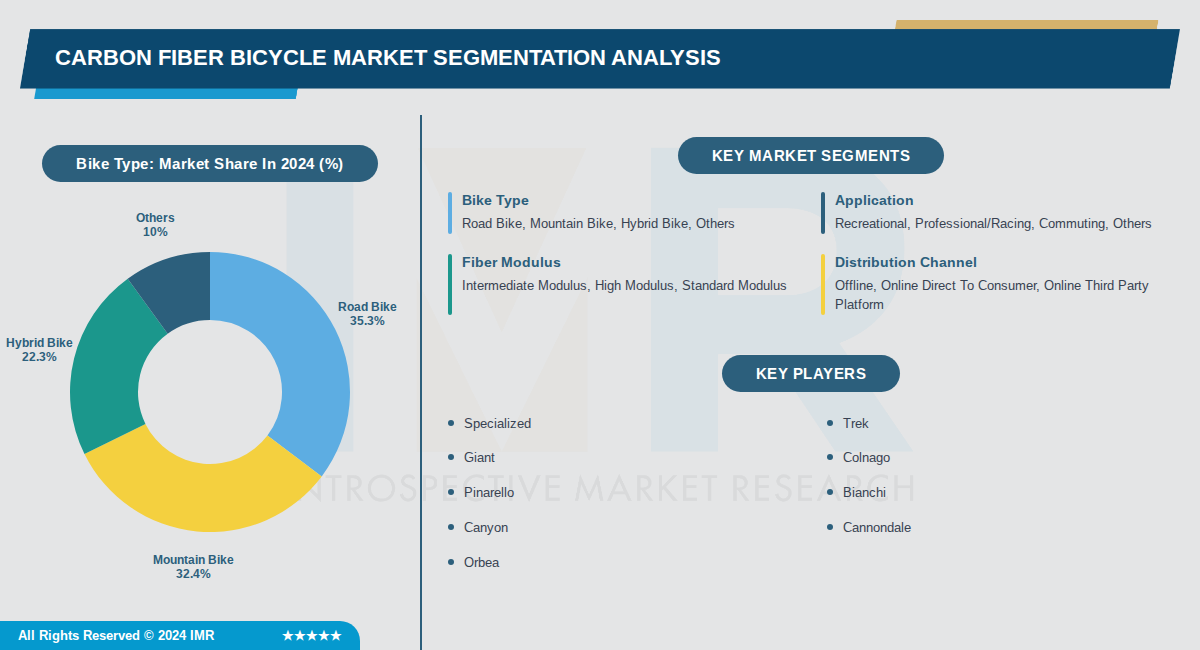
By Bike Type, Road Bike segment is expected to dominate the market during the forecast period
- Road bikes dominate due to their lightweight design, aerodynamic features, and suitability for long-distance riding and competitive cycling events, appealing to both professionals and enthusiasts.
- They hold the largest share driven by high demand in endurance cycling and road racing, with performance advantages leading to over 35% market capture in 2023.
By Application, Recreational segment is expected to dominate the market during the forecast period
- Recreational applications lead due to widespread appeal among hobbyists, leisure riders, and fitness enthusiasts pursuing health, outdoor activities, and social group rides.
- The segment's dominance is fueled by growing interest in casual cycling for wellness, capturing over 42% share as carbon fiber bikes become accessible for non-competitive use.
By Fiber Modulus, Intermediate Modulus segment is expected to dominate the market during the forecast period
- Intermediate modulus fibers dominate as they balance stiffness, weight savings, and cost-effectiveness, ideal for most high-performance frames used by enthusiasts and pros.
- This segment leads due to alignment with diverse pricing strategies and fatigue resistance needs, serving the broadest customer base from elite athletes to value-focused riders.
By Distribution Channel, Offline segment is expected to dominate the market during the forecast period
- Offline channels like specialty shops and local bicycle stores dominate due to hands-on testing, expert advice, and personalized fitting essential for premium carbon fiber bikes.
- They hold the majority share as consumers prefer physical inspection of high-value purchases, with specialty shops offering after-sales support and customization.
Carbon Fiber Bicycle Market Regional Insights:
North America is Expected to Dominate the Market Over the Forecast Period
- North America dominates the carbon fiber bicycle market, particularly led by the United States, which holds over 40% of global revenue in related segments like carbon fiber road bikes. Canada and Mexico also contribute through strong consumer demand for premium cycling products. This leadership is driven by high market penetration and projected growth rates outpacing other regions.
- The region benefits from a robust cycling culture, strong sports participation, and high disposable incomes enabling purchases of premium carbon fiber bikes. Advanced infrastructure supports urban commuting and recreational cycling, while favorable regulations promote eco-friendly transportation solutions. These factors create a mature market environment ideal for high-performance bicycles.
- Major players like Trek Bicycle Corporation, Specialized Bicycle Components, and Giant Bicycles have significant presence and invest heavily in North America. Recent developments include integration of advanced carbon technologies tailored for sports and fitness applications. These companies leverage specialty stores and online channels to maintain market leadership.
Active Key Players in the Carbon Fiber Bicycle Market:
- Specialized (USA)
- Trek (USA)
- Giant (Taiwan)
- Colnago (Italy)
- Pinarello (Italy)
- Bianchi (Italy)
- Canyon (Germany)
- Cannondale (USA)
- Orbea (Spain)
- Ridley (Belgium)
- Wilier (Italy)
- Factor (Austria)
- Cervélo (Canada)
- Scott (Switzerland)
- Lapierre (France)
- Trek Domane (USA)
- Tideacebike (China)
- Enve (USA)
- Fairlight Cycles (USA)
- Boardman (United Kingdom)
- Other Active Players
|
Carbon Fiber Bicycle Market |
|||
|
Base Year: |
2024 |
Forecast Period: |
2024-2035 |
|
Historical Data: |
2017 to 2024 |
Market Size in 2024: |
USD 3.0 Billion |
|
Forecast Period 2024-2035 CAGR: |
6.0 % |
Market Size in 2035: |
USD 6.0 Billion |
|
Segments Covered: |
By Bike Type |
|
|
|
By Application |
|
||
|
By Fiber Modulus |
|
||
|
By Distribution Channel |
|
||
|
By Region |
|
||
|
Key Market Drivers: |
|
||
|
Key Market Restraints: |
|
||
|
Key Opportunities: |
|
||
|
Companies Covered in the report: |
|
||
Chapter 1: Introduction
1.1 Scope and Coverage
Chapter 2: Executive Summary
Chapter 3: Market Landscape
3.1 Market Dynamics and Opportunity Analysis
3.1.1 Growth Drivers
3.1.2 Limiting Factors
3.1.3 Growth Opportunities
3.1.4 Challenges and Risks
3.2 Market Trend Analysis
3.3 Industry Ecosystem
3.4 Industry Value Chain Mapping
3.5 Strategic PESTLE Overview
3.6 Porter's Five Forces Framework
3.7 Regulatory Framework
3.8 Pricing Trend Analysis
3.9 Intellectual Property Review
3.10 Technology Evolution
3.11 Import-Export Analysis
3.12 Consumer Behavior Analysis
3.13 Investment Pocket Analysis
3.14 Go-To Market Strategy
Chapter 4: Carbon Fiber Bicycle Market by Bike Type (2017-2035)
4.1 Carbon Fiber Bicycle Market Snapshot and Growth Engine
4.2 Market Overview
4.3 Road Bike
4.3.1 Introduction and Market Overview
4.3.2 Historic and Forecasted Market Size in Value USD and Volume Units
4.3.3 Key Market Trends, Growth Factors, and Opportunities
4.3.4 Geographic Segmentation Analysis
4.4 Mountain Bike
4.5 Hybrid Bike
4.6 Others
Chapter 5: Carbon Fiber Bicycle Market by Application (2017-2035)
5.1 Carbon Fiber Bicycle Market Snapshot and Growth Engine
5.2 Market Overview
5.3 Recreational
5.3.1 Introduction and Market Overview
5.3.2 Historic and Forecasted Market Size in Value USD and Volume Units
5.3.3 Key Market Trends, Growth Factors, and Opportunities
5.3.4 Geographic Segmentation Analysis
5.4 Professional/Racing
5.5 Commuting
5.6 Others
Chapter 6: Carbon Fiber Bicycle Market by Fiber Modulus (2017-2035)
6.1 Carbon Fiber Bicycle Market Snapshot and Growth Engine
6.2 Market Overview
6.3 Intermediate Modulus
6.3.1 Introduction and Market Overview
6.3.2 Historic and Forecasted Market Size in Value USD and Volume Units
6.3.3 Key Market Trends, Growth Factors, and Opportunities
6.3.4 Geographic Segmentation Analysis
6.4 High Modulus
6.5 Standard Modulus
Chapter 7: Carbon Fiber Bicycle Market by Distribution Channel (2017-2035)
7.1 Carbon Fiber Bicycle Market Snapshot and Growth Engine
7.2 Market Overview
7.3 Offline
7.3.1 Introduction and Market Overview
7.3.2 Historic and Forecasted Market Size in Value USD and Volume Units
7.3.3 Key Market Trends, Growth Factors, and Opportunities
7.3.4 Geographic Segmentation Analysis
7.4 Online Direct To Consumer
7.5 Online Third Party Platform
Chapter 8: Company Profiles and Competitive Analysis
8.1 Competitive Landscape
8.1.1 Competitive Benchmarking
8.1.2 Carbon Fiber Bicycle Market Share by Manufacturer/Service Provider (2024)
8.1.3 Industry BCG Matrix
8.1.4 Partnerships, Mergers & Acquisitions
8.2 SPECIALIZED
8.2.1 Company Overview
8.2.2 Key Executives
8.2.3 Company Snapshot
8.2.4 Role of the Company in the Market
8.2.5 Sustainability and Social Responsibility
8.2.6 Operating Business Segments
8.2.7 Product Portfolio
8.2.8 Business Performance
8.2.9 Recent News & Developments
8.2.10 SWOT Analysis
8.3 TREK
8.4 GIANT
8.5 COLNAGO
8.6 PINARELLO
8.7 BIANCHI
8.8 CANYON
8.9 CANNONDALE
8.10 ORBEA
8.11 RIDLEY
8.12 WILIER
8.13 FACTOR
8.14 CERVÉLO
8.15 SCOTT
8.16 LAPIERRE
8.17 TREK DOMANE
8.18 TIDEACEBIKE
8.19 ENVE
8.20 FAIRLIGHT CYCLES
8.21 BOARDMAN
Chapter 9: Global Carbon Fiber Bicycle Market By Region
9.1 Overview
9.2. North America Carbon Fiber Bicycle Market
9.2.1 Key Market Trends, Growth Factors and Opportunities
9.2.2 Top Key Companies
9.2.3 Historic and Forecasted Market Size by Segments
9.2.4 Historic and Forecast Market Size by Country
9.3. Eastern Europe Carbon Fiber Bicycle Market
9.3.1 Key Market Trends, Growth Factors and Opportunities
9.3.2 Top Key Companies
9.3.3 Historic and Forecasted Market Size by Segments
9.3.4 Historic and Forecast Market Size by Country
9.4. Western Europe Carbon Fiber Bicycle Market
9.4.1 Key Market Trends, Growth Factors and Opportunities
9.4.2 Top Key Companies
9.4.3 Historic and Forecasted Market Size by Segments
9.4.4 Historic and Forecast Market Size by Country
9.5. Asia Pacific Carbon Fiber Bicycle Market
9.5.1 Key Market Trends, Growth Factors and Opportunities
9.5.2 Top Key Companies
9.5.3 Historic and Forecasted Market Size by Segments
9.5.4 Historic and Forecast Market Size by Country
9.6. Middle East & Africa Carbon Fiber Bicycle Market
9.6.1 Key Market Trends, Growth Factors and Opportunities
9.6.2 Top Key Companies
9.6.3 Historic and Forecasted Market Size by Segments
9.6.4 Historic and Forecast Market Size by Country
9.7. South America Carbon Fiber Bicycle Market
9.7.1 Key Market Trends, Growth Factors and Opportunities
9.7.2 Top Key Companies
9.7.3 Historic and Forecasted Market Size by Segments
9.7.4 Historic and Forecast Market Size by Country
Chapter 10: Analyst Viewpoint and Conclusion
Chapter 11: Research Methodology
11.1 Research Process
11.2 Primary Research
11.3 Secondary Research
Chapter 12: Case Study
Chapter 13: Appendix
13.1 Sources
13.2 List of Tables and Figures
13.3 Short Forms and Citations
13.4 Assumption and Conversion
13.5 Disclaimer
|
Carbon Fiber Bicycle Market |
|||
|
Base Year: |
2024 |
Forecast Period: |
2024-2035 |
|
Historical Data: |
2017 to 2024 |
Market Size in 2024: |
USD 3.0 Billion |
|
Forecast Period 2024-2035 CAGR: |
6.0 % |
Market Size in 2035: |
USD 6.0 Billion |
|
Segments Covered: |
By Bike Type |
|
|
|
By Application |
|
||
|
By Fiber Modulus |
|
||
|
By Distribution Channel |
|
||
|
By Region |
|
||
|
Key Market Drivers: |
|
||
|
Key Market Restraints: |
|
||
|
Key Opportunities: |
|
||
|
Companies Covered in the report: |
|
||


