




Building Energy Simulation Software Market Synopsis:
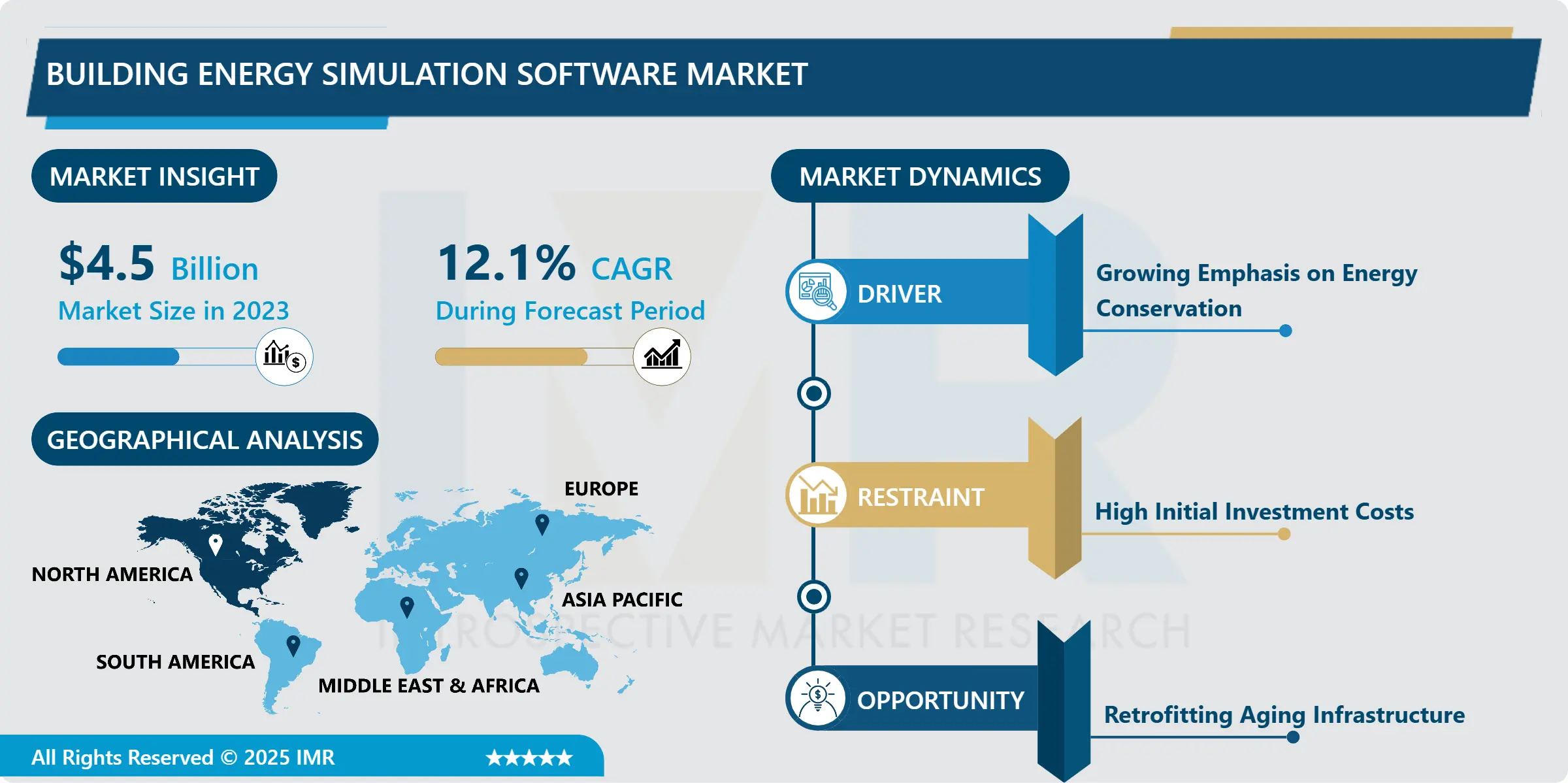
Building Energy Simulation Software Market Size Was Valued at USD 4.5 Billion in 2023, and is Projected to Reach USD 12.58 Billion by 2032, Growing at a CAGR of 12.1% From 2024-2032.
The Building Energy Simulation Software Market deals with different types of advanced computer applications that can be used to predict and analyze the performance of different building systems in terms of energy utilization. The above software solutions help to make recommendations for the use of power, estimate power demand, besides, satisfy legal requirements in the use of power in society.
The Building Energy Simulation Software Market has grown substantially in the past few years at the global level due to growing concerns towards energy conservation and judicious consumption of cost effective energy in construction sector. The use of such software is gradually becoming mandatory in both highly and less developed countries as codes and standards along with sustainability credentials including LEED and BREEAM are incorporated into the development of urban cities and real estate. These tools are now being sought not only for architectural designs of new structures but structural upgrades of existing to conform with the current energy performance hence proposing solutions to reduced carbon footprints.
The urban population growth combined with developments in smart products have also most notably fuelled the market evolution. To foster sustainable building designs, more governments across the globe are implementing programs and bonuses. For instance, many countries are providing tax incentives and grants on the use of energy modeling at the construction stage. This along with the needs for green and intelligent building has made the Building Energy Simulation Software Market vendor as one of the important solution providers in the move towards a sustainable future.
Building Energy Simulation Software Market Trend Analysis
Integration of AI and IoT Enhancing Simulation Precision
-
The use of Artificial Intelligence or AI with the Internet of Things or IoT is transforming the Building Energy Simulation Software Market. Thus, the designs of very large energy models are being built with the help of AI, while IoT is giving real-time data about the usage of energy and the conditions that surround it. Collectively, these technologies support function of predictive analysis, by which users can better anticipate their energy needs.
- The simulation software powered by AI can identify changes on its own that would make it friendly to energy efficiency and provide recommendations on the modifications that might enhance its efficiency, lessening the effort spent. The trend is also expected to expand even further in the future to cater for new smart building solutions being adopted in the construction industry.
Growing Demand for Retrofitting Aging Infrastructure
-
Rising environmental awareness and the need to decrease the emission of greenhouse gases have led to new opportunities for the Building Energy Simulation Software Market mainly for retrofitting of existing structures. Existing premises, where construction was carried out without regard to modern high-efficiency requirements, occupy an extensive area and contribute significantly to energy loss.
- A particular focus is simulation software, which helps to detect main lose-making factors and propose upgrades that can result in significant energy saving. Several governments and private companies worldwide are spending more money on retrofitting school, healthcare facilities, and offices, which offers a huge business opportunity to market players. The general inclination towards urban redevelopment and green certifications effectively intensifies this chance also.
Building Energy Simulation Software Market Segment Analysis:
Building Energy Simulation Software Market is Segmented on the basis of Component, application, end-user, and Region
By Component, Software segment is expected to dominate the market during the forecast period
-
The software segment of the Building Energy Simulation Software Market is expected to maintain its lead in the overall market throughout the forecast period due to it being an essential tool in realizing energy efficiency. Such software applications offer diverse systems for simulation, including thermal modeling, HEVs,IFIC, and renewable power systems. As the construction industry shifts from traditional to digital platforms, software has gradually emerged as a core enabler for stakeholders to realise energy saving and regulatory compliance.
- Also, through cloud-based solutions’ help and flexibility in regards to the new trends in pricing, such as the subscription model, they becamealble for SMEs also. The opportunities for the software segment to become even more dominant are reinforced by the ability to cooperate with BIM systems in providing comprehensive solutions for energy management throughout the building life cycle. It is anticipated that with the increasing trend of sustainability among various organizations of the world then the need for accurate energy simulation instruments will also keep on growing.
By Application, Commercial Buildings segment expected to held the largest share
-
The commercial buildings segment is expected to hold the maximum Market Share in the Building Energy Simulation Software Market, due to the high energy usage in commercial applications like offices, malls, and hotels. These facilities have to act energetically wise and are designed often to use materials and meet requirements in sustainability that could be helpful on demand for simulation tools.
- Commercial buildings are mostly located in large urban areas, and due to their business nature, they embrace new technologies when deploying production technologies, which are similar to energy simulation software’s goal of optimizing its functionalities. Moreover, incentives for green certification added to an increasing trend in making commercial spaces in cities more sustainable contribute to a further promotion of such tools in the commercial segment.
Building Energy Simulation Software Market Regional Insights:
North America is Expected to Dominate the Market Over the Forecast period
-
The North American region is anticipated to lead the Building Energy Simulation Software market throughout the forecast period, driven by robust investments in energy-efficient construction and stringent regulatory frameworks promoting sustainable building practices. The United States and Canada are at the forefront, with increasing adoption of green building certifications such as LEED and growing emphasis on reducing carbon emissions. The region's advanced technological infrastructure, combined with government initiatives supporting smart city projects, further accelerates the demand for energy simulation solutions among architects, engineers, and facility managers.
- North America's strong presence of key market players and continuous advancements in simulation technologies enhance its competitive edge. The rise in retrofitting activities across commercial and residential sectors to meet energy standards is also a significant growth driver. Companies operating in this space are strategically investing in R&D to offer more sophisticated, user-friendly software, enabling more accurate energy modeling and supporting the region’s leadership position in the global market.
Active Key Players in the Building Energy Simulation Software Market:
-
AECOM (USA)
- Autodesk Inc. (USA)
- Bentley Systems (USA)
- Carrier Global Corporation (USA)
- DesignBuilder Software Ltd (UK)
- EnergyPlus (USA)
- Engie (France)
- Honeywell International Inc. (USA)
- IES Ltd (UK)
- NREL (USA)
- Siemens AG (Germany)
- SimScale GmbH (Germany)
- Skyspark (USA)
- Sefaira (UK)
- Trane Technologies (USA)
- Other Active Players
|
Global Building Energy Simulation Software Market |
|||
|
Base Year: |
2023 |
Forecast Period: |
2024-2032 |
|
Historical Data: |
2017 to 2023 |
Market Size in 2023: |
USD 4.5 Billion |
|
Forecast Period 2024-32 CAGR: |
12.1% |
Market Size in 2032: |
USD 12.58 Billion |
|
Segments Covered: |
By Component |
|
|
|
By Application |
|
||
|
By End User |
|
||
|
By Region |
|
||
|
Key Market Drivers: |
|
||
|
Key Market Restraints: |
|
||
|
Key Opportunities: |
|
||
|
Companies Covered in the report: |
|
||
Chapter 1: Introduction
1.1 Scope and Coverage
Chapter 2:Executive Summary
Chapter 3: Market Landscape
3.1 Market Dynamics
3.1.1 Drivers
3.1.2 Restraints
3.1.3 Opportunities
3.1.4 Challenges
3.2 Market Trend Analysis
3.3 PESTLE Analysis
3.4 Porter's Five Forces Analysis
3.5 Industry Value Chain Analysis
3.6 Ecosystem
3.7 Regulatory Landscape
3.8 Price Trend Analysis
3.9 Patent Analysis
3.10 Technology Evolution
3.11 Investment Pockets
3.12 Import-Export Analysis
Chapter 4: Building Energy Simulation Software Market by Component
4.1 Building Energy Simulation Software Market Snapshot and Growth Engine
4.2 Building Energy Simulation Software Market Overview
4.3 Software
4.3.1 Introduction and Market Overview
4.3.2 Historic and Forecasted Market Size in Value USD and Volume Units (2017-2032F)
4.3.3 Key Market Trends, Growth Factors and Opportunities
4.3.4 Software: Geographic Segmentation Analysis
4.4 Services
4.4.1 Introduction and Market Overview
4.4.2 Historic and Forecasted Market Size in Value USD and Volume Units (2017-2032F)
4.4.3 Key Market Trends, Growth Factors and Opportunities
4.4.4 Services: Geographic Segmentation Analysis
4.5 Others
4.5.1 Introduction and Market Overview
4.5.2 Historic and Forecasted Market Size in Value USD and Volume Units (2017-2032F)
4.5.3 Key Market Trends, Growth Factors and Opportunities
4.5.4 Others: Geographic Segmentation Analysis
Chapter 5: Building Energy Simulation Software Market by Application
5.1 Building Energy Simulation Software Market Snapshot and Growth Engine
5.2 Building Energy Simulation Software Market Overview
5.3 Commercial Buildings
5.3.1 Introduction and Market Overview
5.3.2 Historic and Forecasted Market Size in Value USD and Volume Units (2017-2032F)
5.3.3 Key Market Trends, Growth Factors and Opportunities
5.3.4 Commercial Buildings: Geographic Segmentation Analysis
5.4 Residential Buildings
5.4.1 Introduction and Market Overview
5.4.2 Historic and Forecasted Market Size in Value USD and Volume Units (2017-2032F)
5.4.3 Key Market Trends, Growth Factors and Opportunities
5.4.4 Residential Buildings: Geographic Segmentation Analysis
5.5 Government Buildings
5.5.1 Introduction and Market Overview
5.5.2 Historic and Forecasted Market Size in Value USD and Volume Units (2017-2032F)
5.5.3 Key Market Trends, Growth Factors and Opportunities
5.5.4 Government Buildings: Geographic Segmentation Analysis
5.6 Others
5.6.1 Introduction and Market Overview
5.6.2 Historic and Forecasted Market Size in Value USD and Volume Units (2017-2032F)
5.6.3 Key Market Trends, Growth Factors and Opportunities
5.6.4 Others: Geographic Segmentation Analysis
Chapter 6: Building Energy Simulation Software Market by End User
6.1 Building Energy Simulation Software Market Snapshot and Growth Engine
6.2 Building Energy Simulation Software Market Overview
6.3 Architecture & Construction
6.3.1 Introduction and Market Overview
6.3.2 Historic and Forecasted Market Size in Value USD and Volume Units (2017-2032F)
6.3.3 Key Market Trends, Growth Factors and Opportunities
6.3.4 Architecture & Construction: Geographic Segmentation Analysis
6.4 Government & Defense
6.4.1 Introduction and Market Overview
6.4.2 Historic and Forecasted Market Size in Value USD and Volume Units (2017-2032F)
6.4.3 Key Market Trends, Growth Factors and Opportunities
6.4.4 Government & Defense: Geographic Segmentation Analysis
6.5 Automotive & Transportation
6.5.1 Introduction and Market Overview
6.5.2 Historic and Forecasted Market Size in Value USD and Volume Units (2017-2032F)
6.5.3 Key Market Trends, Growth Factors and Opportunities
6.5.4 Automotive & Transportation: Geographic Segmentation Analysis
6.6 Manufacturing & Engineering
6.6.1 Introduction and Market Overview
6.6.2 Historic and Forecasted Market Size in Value USD and Volume Units (2017-2032F)
6.6.3 Key Market Trends, Growth Factors and Opportunities
6.6.4 Manufacturing & Engineering: Geographic Segmentation Analysis
6.7 Others
6.7.1 Introduction and Market Overview
6.7.2 Historic and Forecasted Market Size in Value USD and Volume Units (2017-2032F)
6.7.3 Key Market Trends, Growth Factors and Opportunities
6.7.4 Others: Geographic Segmentation Analysis
Chapter 7: Company Profiles and Competitive Analysis
7.1 Competitive Landscape
7.1.1 Competitive Benchmarking
7.1.2 Building Energy Simulation Software Market Share by Manufacturer (2023)
7.1.3 Industry BCG Matrix
7.1.4 Heat Map Analysis
7.1.5 Mergers and Acquisitions
7.2 AECOM (USA)
7.2.1 Company Overview
7.2.2 Key Executives
7.2.3 Company Snapshot
7.2.4 Role of the Company in the Market
7.2.5 Sustainability and Social Responsibility
7.2.6 Operating Business Segments
7.2.7 Product Portfolio
7.2.8 Business Performance
7.2.9 Key Strategic Moves and Recent Developments
7.2.10 SWOT Analysis
7.3 AUTODESK INC. (USA)
7.4 BENTLEY SYSTEMS (USA)
7.5 CARRIER GLOBAL CORPORATION (USA)
7.6 DESIGNBUILDER SOFTWARE LTD (UK)
7.7 ENERGYPLUS (USA)
7.8 ENGIE (FRANCE)
7.9 HONEYWELL INTERNATIONAL INC. (USA)
7.10 IES LTD (UK)
7.11 NREL (USA)
7.12 SIEMENS AG (GERMANY)
7.13 SIMSCALE GMBH (GERMANY)
7.14 SKYSPARK (USA)
7.15 SEFAIRA (UK)
7.16 TRANE TECHNOLOGIES (USA)
7.17 OTHER ACTIVE PLAYERS
Chapter 8: Global Building Energy Simulation Software Market By Region
8.1 Overview
8.2. North America Building Energy Simulation Software Market
8.2.1 Key Market Trends, Growth Factors and Opportunities
8.2.2 Top Key Companies
8.2.3 Historic and Forecasted Market Size by Segments
8.2.4 Historic and Forecasted Market Size By Component
8.2.4.1 Software
8.2.4.2 Services
8.2.4.3 Others
8.2.5 Historic and Forecasted Market Size By Application
8.2.5.1 Commercial Buildings
8.2.5.2 Residential Buildings
8.2.5.3 Government Buildings
8.2.5.4 Others
8.2.6 Historic and Forecasted Market Size By End User
8.2.6.1 Architecture & Construction
8.2.6.2 Government & Defense
8.2.6.3 Automotive & Transportation
8.2.6.4 Manufacturing & Engineering
8.2.6.5 Others
8.2.7 Historic and Forecast Market Size by Country
8.2.7.1 US
8.2.7.2 Canada
8.2.7.3 Mexico
8.3. Eastern Europe Building Energy Simulation Software Market
8.3.1 Key Market Trends, Growth Factors and Opportunities
8.3.2 Top Key Companies
8.3.3 Historic and Forecasted Market Size by Segments
8.3.4 Historic and Forecasted Market Size By Component
8.3.4.1 Software
8.3.4.2 Services
8.3.4.3 Others
8.3.5 Historic and Forecasted Market Size By Application
8.3.5.1 Commercial Buildings
8.3.5.2 Residential Buildings
8.3.5.3 Government Buildings
8.3.5.4 Others
8.3.6 Historic and Forecasted Market Size By End User
8.3.6.1 Architecture & Construction
8.3.6.2 Government & Defense
8.3.6.3 Automotive & Transportation
8.3.6.4 Manufacturing & Engineering
8.3.6.5 Others
8.3.7 Historic and Forecast Market Size by Country
8.3.7.1 Russia
8.3.7.2 Bulgaria
8.3.7.3 The Czech Republic
8.3.7.4 Hungary
8.3.7.5 Poland
8.3.7.6 Romania
8.3.7.7 Rest of Eastern Europe
8.4. Western Europe Building Energy Simulation Software Market
8.4.1 Key Market Trends, Growth Factors and Opportunities
8.4.2 Top Key Companies
8.4.3 Historic and Forecasted Market Size by Segments
8.4.4 Historic and Forecasted Market Size By Component
8.4.4.1 Software
8.4.4.2 Services
8.4.4.3 Others
8.4.5 Historic and Forecasted Market Size By Application
8.4.5.1 Commercial Buildings
8.4.5.2 Residential Buildings
8.4.5.3 Government Buildings
8.4.5.4 Others
8.4.6 Historic and Forecasted Market Size By End User
8.4.6.1 Architecture & Construction
8.4.6.2 Government & Defense
8.4.6.3 Automotive & Transportation
8.4.6.4 Manufacturing & Engineering
8.4.6.5 Others
8.4.7 Historic and Forecast Market Size by Country
8.4.7.1 Germany
8.4.7.2 UK
8.4.7.3 France
8.4.7.4 The Netherlands
8.4.7.5 Italy
8.4.7.6 Spain
8.4.7.7 Rest of Western Europe
8.5. Asia Pacific Building Energy Simulation Software Market
8.5.1 Key Market Trends, Growth Factors and Opportunities
8.5.2 Top Key Companies
8.5.3 Historic and Forecasted Market Size by Segments
8.5.4 Historic and Forecasted Market Size By Component
8.5.4.1 Software
8.5.4.2 Services
8.5.4.3 Others
8.5.5 Historic and Forecasted Market Size By Application
8.5.5.1 Commercial Buildings
8.5.5.2 Residential Buildings
8.5.5.3 Government Buildings
8.5.5.4 Others
8.5.6 Historic and Forecasted Market Size By End User
8.5.6.1 Architecture & Construction
8.5.6.2 Government & Defense
8.5.6.3 Automotive & Transportation
8.5.6.4 Manufacturing & Engineering
8.5.6.5 Others
8.5.7 Historic and Forecast Market Size by Country
8.5.7.1 China
8.5.7.2 India
8.5.7.3 Japan
8.5.7.4 South Korea
8.5.7.5 Malaysia
8.5.7.6 Thailand
8.5.7.7 Vietnam
8.5.7.8 The Philippines
8.5.7.9 Australia
8.5.7.10 New Zealand
8.5.7.11 Rest of APAC
8.6. Middle East & Africa Building Energy Simulation Software Market
8.6.1 Key Market Trends, Growth Factors and Opportunities
8.6.2 Top Key Companies
8.6.3 Historic and Forecasted Market Size by Segments
8.6.4 Historic and Forecasted Market Size By Component
8.6.4.1 Software
8.6.4.2 Services
8.6.4.3 Others
8.6.5 Historic and Forecasted Market Size By Application
8.6.5.1 Commercial Buildings
8.6.5.2 Residential Buildings
8.6.5.3 Government Buildings
8.6.5.4 Others
8.6.6 Historic and Forecasted Market Size By End User
8.6.6.1 Architecture & Construction
8.6.6.2 Government & Defense
8.6.6.3 Automotive & Transportation
8.6.6.4 Manufacturing & Engineering
8.6.6.5 Others
8.6.7 Historic and Forecast Market Size by Country
8.6.7.1 Turkiye
8.6.7.2 Bahrain
8.6.7.3 Kuwait
8.6.7.4 Saudi Arabia
8.6.7.5 Qatar
8.6.7.6 UAE
8.6.7.7 Israel
8.6.7.8 South Africa
8.7. South America Building Energy Simulation Software Market
8.7.1 Key Market Trends, Growth Factors and Opportunities
8.7.2 Top Key Companies
8.7.3 Historic and Forecasted Market Size by Segments
8.7.4 Historic and Forecasted Market Size By Component
8.7.4.1 Software
8.7.4.2 Services
8.7.4.3 Others
8.7.5 Historic and Forecasted Market Size By Application
8.7.5.1 Commercial Buildings
8.7.5.2 Residential Buildings
8.7.5.3 Government Buildings
8.7.5.4 Others
8.7.6 Historic and Forecasted Market Size By End User
8.7.6.1 Architecture & Construction
8.7.6.2 Government & Defense
8.7.6.3 Automotive & Transportation
8.7.6.4 Manufacturing & Engineering
8.7.6.5 Others
8.7.7 Historic and Forecast Market Size by Country
8.7.7.1 Brazil
8.7.7.2 Argentina
8.7.7.3 Rest of SA
Chapter 9 Analyst Viewpoint and Conclusion
9.1 Recommendations and Concluding Analysis
9.2 Potential Market Strategies
Chapter 10 Research Methodology
10.1 Research Process
10.2 Primary Research
10.3 Secondary Research
|
Global Building Energy Simulation Software Market |
|||
|
Base Year: |
2023 |
Forecast Period: |
2024-2032 |
|
Historical Data: |
2017 to 2023 |
Market Size in 2023: |
USD 4.5 Billion |
|
Forecast Period 2024-32 CAGR: |
12.1% |
Market Size in 2032: |
USD 12.58 Billion |
|
Segments Covered: |
By Component |
|
|
|
By Application |
|
||
|
By End User |
|
||
|
By Region |
|
||
|
Key Market Drivers: |
|
||
|
Key Market Restraints: |
|
||
|
Key Opportunities: |
|
||
|
Companies Covered in the report: |
|
||


