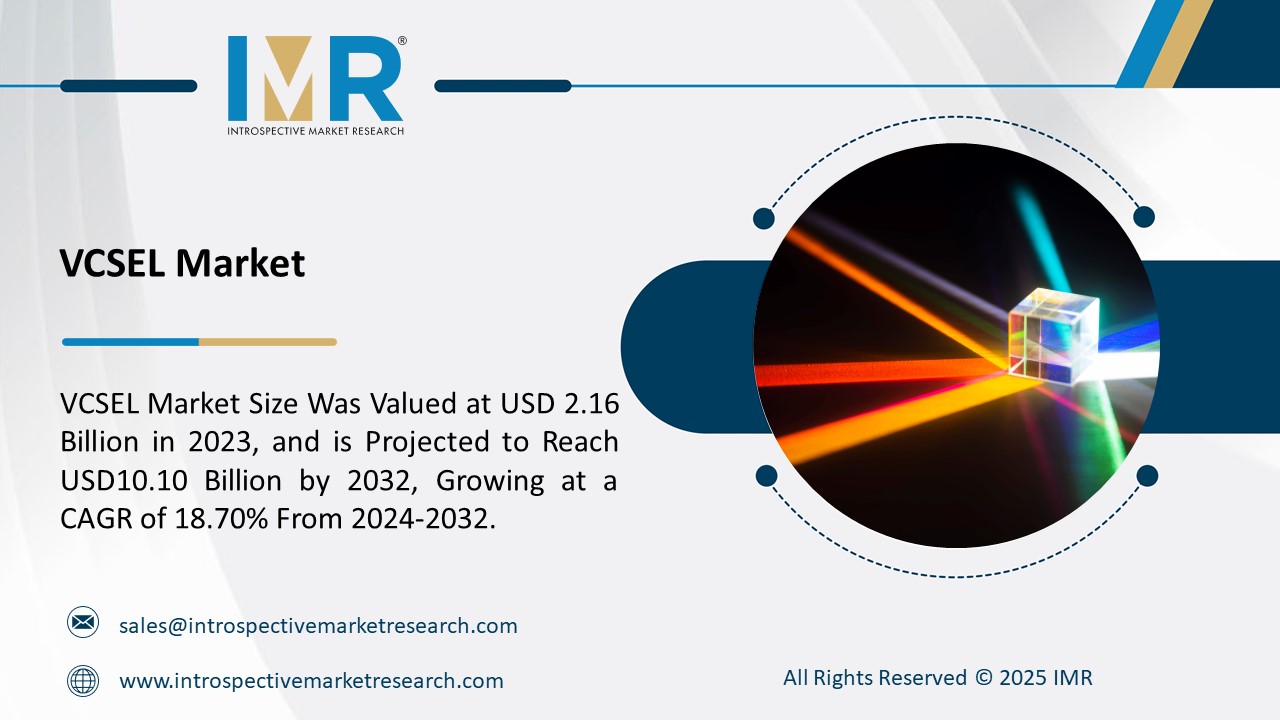
According to a new report published by Introspective Market Research, titled, VCSEL Market by Type (Multimode and Single-mode), By Material (Gallium Arsenide (GaAs), Indium Phosphide (InP), Gallium Nitride (GaN), and Others), By Application (Data Communication, Sensing, Industrial Heating, Medical, and Others), By End-use Industry (Consumer Electronics, Data Centers, Automotive, Healthcare, and Others), The Global VCSEL Market Size Was Valued at USD 2.16 Billion in 2023 and is Projected to Reach USD 10.10 Billion by 2032, Growing at a CAGR of 18.70%. The Vertical Cavity Surface Emitting Laser (VCSEL) market comprises highly efficient semiconductor lasers that emit light perpendicularly from the wafer surface, offering significant advantages over traditional edge-emitting lasers. These compact and power-efficient devices are integral to modern optical communication and sensing technologies. VCSELs boast superior beam quality, lower power consumption, and ease of integration into arrays, making them a preferred choice for high-speed data transmission and advanced sensing applications. Their unique architecture allows for cost-effective manufacturing and testing, contributing to their growing adoption across diverse industries.
VCSELs are revolutionizing various sectors, from enabling lightning-fast data communication within data centers to powering sophisticated 3D sensing in consumer electronics. In data communication, they are critical for short-reach optical interconnects, supporting the immense bandwidth demands of cloud computing and enterprise networks. For consumer electronics, VCSELs are the core technology behind facial recognition systems, proximity sensors, and augmented reality devices in smartphones and smart wearables. Beyond these, they find applications in automotive LiDAR for autonomous vehicles, industrial heating processes, and medical diagnostics, underscoring their broad and expanding utility.
A primary growth driver for the VCSEL market is the explosive demand for 3D sensing and facial recognition technologies, particularly within the consumer electronics sector. VCSELs are the foundational components for structured light and time-of-flight (ToF) sensors used in smartphones, tablets, and other smart devices for secure authentication, augmented reality (AR) applications, and advanced photography features. As consumers increasingly rely on these intuitive and secure interaction methods, and as manufacturers integrate more sophisticated sensing capabilities into their products, the demand for high-performance and cost-effective VCSEL arrays is surging, directly fueling market expansion.
A significant market opportunity for the VCSEL market lies in the rapidly expanding adoption of LiDAR systems in autonomous vehicles and advanced driver-assistance systems (ADAS). VCSELs offer several advantages for LiDAR, including compact size, high modulation speed, and the ability to operate across a range of temperatures, making them ideal light sources for precise distance measurement and environmental mapping. As the automotive industry accelerates its transition towards fully autonomous driving, the need for robust, reliable, and cost-effective LiDAR solutions will intensify, creating a substantial growth avenue for VCSEL technology developers and manufacturers in the coming decade.
VCSEL Market, Segmentation
Type
- The Type segment is further classified into Multimode and Single-mode. Among these, the Multimode sub-segment accounted for the highest market share in 2023. Multimode VCSELs are predominantly utilized in short-reach optical interconnects within data centers and local area networks due to their cost-effectiveness and relatively simple coupling into multimode fibers. While they transmit multiple light paths or "modes," they are highly efficient for distances up to a few hundred meters, which is common in server-to-server and rack-to-rack communication. Their ease of manufacturing and integration into arrays, coupled with sufficient bandwidth for current data center demands, makes them the preferred choice for scaling high-speed optical links.
Material
-
The Material segment is further classified into Gallium Arsenide (GaAs), Indium Phosphide (InP), Gallium Nitride (GaN), and Others. Among these, the Gallium Arsenide (GaAs) sub-segment accounted for the highest market share in 2023. Gallium Arsenide (GaAs) is the most widely used material for VCSEL fabrication, primarily because it enables the emission of light in the near-infrared spectrum (around 850 nm to 980 nm), which is ideal for a broad range of applications. These include high-speed data communication, 3D sensing for facial recognition, and optical mice. GaAs-based VCSELs benefit from mature manufacturing processes, excellent efficiency, and reliable performance, contributing to their dominant position in the market due to their suitability for numerous consumer and enterprise applications.
Some of The Leading/Active Market Players Are-
- Broadcom Inc. (USA)
- II-VI Incorporated (USA)
- Lumentum Holdings Inc. (USA)
- ams AG (Austria)
- Coherent Corp. (USA)
- Sony Corporation (Japan)
- TRUMPF GmbH + Co. KG (Germany)
- Sichuan EM Technology Co., Ltd. (China)
- Vertilas GmbH (Germany)
- Thorlabs, Inc. (USA)
- Finisar (acquired by II-VI Incorporated, USA)
- San’an Optoelectronics (China)
- Sumitomo Electric Industries, Ltd. (Japan)
- NEC Corporation (Japan)
- Fujitsu Optical Components Ltd. (Japan)
- other active players.
Key Industry Developments
-
In June 2023, Lumentum announced an expansion of its VCSEL manufacturing capacity to meet the surging demand for 3D sensing components in consumer electronics and automotive LiDAR applications. This strategic investment highlights the company's commitment to supporting next-generation technologies that rely on advanced optical sensing. The increased production capabilities aim to ensure a robust supply chain for key customers in these rapidly growing markets.
- In September 2022, II-VI Incorporated (now Coherent Corp.) introduced new high-power VCSEL arrays designed for industrial heating and advanced sensing applications. This development showcased innovation in enhancing the power output and efficiency of VCSELs, opening up new possibilities for their use in demanding industrial environments. The new arrays target applications requiring precise and uniform heating, as well as high-performance LiDAR systems.
Key Findings of the Study
- Multimode VCSELs dominate the market due to their prevalence in data communication.
- Gallium Arsenide (GaAs) remains the leading material for VCSEL fabrication.
- The escalating demand for 3D sensing in consumer electronics is a key growth driver.
- LiDAR in autonomous vehicles presents a significant untapped market opportunity.
- The market is witnessing rapid innovation in power, efficiency, and application-specific designs.