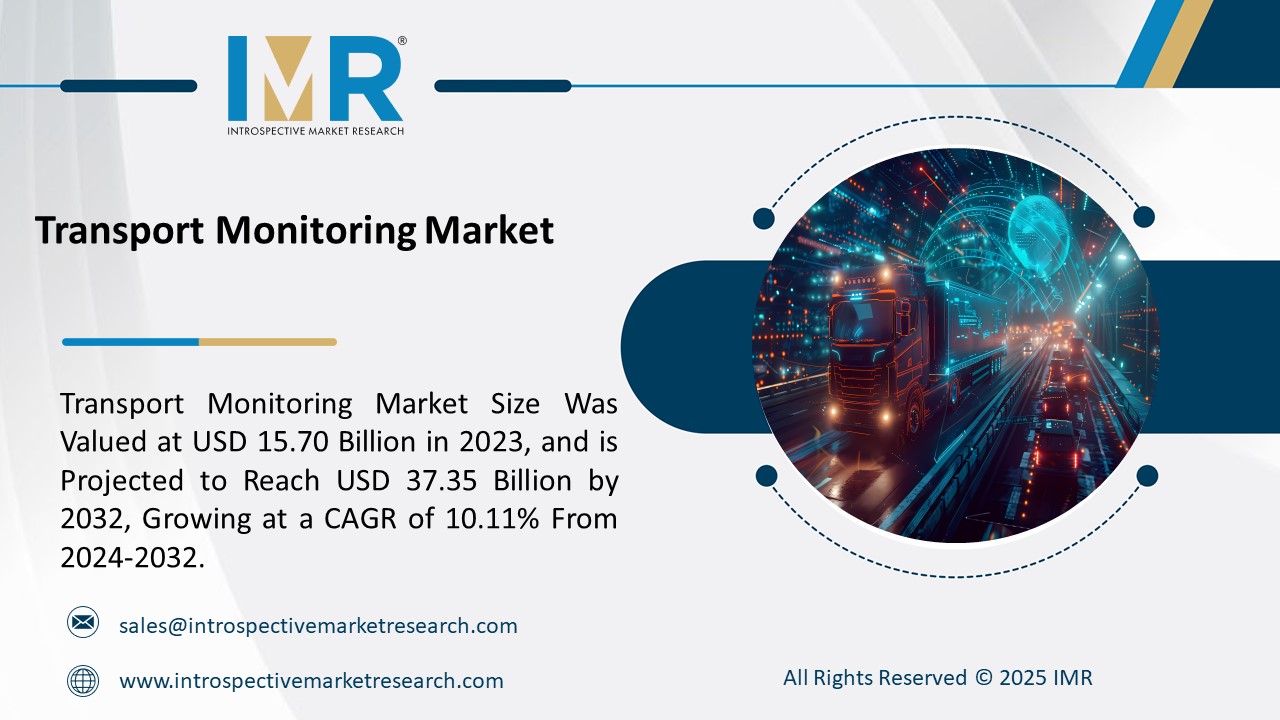
According to a new report published by Introspective Market Research, titled, Transport Monitoring Market by Component, System, and Application, The Global Transport Monitoring Market Size Was Valued at USD 15.70 Billion in 2023 and is Projected to Reach USD 37.35 Billion by 2032, Growing at a CAGR of 10.11%. The Transport Monitoring Market is experiencing significant growth as governments and private enterprises seek to improve traffic management, enhance road safety, and reduce environmental impacts. Transport monitoring systems involve the use of advanced technologies such as IoT, AI, sensors, and GPS to collect, analyze, and manage real-time data related to road, rail, air, and maritime transport operations. These systems ensure smooth mobility, reduce congestion, and support smarter decision-making.
Rising urbanization, increasing vehicle ownership, and growing pressure to reduce traffic-related accidents and emissions are fueling the adoption of transport monitoring solutions worldwide. Cities are adopting intelligent transport systems (ITS) to optimize traffic flow, reduce travel times, and enable eco-friendly commuting. Furthermore, advancements in data analytics and cloud computing are enabling predictive maintenance and real-time monitoring, positioning the market as a vital component of future smart city infrastructure.
A key driver of the Transport Monitoring Market is the increasing adoption of smart city initiatives globally. Governments are investing heavily in intelligent infrastructure to tackle urban traffic congestion, road safety, and pollution challenges. By integrating IoT-enabled transport monitoring systems, authorities can access real-time traffic updates, accident alerts, and environmental data. These systems improve resource allocation, reduce delays, and enhance commuter experiences. As smart city projects accelerate in regions such as Asia-Pacific, North America, and Europe, the demand for advanced transport monitoring solutions continues to grow, creating strong momentum for market expansion over the forecast period.
A major opportunity for the Transport Monitoring Market lies in the integration of AI and predictive analytics for proactive transport management. With the increasing availability of real-time traffic and environmental data, AI-powered platforms can predict congestion, detect equipment failures, and suggest preventive measures. This capability not only reduces operational costs but also minimizes accidents and delays. Additionally, predictive models can optimize public transport scheduling, improve logistics efficiency, and support eco-friendly policies. As urban areas continue to expand, the adoption of AI-driven transport monitoring solutions will present lucrative opportunities for vendors to innovate and deliver next-generation intelligent mobility systems.
Transport Monitoring Market, Segmentation
Component
-
The Component segment is further classified into Hardware, Software, and Services. Among these, the Hardware sub-segment accounted for the highest market share in 2023. Hardware components such as sensors, GPS devices, cameras, and connected infrastructure form the backbone of transport monitoring systems. The rising demand for vehicle detection, surveillance, and air quality monitoring equipment has boosted hardware adoption globally. Hardware investments remain crucial for enabling smart traffic lights, automated toll collection, and safety systems, ensuring this sub-segment’s continued dominance.
System
-
The System segment is further classified into Road Monitoring, Rail Monitoring, Air Monitoring, and Maritime Monitoring. Among these, the Road Monitoring sub-segment accounted for the highest market share in 2023. With rapid urbanization and rising vehicle density, road monitoring has become essential for traffic management, accident prevention, and pollution control. Cities worldwide are implementing road monitoring systems to track traffic flow, optimize signals, and enhance commuter safety. The deployment of advanced cameras, license plate recognition systems, and environmental sensors is driving this sub-segment’s leadership in the market.
Some of The Leading/Active Market Players Are-
-
Siemens AG (Germany)
- Thales Group (France)
- Huawei Technologies Co., Ltd. (China)
- IBM Corporation (USA)
- Cisco Systems, Inc. (USA)
- Hitachi Ltd. (Japan)
- Alstom SA (France)
- Cubic Corporation (USA)
- NEC Corporation (Japan)
- Indra Sistemas (Spain)
- TomTom International BV (Netherlands)
- Atkins Global (UK)
- Trimble Inc. (USA)
- Sensys Networks, Inc. (USA)
- Iteris, Inc. (USA)
and other active players.
Key Industry Developments
-
In May 2024, Siemens Mobility introduced its latest AI-powered traffic management system in Europe, designed to improve urban mobility and reduce congestion. The system integrates real-time analytics, adaptive traffic signals, and connected sensors, enabling city authorities to optimize transport networks efficiently and reduce carbon emissions.
- In February 2024, Cisco Systems partnered with the Dubai Roads and Transport Authority (RTA) to launch a smart transport monitoring initiative. The project includes IoT-enabled sensors and AI-driven analytics to monitor traffic density, improve commuter safety, and enhance operational efficiency across Dubai’s growing smart city infrastructure.
Key Findings of the Study
-
Hardware dominated the component category in 2023.
- Road Monitoring led the system segment, driven by urbanization and rising vehicle density.
- North America and Europe are leading regions for adoption due to advanced infrastructure projects.
- Growth is fueled by smart city initiatives and AI-driven transport monitoring innovations.