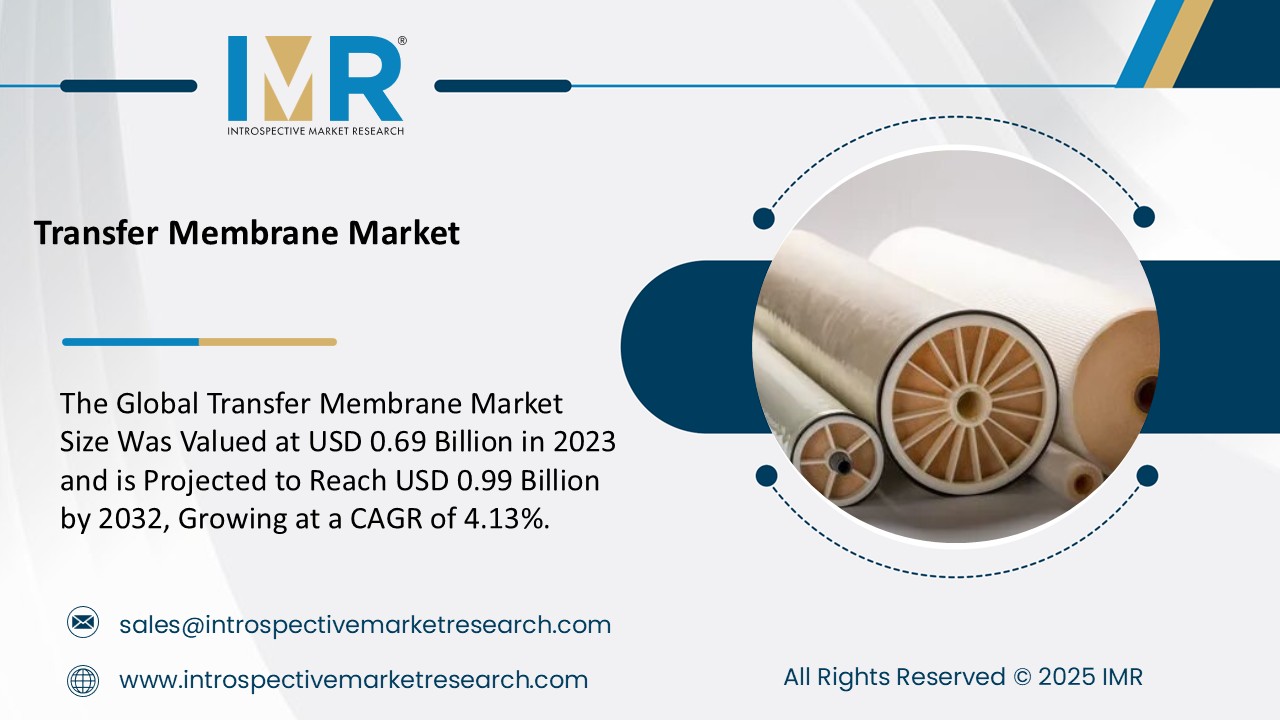
According to a new report published by Introspective Market Research, titled, Transfer Membrane Market by Product Type, Transfer Method, Application, and End-Use, The Global Transfer Membrane Market Size Was Valued at USD 0.69 Billion in 2023 and is Projected to Reach USD 0.99 Billion by 2032, Growing at a CAGR of 4.13%. The Global Transfer Membrane Market is witnessing steady growth due to the increasing adoption of molecular biology and proteomics techniques in research and diagnostics. Transfer membranes, also known as blotting membranes, are thin polymer sheets used to immobilize biomolecules, such as proteins and nucleic acids, for detection and analysis. These membranes serve as essential components in Western blotting, Southern blotting, and Northern blotting procedures.
Transfer membranes offer high binding capacity, chemical compatibility, and low background interference, making them superior to traditional alternatives such as paper-based or gel-supported substrates. They are widely used in academic laboratories, biotechnology firms, and pharmaceutical industries for protein expression studies, gene expression analysis, and biomarker discovery. The rising emphasis on personalized medicine, disease research, and advances in life sciences are expected to drive the long-term demand for these membranes across key global markets.
The Transfer Membrane Market is segmented into Product Type, Transfer Method, and Application. By Product Type, the market is categorized into (Nitrocellulose Membranes, PVDF Membranes, Nylon Membranes). By Transfer Method, the market is categorized into (Wet Transfer, Semi-Dry Transfer, Dry Transfer). By Application, the market is categorized into (Western Blotting, Southern Blotting, Northern Blotting, Others).
One of the key drivers propelling the Transfer Membrane Market is the growing investment in proteomics and genomics research. With increasing funding from both public and private sectors for life science R&D, particularly in disease diagnostics and drug development, the demand for protein detection tools such as Western blotting is expanding. This creates consistent demand for high-performance transfer membranes that ensure accuracy and reproducibility in complex analytical procedures. The surge in academic collaborations and government-backed health programs across emerging economies further fuels the adoption of transfer membranes in research and diagnostic laboratories worldwide.
A significant opportunity in the Transfer Membrane Market lies in the development of next-generation membranes offering improved performance and automation compatibility. As laboratories increasingly adopt high-throughput workflows and automation systems, there is growing demand for membranes that support faster processing, minimal sample loss, and enhanced signal clarity. Additionally, membrane manufacturers can capitalize on eco-friendly materials and recyclable packaging to align with rising sustainability standards in research institutions. Companies that focus on innovation in membrane design and scalability will be well-positioned to capture emerging demands from both academic and industrial sectors.
Transfer Membrane Market, Segmentation
The Transfer Membrane Market is segmented on the basis of Product Type, Transfer Method, and Application.
Product Type
The Product Type segment is further classified into Nitrocellulose Membranes, PVDF Membranes, and Nylon Membranes. Among these, the PVDF Membranes sub-segment accounted for the highest market share in 2023. PVDF membranes are known for their superior protein-binding capacity, mechanical strength, and chemical resistance, making them ideal for Western blotting and long-term archival purposes. Their compatibility with chemiluminescence and fluorescence detection systems makes them a preferred choice in proteomics and biomedical research. The increased use of PVDF membranes in diagnostic and therapeutic development applications contributes to their widespread adoption across laboratories globally.
Transfer Method
The Transfer Method segment is further classified into Wet Transfer, Semi-Dry Transfer, and Dry Transfer. Among these, the Wet Transfer sub-segment accounted for the highest market share in 2023. Wet transfer remains the most commonly used method in protein blotting due to its high transfer efficiency and reproducibility. Although it requires longer run times, it is particularly suited for transferring large or high molecular weight proteins. Wet transfer systems are also favored in academic and clinical research settings for their reliability in producing clear and consistent blotting results.
Some of The Leading/Active Market Players Are–
- Thermo Fisher Scientific Inc. (United States)
- Merck KGaA (Germany)
- Bio-Rad Laboratories, Inc. (United States)
- GE Healthcare (United Kingdom)
- Pall Corporation (United States)
- PerkinElmer Inc. (United States)
- Advansta Inc. (United States)
- ATTO Corporation (Japan)
- GVS S.p.A. (Italy)
- Sartorius AG (Germany)
- Azure Biosystems Inc. (United States)
- Macherey-Nagel GmbH & Co. KG (Germany)
- … and other active players.
Key Industry Developments
In May 2024, Bio-Rad Laboratories introduced its new “Stain-Free PVDF Membranes” designed to enhance Western blot sensitivity and minimize background interference. This next-gen membrane allows researchers to detect low-abundance proteins with greater clarity and faster processing times, aligning with high-throughput research requirements.
In February 2024, Merck KGaA announced a strategic partnership with an academic consortium in Europe to co-develop sustainable transfer membranes using biodegradable polymers. The initiative aims to reduce plastic waste in laboratory environments and improve the environmental impact of molecular biology research tools.
Key Findings of the Study
- PVDF Membranes dominate the product segment due to high performance in protein detection.
- Wet Transfer remains the preferred method for large protein separation.
- Increasing proteomics and diagnostics R&D is fueling global demand.
- Emerging economies and automation trends present significant market opportunities.