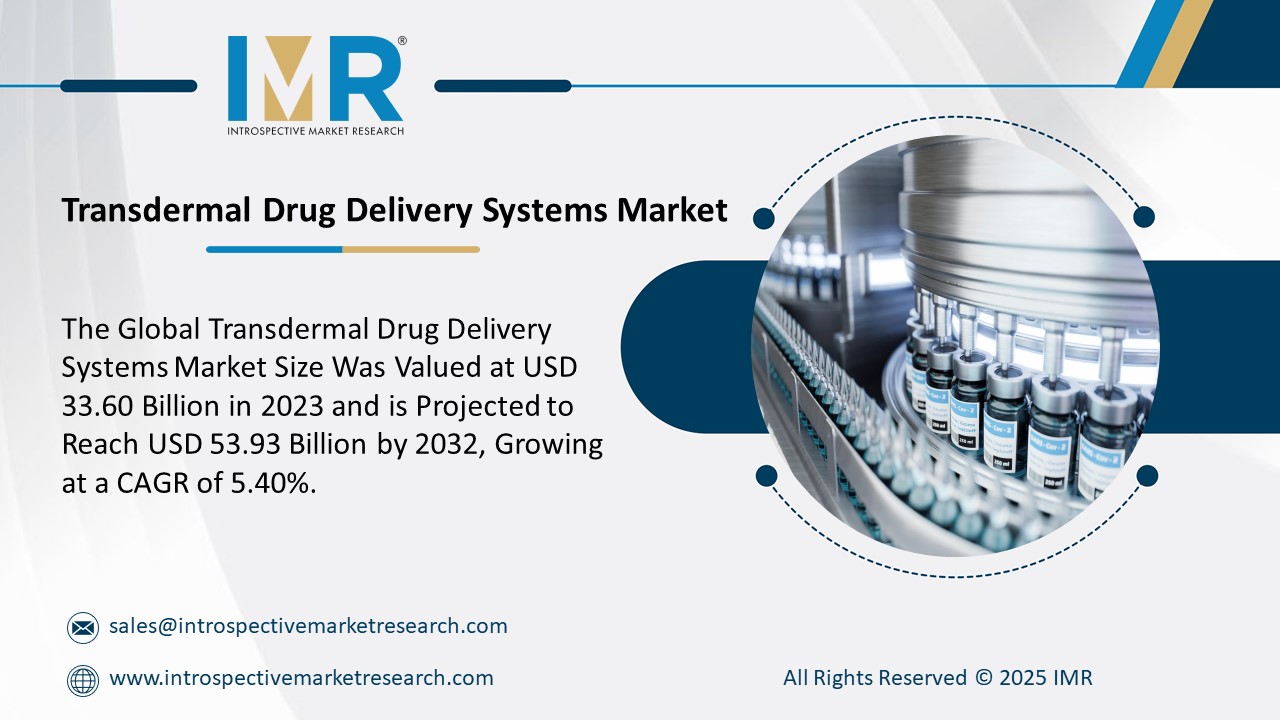
According to a new report published by Introspective Market Research, titled, Transdermal Drug Delivery Systems Market by Technology, Application, and End User, The Global Transdermal Drug Delivery Systems Market Size Was Valued at USD 33.60 Billion in 2023 and is Projected to Reach USD 53.93 Billion by 2032, Growing at a CAGR of 5.40%. The Transdermal Drug Delivery Systems Market is gaining strong momentum due to its ability to deliver therapeutic agents directly through the skin into systemic circulation, providing controlled and sustained drug release. Unlike conventional oral or injectable routes, transdermal systems minimize gastrointestinal irritation, bypass first-pass metabolism, and improve patient compliance through painless administration.
These systems are increasingly used for a wide range of therapeutic areas, including pain management, cardiovascular diseases, central nervous system disorders, and hormonal therapies. With the advancement of adhesive technologies, microneedle patches, and polymer science, transdermal systems are evolving into a reliable alternative for chronic disease management. Growing adoption in both developed and emerging economies underscores their importance in modern healthcare.
The Transdermal Drug Delivery Systems Market is segmented into Technology, Application, and End User. By Technology, the market is categorized into (Passive, Active, and Others). By Application, the market is categorized into (Pain Management, Cardiovascular Disorders, Hormone Replacement Therapy, Central Nervous System Disorders, Smoking Cessation, and Others). By End User, the market is categorized into (Hospitals, Homecare, and Clinics).
One of the key growth drivers of the Transdermal Drug Delivery Systems Market is the rising prevalence of chronic diseases requiring long-term therapy. Patients with cardiovascular conditions, chronic pain, or neurological disorders benefit from consistent and controlled drug release, reducing dosing frequency and enhancing adherence. This growing demand for convenient, non-invasive, and patient-friendly drug administration methods is accelerating market expansion globally.
A major market opportunity lies in the development of advanced microneedle patches and next-generation wearable drug delivery systems. These innovations offer painless administration and precision dosing, opening doors for biologics, peptides, and vaccines traditionally limited to injections. Strategic collaborations between pharmaceutical companies and medtech innovators are expected to accelerate commercialization, creating lucrative opportunities in the coming years.
Transdermal Drug Delivery Systems Market, Segmentation
The Transdermal Drug Delivery Systems Market is segmented on the basis of Technology, Application, and End User.
Technology
The technology segment is further classified into Passive, Active, and Others. Among these, the Passive sub-segment accounted for the highest market share in 2023. Passive transdermal systems are widely adopted due to their cost-effectiveness, ease of manufacturing, and strong safety profile. They have been the backbone of commercially available patches for decades, with proven efficacy in nicotine replacement, hormone therapy, and pain management applications.
Application
The application segment is further classified into Pain Management, Cardiovascular Disorders, Hormone Replacement Therapy, Central Nervous System Disorders, Smoking Cessation, and Others. Among these, the Pain Management sub-segment accounted for the highest market share in 2023. The rising prevalence of chronic pain conditions such as arthritis, neuropathic pain, and post-surgical pain has increased demand for transdermal patches, which offer steady analgesic delivery while minimizing gastrointestinal side effects associated with oral medications.
Some of The Leading/Active Market Players Are-
- Johnson & Johnson (US)
- Novartis AG (Switzerland)
- 3M Company (US)
- GlaxoSmithKline plc (UK)
- Hisamitsu Pharmaceutical Co., Inc. (Japan)
- Mylan N.V. (US)
- Luye Pharma Group (China)
- Corium, Inc. (US)
- Teva Pharmaceutical Industries Ltd. (Israel)
- Endo International plc (Ireland)
- Boehringer Ingelheim (Germany)
- Zosano Pharma Corporation (US)
- Nitto Denko Corporation (Japan)
- Purdue Pharma (US)
- Bayer AG (Germany) and other active players.
Key Industry Developments
-
In February 2024, 3M launched its next-generation transdermal drug delivery platform designed to enhance efficiency in delivering large-molecule biologics.
This innovation is expected to expand transdermal applications beyond traditional drugs, supporting the shift towards biologic therapies and improving treatment accessibility. - In April 2024, Johnson & Johnson partnered with a medtech startup to develop wearable microneedle patches for vaccine delivery.
The collaboration highlights growing industry interest in painless, self-administered transdermal technologies, offering a promising alternative to syringes in global immunization programs.
Key Findings of the Study
- Passive transdermal technology dominates the market.
- Pain management is the leading application segment.
- Growth driven by rising chronic disease prevalence.
- Microneedle and wearable systems present new opportunities.
- North America and Europe lead in adoption.