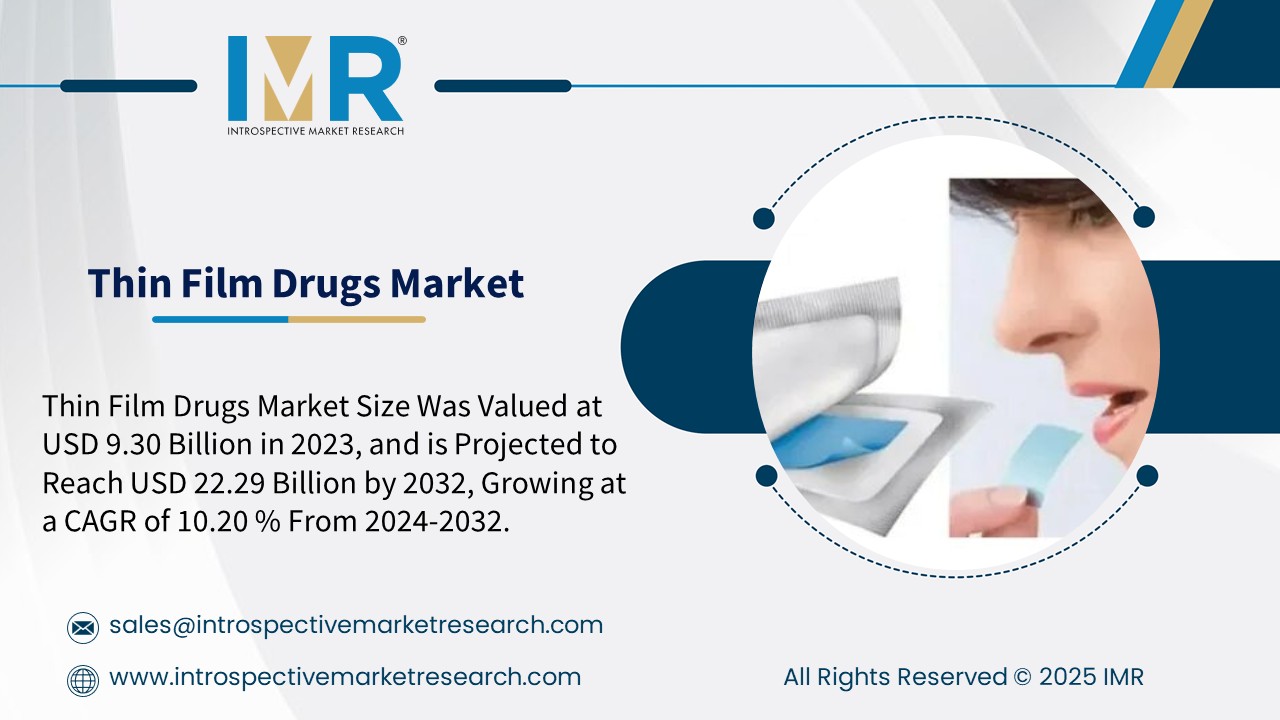
According to a new report published by Introspective Market Research, titled, Thin Film Drugs Market by Product, Disease Indication, and Distribution Channel, the Global Thin Film Drugs Market Size Was Valued at USD 9.30 Billion in 2023 and is Projected to Reach USD 22.29 Billion by 2032, Growing at a CAGR of 10.20% from 2024 to 2032.The Thin Film Drugs Market is gaining significant traction as a modern drug delivery technology that offers a convenient, effective, and patient-friendly alternative to conventional dosage forms. Thin films dissolve rapidly on the tongue or oral mucosa, enabling faster absorption, improved bioavailability, and greater ease of administration compared to tablets or capsules.
With increasing demand for painless, non-invasive, and precise drug delivery methods, thin film technologies are being widely adopted across therapeutic areas such as central nervous system disorders, pain management, gastrointestinal conditions, and hormonal therapies. Their portability, dosing accuracy, and suitability for pediatric and geriatric patients make thin film drugs a preferred choice for both patients and healthcare providers.
A major growth driver for the Thin Film Drugs Market is the increasing preference for non-invasive and fast-acting drug delivery systems. Patients, particularly pediatric and geriatric populations, often face difficulties in swallowing tablets or capsules, making thin film formulations a more accessible and convenient option. Additionally, their ability to bypass the gastrointestinal tract and first-pass metabolism enhances bioavailability, which further boosts adoption among pharmaceutical companies and healthcare providers.
The Thin Film Drugs Market presents a strong opportunity in expanding its applications to emerging therapeutic areas such as vaccines and personalized medicine. The rapid onset of action and ability to deliver peptides, proteins, and other biologics through innovative thin film technologies could revolutionize drug delivery. Increasing R&D investment and partnerships between pharmaceutical companies and research institutes are expected to accelerate product pipeline development, creating significant market potential over the coming decade.
Thin Film Drugs Market, Segmentation
The Thin Film Drugs Market is segmented on the basis of Product, Disease Indication, and Distribution Channel.
Product
- The product segment is further classified into Oral Thin Films and Transdermal Thin Films. Among these, the Oral Thin Films sub-segment accounted for the highest market share in 2023. Oral thin films are increasingly adopted due to their ease of use, quick disintegration in the oral cavity, and enhanced patient compliance. Their application in treating CNS disorders, migraines, and nausea has accelerated demand, while ongoing innovations in taste masking and formulation technologies are expected to sustain growth.
Disease Indication
- The disease indication segment is further classified into Schizophrenia, Migraine, Opioid Dependence, Nausea & Vomiting, and Others. Among these, the Schizophrenia sub-segment accounted for the highest market share in 2023. Thin film drugs provide consistent dosing and improved compliance in schizophrenia treatment, addressing one of the most critical challenges in managing the disorder. The non-invasive format ensures greater acceptance among patients who require long-term medication adherence.
Some of The Leading/Active Market Players Are-
- Aquestive Therapeutics (USA)
- ZIM Laboratories (India)
- IntelGenx Corp. (Canada)
- Pfizer Inc. (USA)
- Johnson & Johnson (USA)
- Indivior PLC (UK)
- Sanofi (France)
- Sunovion Pharmaceuticals (USA)
- CURE Pharmaceutical (USA)
- NAL Pharma (Singapore)
- Novartis AG (Switzerland)
- Allergan (Ireland)
- LTS Lohmann Therapie-Systeme AG (Germany)
- BioDelivery Sciences International (USA) and other active players.
Key Industry Developments
- In May 2023, Aquestive Therapeutics announced positive clinical trial results for its sublingual film designed for epilepsy treatment.
This development highlighted the potential of thin film technology in expanding treatment options beyond conventional formulations, improving bioavailability and patient adherence. - In November 2022, IntelGenx partnered with atai Life Sciences to advance psychedelic-based oral thin film therapeutics for mental health disorders.
The collaboration demonstrated growing innovation in thin film delivery platforms, targeting unmet needs in mental health and strengthening pipeline diversity.
Key Findings of the Study
- Oral Thin Films dominated the product segment in 2023.
- Schizophrenia treatment held the largest share among disease indications.
- North America emerged as the leading regional market.
- Rising demand for non-invasive, patient-friendly dosage forms drives growth.
- Increasing R&D in biologics and personalized medicine creates future opportunities.