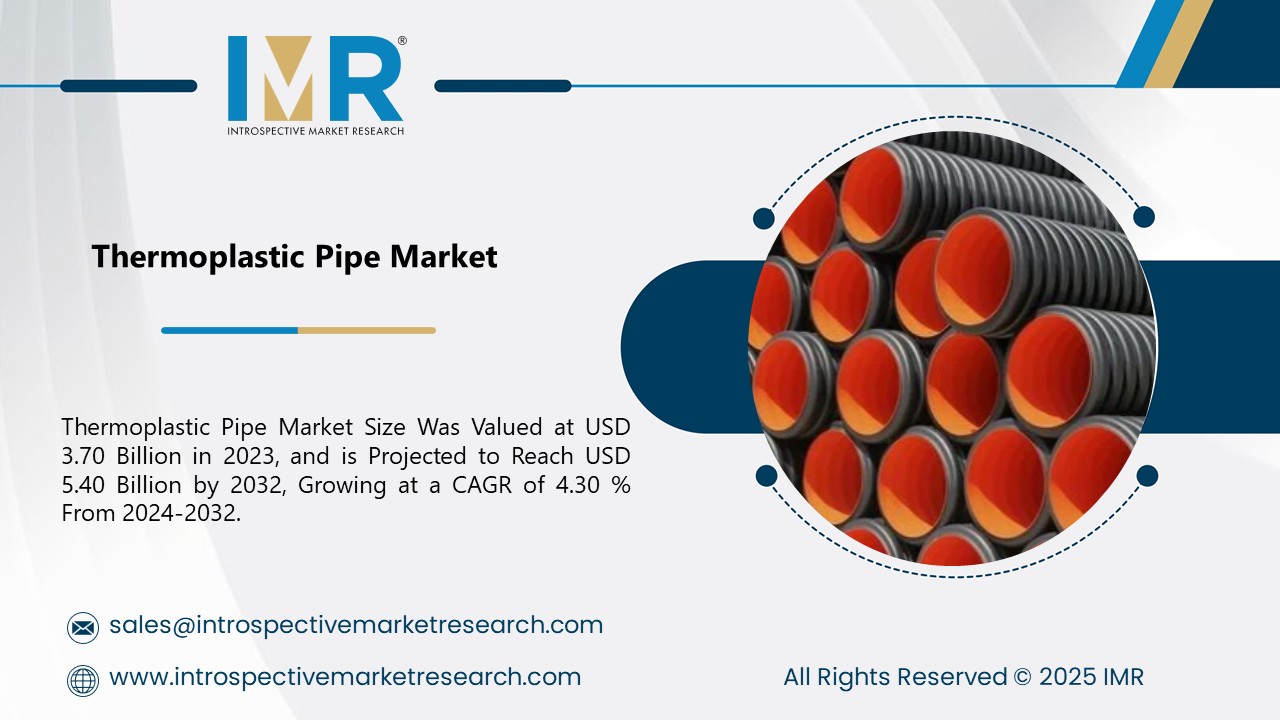
According to a new report published by Introspective Market Research, titled, Thermoplastic Pipe Market by Product Type, Application, and Region, The Global Thermoplastic Pipe Market Size Was Valued at USD 3.70 Billion in 2023 and is Projected to Reach USD 5.40 Billion by 2032, Growing at a CAGR of 4.30%.”The thermoplastic pipe market is experiencing robust growth, driven by increasing demand across various industrial sectors. These advanced piping systems offer a superior alternative to traditional materials like metal, providing enhanced durability, corrosion resistance, and flexibility. Thermoplastic pipes are manufactured from a range of polymeric materials, including polyethylene (PE), polypropylene (PP), and polyvinylidene fluoride (PVDF), each offering distinct properties suited for specific applications.
These pipes are extensively utilized in critical infrastructure projects such as water and wastewater management, oil and gas transportation, chemical processing, and mining. Their lightweight nature facilitates easier installation and reduces transportation costs, while their inertness to chemicals ensures a longer lifespan and minimal maintenance compared to conventional options. The inherent advantages of thermoplastic pipes are making them an increasingly preferred choice for engineers and project managers seeking reliable and cost-effective solutions.
The Thermoplastic Pipe Market is segmented into Product Type, Application, and Region. By Product Type, the market is categorized into (PE, PP, PVDF, and Others). By Application, the market is categorized into (Oil & Gas, Chemical, Water & Wastewater, Mining, and Others). By Region, the market is categorized into (North America, Europe, Asia Pacific, Middle East & Africa, and Latin America).
key growth driver for the thermoplastic pipe market is the escalating demand for infrastructure development globally, particularly in emerging economies. Governments and private entities are investing heavily in upgrading and expanding water supply networks, sanitation systems, and industrial facilities. Thermoplastic pipes, with their superior performance characteristics such as corrosion resistance, leak-free joints, and long service life, are ideally suited for these long-term infrastructure projects. The need for sustainable and efficient solutions that can withstand harsh operating conditions and reduce operational costs further fuels their adoption.
A significant market opportunity lies in the increasing adoption of trenchless technology for pipe installation and rehabilitation. Trenchless methods, such as horizontal directional drilling (HDD) and pipe bursting, minimize disruption to surface areas, reduce environmental impact, and lower overall project costs. Thermoplastic pipes, particularly those made from polyethylene, are highly compatible with these techniques due to their flexibility, strength, and ability to be fusion-welded into long, continuous lengths. As urbanisation continues and the need for efficient infrastructure upgrades grows, the synergy between thermoplastic pipes and trenchless technologies presents a lucrative avenue for market expansion.
Thermoplastic Pipe Market, Segmentation
The Thermoplastic Pipe Market is segmented on the basis of Product Type, Application, and Region.
Product Type
- The Product Type segment is further classified into PE, PP, PVDF, and Others. Among these, the PE (Polyethylene) sub-segment accounted for the highest market share in 2023. PE pipes are widely used due to their excellent flexibility, impact resistance, and chemical inertness, making them suitable for a diverse range of applications including water distribution, gas gathering, and industrial piping. Their ability to be fusion-welded creates leak-free systems, significantly reducing maintenance and operational costs over their long lifespan. The material's durability and resistance to harsh environmental conditions also contribute to its dominance in the market.
Application
- The Application segment is further classified into Oil & Gas, Chemical, Water & Wastewater, Mining, and Others. Among these, the Oil & Gas sub-segment accounted for the highest market share in 2023. Thermoplastic pipes are increasingly being adopted in the oil and gas industry for various applications, including gathering lines, flow lines, and injection lines, particularly in challenging offshore and corrosive environments. Their resistance to corrosion from hydrocarbons and various chemicals, coupled with their high pressure ratings, offers a significant advantage over traditional steel pipes. The lightweight nature also reduces installation time and costs, enhancing operational efficiency in exploration and production activities.
Some of The Leading/Active Market Players Are-
- Advanced Drainage Systems (USA)
- Acu-Tech Piping Systems (Australia)
- Aliaxis (Belgium)
- Chevron Phillips Chemical Company (USA)
- Egeplast international (Germany)
- F.W. Webb Company (USA)
- Future Pipe Industries (UAE)
- Georg Fischer Ltd. (Switzerland)
- JM Eagle (USA)
- Pipelife International GmbH (Austria)
- Polypipe (UK)
- SABIC (Saudi Arabia)
- Uponor Corporation (Finland)
- Wienerberger AG (Austria)
- WL Plastics (USA) Other active players.
Key Industry Developments
- In January 2023, a major pipeline project in North America announced its decision to exclusively use large-diameter PE thermoplastic pipes for its new water transmission network. This project, aimed at improving municipal water supply, highlights the growing confidence in thermoplastic solutions for critical urban infrastructure. The selection was primarily based on the pipes' long-term reliability and resistance to corrosion, ensuring a sustainable and cost-effective system for decades to come.
- In June 2023, a leading thermoplastic pipe manufacturer unveiled a new line of high-pressure PVDF pipes specifically designed for aggressive chemical processing applications. This innovation responds to the increasing demand from the chemical industry for piping solutions that can withstand extreme temperatures and highly corrosive substances. The new product range is expected to enhance safety and operational efficiency in chemical plants worldwide, offering superior performance compared to existing alternatives.
Key Findings of the Study
- The PE segment dominates the thermoplastic pipe market due to its versatility and durability.
- The oil and gas industry remains the leading application area, driven by corrosion resistance needs.
- Infrastructure development and trenchless technology adoption are key growth drivers.
- The market is experiencing a shift towards sustainable and cost-effective piping solutions.
- North America and Asia Pacific are leading regions in market adoption and growth.