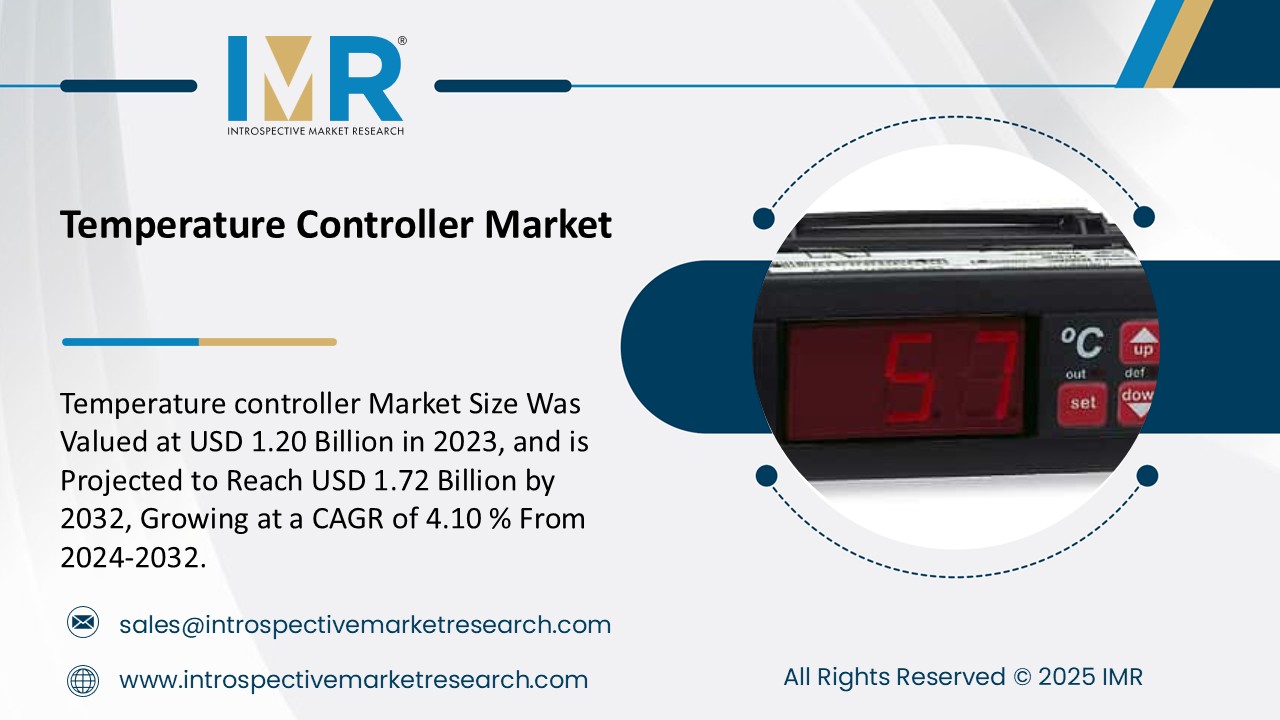
According to a new report published by Introspective Market Research, titled, Global Temperature Controller Market by Type, Control Method, and End-Use Industry, the Global Temperature Controller Market Size Was Valued at USD 1.20 Billion in 2023 and is Projected to Reach USD 1.72 Billion by 2032, Growing at a CAGR of 4.10% from 2024 to 2032. The Global Temperature Controller Market is steadily expanding as industries increasingly adopt automation and precision-driven technologies. Temperature controllers are devices that regulate temperature by comparing a sensor signal with a setpoint and performing necessary adjustments via heating or cooling mechanisms. These controllers play a crucial role in industries where maintaining exact temperature ranges is vital for product quality, safety, and process efficiency.
Modern temperature controllers offer improved performance, flexibility, and connectivity compared to traditional thermostats or analog devices. Equipped with digital interfaces, programmable parameters, and integration with IoT platforms, these controllers are widely used across manufacturing, food processing, chemical, plastics, HVAC, and laboratory environments. The shift toward Industry 4.0, along with increasing demand for energy efficiency, is contributing to the wider adoption of advanced temperature control solutions globally.
The Global Temperature Controller Market is segmented into Type, Control Method, and End-Use Industry. By Type, the market is categorized into (Analog, Digital, and Hybrid). By Control Method, the market is categorized into (On/Off Control, Proportional Control, and PID Control). By End-Use Industry, the market is categorized into (Food & Beverage, Chemicals, Oil & Gas, Plastics, Pharmaceuticals, and HVAC & Refrigeration).
One of the key drivers of the Global Temperature Controller Market is the increasing demand for automation in manufacturing processes. Modern production lines rely on highly accurate thermal control to maintain product quality, reduce waste, and improve safety. Temperature controllers allow real-time adjustments, reducing human error and increasing operational efficiency. Their compatibility with industrial control systems and IoT networks makes them vital for next-generation smart factories, helping enterprises meet regulatory standards and maintain competitive production cycles.
A major opportunity lies in the growing demand for energy-efficient solutions, particularly in HVAC and industrial applications. As industries aim to lower carbon footprints and optimize energy consumption, temperature controllers with intelligent algorithms and adaptive features are becoming essential. Companies investing in energy-saving solutions are increasingly adopting digital and PID-based controllers, which offer superior accuracy and control. This presents a lucrative opportunity for manufacturers to innovate and offer environmentally sustainable and cost-effective solutions to a broad customer base.
Global Temperature Controller Market, Segmentation
The Global Temperature Controller Market is segmented on the basis of Type, Control Method, and End-Use Industry.
Type
The Type segment is further classified into Analog, Digital, and Hybrid. Among these, the Digital sub-segment accounted for the highest market share in 2024. Digital temperature controllers offer higher accuracy, flexible programming, and better integration with digital interfaces and IoT platforms. Their ability to provide real-time monitoring and remote access makes them a preferred choice in modern industrial environments, where efficiency and automation are key operational priorities.
Control Method
The Control Method segment is further classified into On/Off Control, Proportional Control, and PID Control. Among these, the PID Control sub-segment accounted for the highest market share in 2024. PID controllers (Proportional-Integral-Derivative) deliver precise and stable temperature regulation, minimizing overshoot and fluctuations. They are ideal for complex systems where high-accuracy control is necessary, such as in chemical processing, pharmaceuticals, and advanced manufacturing. Their adaptability and reliability have driven widespread adoption across multiple sectors.
Some of The Leading/Active Market Players Are–
- Omron Corporation (Japan)
- Honeywell International Inc. (USA)
- ABB Ltd. (Switzerland)
- Schneider Electric SE (France)
- Fuji Electric Co., Ltd. (Japan)
- Watlow Electric Manufacturing Company (USA)
- Eurotherm by Schneider Electric (UK)
- Durex Industries (USA)
- Autonics Corporation (South Korea)
- West Control Solutions (Germany)
- Delta Electronics, Inc. (Taiwan)
- Panasonic Corporation (Japan)
- RKC Instrument Inc. (Japan)
- …and other active players.
Key Industry Developments
In February 2024, Omron Corporation launched its next-generation digital temperature controller series, featuring AI-based predictive control.
The new controller series is designed to minimize process deviation, automatically adjust parameters, and improve energy efficiency in industrial applications. With built-in connectivity to major PLCs and cloud platforms, this product aims to support smart manufacturing initiatives across industries, particularly in Asia-Pacific and Europe.
In June 2024, Honeywell introduced a scalable temperature and environmental control platform for commercial HVAC systems.
This modular system provides seamless integration with building automation systems and uses predictive analytics to optimize HVAC performance and energy use. The solution was piloted in large commercial buildings in the United States and showed significant improvements in energy savings and occupant comfort.
Key Findings of the Study
- Digital temperature controllers lead the market due to higher precision and integration capabilities.
- PID control is the most dominant method, driven by demand for accuracy in complex processes.
- Manufacturing and HVAC industries are primary end-users of temperature controllers.
- Rising industrial automation and energy efficiency standards are key market growth drivers.
- Asia-Pacific is emerging as a high-growth region due to increased factory automation adoption.