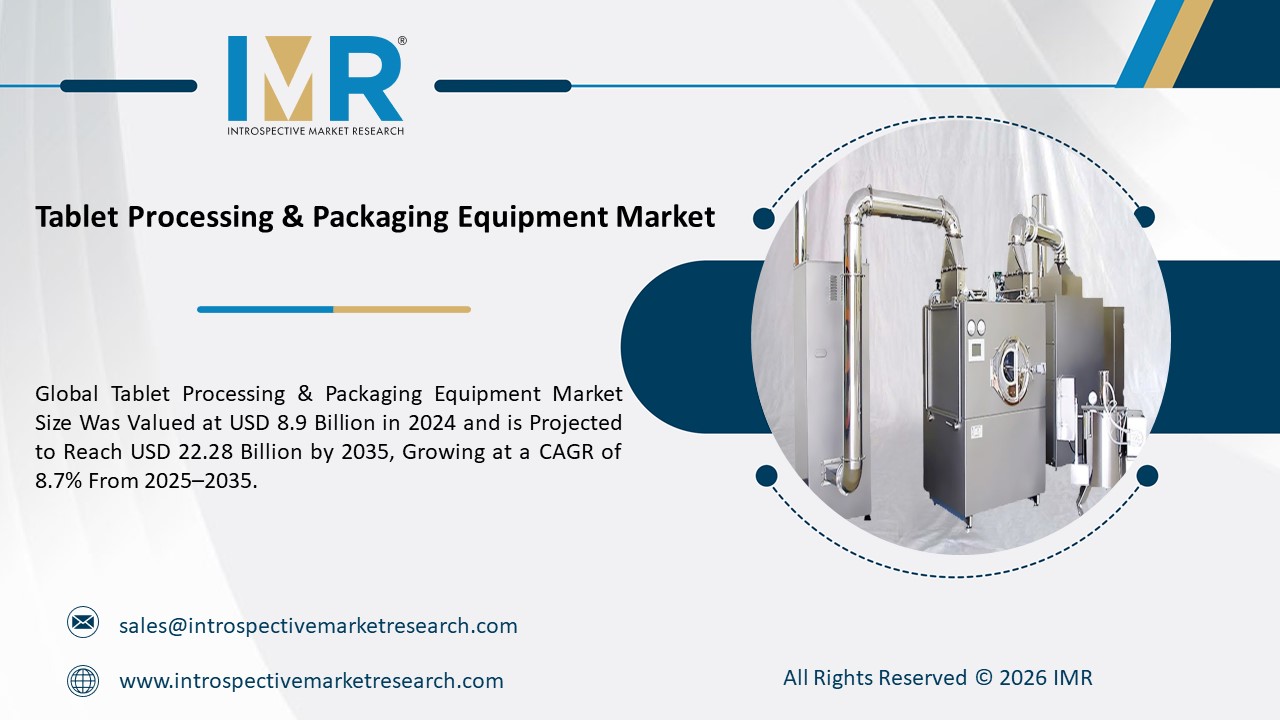
According to a new report published by Introspective Market Research, titled, “Tablet Processing & Packaging Equipment Market by Equipment Type, End User, and Region,” The Global Tablet Processing & Packaging Equipment Market Size Was Valued at USD 8.9 Billion in 2024 and is Projected to Reach USD 22.28 Billion by 2035, Growing at a CAGR of 8.7% From 2025–2035.
The tablet processing market plays a critical role in the pharmaceutical, nutraceutical, and chemical industries by enabling the efficient production of solid oral dosage forms. Tablet processing includes a range of operations such as granulation, blending, compression, coating, and inspection, all of which ensure uniformity, stability, and quality of tablets. These processes are supported by advanced machinery designed to meet stringent regulatory and quality standards.
Compared to traditional manufacturing methods, modern tablet processing solutions offer higher automation, improved precision, reduced contamination risk, and enhanced production efficiency. Tablets remain one of the most preferred dosage forms due to their convenience, accurate dosing, longer shelf life, and cost-effectiveness. As demand for pharmaceutical products continues to rise globally, tablet processing has become a cornerstone of large-scale drug manufacturing.
Market Segmentation
The Tablet Processing Market is segmented into Equipment Type, End User, and Region.
- By Equipment Type, the market is categorized into Granulation Equipment, Tablet Press Machines, Coating Machines, and Inspection & Packaging Equipment.
- By End User, the market is categorized into Pharmaceutical Companies, Contract Manufacturing Organizations (CMOs), and Nutraceutical Manufacturers.
- By Region, the market is categorized into North America, Europe, Asia-Pacific, Latin America, and the Middle East & Africa.
Growth Driver
One of the key growth drivers of the tablet processing market is the increasing global demand for pharmaceutical products driven by the rising prevalence of chronic diseases. Conditions such as diabetes, cardiovascular disorders, and neurological diseases require long-term medication, most of which is delivered in tablet form. This sustained demand has pushed pharmaceutical manufacturers to expand production capacities, invest in high-speed tablet processing equipment, and adopt automated solutions to improve efficiency, quality, and compliance with regulatory standards.
Market Opportunity
A major market opportunity lies in the rapid growth of the pharmaceutical and nutraceutical industries in emerging economies. Countries in Asia-Pacific and Latin America are witnessing expanding healthcare infrastructure, increasing healthcare spending, and growing access to generic medicines. This creates strong opportunities for tablet processing equipment manufacturers to supply cost-effective, scalable, and technologically advanced solutions. Additionally, the trend toward continuous manufacturing and Industry 4.0 integration is expected to unlock new revenue streams across the market.
Detailed Segmentation
Tablet Processing Market, Segmentation
The Tablet Processing Market is segmented on the basis of Equipment Type, End User, and Region.
Equipment Type
The Equipment Type segment is further classified into Granulation Equipment, Tablet Press Machines, and Coating Machines. Among these, the Tablet Press Machines sub-segment accounted for the highest market share in 2024. Tablet press machines are essential for high-volume tablet production and offer high speed, precision, and consistency. Continuous advancements in press technology, including multi-layer tablet presses and automated control systems, have further strengthened their dominance in the market.
End User
The End User segment is further classified into Pharmaceutical Companies, Contract Manufacturing Organizations, and Nutraceutical Manufacturers. Among these, Pharmaceutical Companies accounted for the highest market share in 2024. Large pharmaceutical manufacturers rely heavily on tablet processing equipment to support mass production, ensure regulatory compliance, and maintain consistent product quality. Increasing investments in drug development and manufacturing facilities continue to support segment growth.
Some of The Leading/Active Market Players Are-
• GEA Group (Germany)
• Fette Compacting (Germany)
• I.M.A. Group (Italy)
• Glatt GmbH (Germany)
• ACG Worldwide (India)
• Bosch Packaging Technology (Germany)
• KORSCH AG (Germany)
• Freund Corporation (Japan)
• Romaco Group (Germany)
• L.B. Bohle Maschinen + Verfahren GmbH (Germany)
• Uhlmann Pac-Systeme (Germany)
• Syntegon Technology (Germany)
• Cambridge Technology (U.S.)
• Elizabeth Companies (U.S.)
• Other active players.
Key Industry Developments
In March 2024, a leading tablet processing equipment manufacturer launched a new high-speed tablet press with enhanced automation features.
The newly introduced system focuses on improving production efficiency, reducing downtime, and ensuring real-time quality monitoring, supporting pharmaceutical manufacturers in meeting rising production demands.
In September 2024, a global pharmaceutical equipment company expanded its manufacturing facility in Asia-Pacific.
This expansion aims to strengthen regional supply chains, reduce equipment delivery timelines, and cater to the rapidly growing demand for tablet processing solutions in emerging pharmaceutical markets.
Key Findings of the Study
• Tablet press machines dominate the equipment type segment
• Pharmaceutical companies remain the leading end users
• Asia-Pacific is the fastest-growing regional market
• Rising chronic disease prevalence drives demand
• Automation and continuous manufacturing are key trends