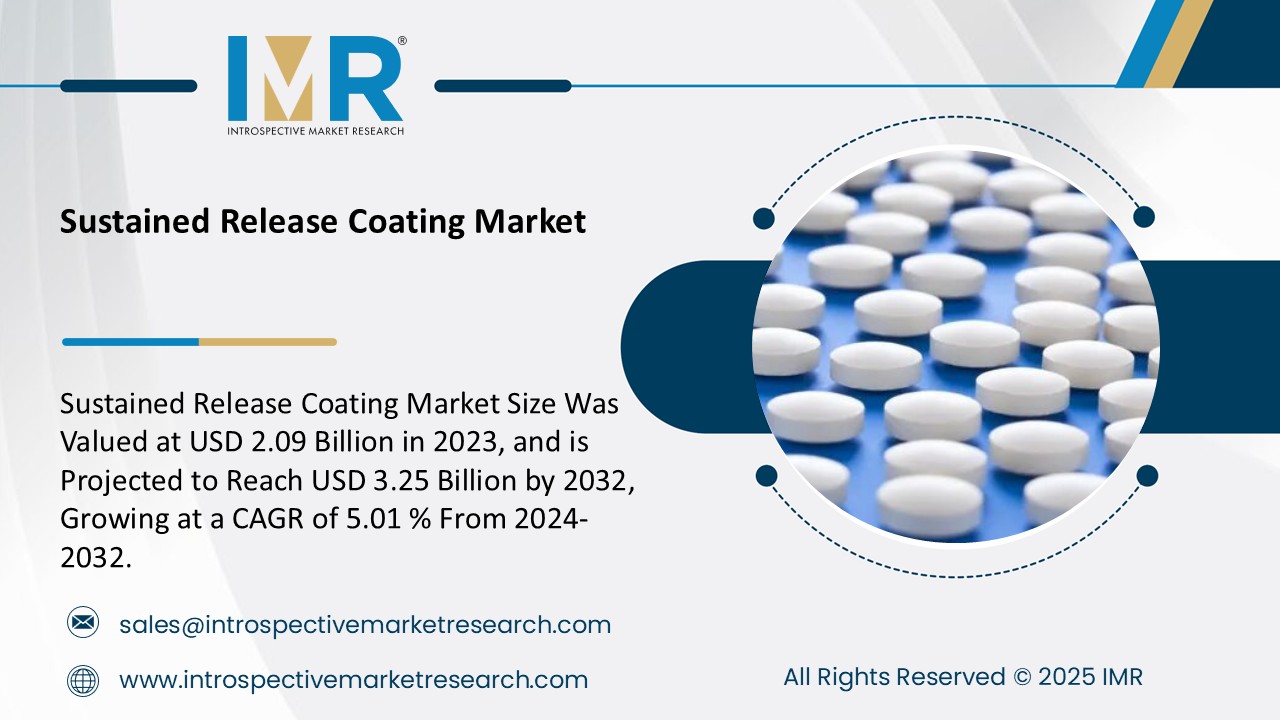
According to a new report published by Introspective Market Research, titled, Sustained Release Coating Market by Polymer Type, Substrate Type, and Application, the Global Sustained Release Coating Market Size Was Valued at USD 2.09 Billion in 2024 and is Projected to Reach USD 3.25 Billion by 2032, Growing at a CAGR of 5.01% from 2025 to 2032. The sustained release coating market is gaining significant momentum in the pharmaceutical industry due to the increasing demand for controlled drug delivery systems. Sustained release coatings are polymer-based materials applied to drug particles or tablets to control the release rate of active pharmaceutical ingredients (APIs) over an extended period. These coatings improve patient compliance, reduce dosage frequency, and help maintain consistent therapeutic drug levels in the bloodstream.
The technology offers a strategic advantage over conventional formulations, particularly for chronic disease management, where prolonged and stable medication effects are crucial. Additionally, the emergence of advanced coating techniques and the development of biocompatible polymers are broadening application scopes. The market is witnessing increased investments from pharmaceutical manufacturers aiming to enhance drug efficacy, minimize side effects, and optimize treatment outcomes.
The Sustained Release Coating Market is segmented into Polymer Type, Substrate Type, and Application. By Polymer Type, the market is categorized into (Ethyl & Methyl Cellulose, Polyvinyl & Cellulose Acetate, Methacrylate, Others). By Substrate Type, the market is categorized into (Tablets, Capsules, Pills). By Application, the market is categorized into (In Vitro and In Vivo).
One of the key growth drivers of the sustained release coating market is the rising prevalence of chronic diseases such as diabetes, cardiovascular disorders, and neurological conditions, which require long-term and consistent drug therapy. Sustained release formulations, enabled by specialized coatings, provide a convenient solution by reducing the frequency of medication, enhancing patient adherence, and improving therapeutic outcomes. This demand is further supported by healthcare providers advocating for treatment regimens that promote stable pharmacokinetics with minimal side effects.
A major market opportunity lies in the innovation and adoption of biodegradable and biocompatible polymers for sustained release coatings. As regulatory agencies place increasing emphasis on safety and environmental impact, pharmaceutical companies are investing in research to develop coatings that are not only efficient but also safe for the human body and the environment. These advanced materials allow for more precise control of drug release rates and open new pathways for targeted delivery systems in complex therapeutic areas.
Sustained Release Coating Market, Segmentation
The Sustained Release Coating Market is segmented on the basis of Polymer Type, Substrate Type, and Application.
Polymer Type
The Polymer Type segment is further classified into Ethyl & Methyl Cellulose, Polyvinyl & Cellulose Acetate, Methacrylate, and Others. Among these, the Ethyl & Methyl Cellulose sub-segment accounted for the highest market share in 2025. This dominance is attributed to its superior film-forming properties, high chemical stability, and ability to create moisture-resistant barriers. These polymers are extensively used in coating formulations for sustained release, particularly in oral solid dosage forms. Their compatibility with a wide range of APIs makes them a preferred choice among pharmaceutical formulators.
Substrate Type
The Substrate Type segment is further classified into Tablets, Capsules, and Pills. Among these, the Tablets sub-segment accounted for the highest market share in 2025. Tablets are the most commonly used oral dosage form, and their popularity stems from ease of manufacturing, packaging, and patient usage. Sustained release coatings on tablets allow precise control over drug release profiles, which is essential for treating chronic conditions. Their scalability and cost-effectiveness make them the preferred substrate for sustained release applications.
Some of The Leading/Active Market Players Are-
- Colorcon Inc. (USA)
- BASF SE (Germany)
- Evonik Industries AG (Germany)
- Lubrizol Corporation (USA)
- Coating Place Inc. (USA)
- Ashland Global Holdings Inc. (USA)
- Merck KGaA (Germany)
- Sensient Technologies Corporation (USA)
- Ideal Cures Pvt. Ltd. (India)
- Kerry Group plc (Ireland)
- Corel Pharma Chem (India)
- Eastman Chemical Company (USA)
…and other active players.
Key Industry Developments
In March 2024, Colorcon launched its new line of Opadry® EC coating systems based on cellulose derivatives for sustained release applications.
This new formulation offers enhanced moisture protection, better flowability during processing, and superior control of API release profiles, making it ideal for high-load tablets. The launch strengthens Colorcon's portfolio in modified-release technologies.
In June 2024, Evonik Industries AG announced the expansion of its production facility in Darmstadt, Germany, for EUDRAGIT® polymers.
The investment is aimed at meeting growing global demand for advanced sustained release coating materials. These polymers are widely used in oral drug delivery systems and support customized drug release across various therapeutic areas.
Key Findings of the Study
- Ethyl & Methyl Cellulose leads the polymer segment due to superior film-forming ability.
- Tablets dominate the substrate segment for their flexibility and high patient acceptance.
- North America and Europe are leading regions, driven by pharmaceutical innovation.
- Growth is driven by chronic disease prevalence and demand for patient-centric therapies.
- Biodegradable polymers present a strong future opportunity for market expansion.