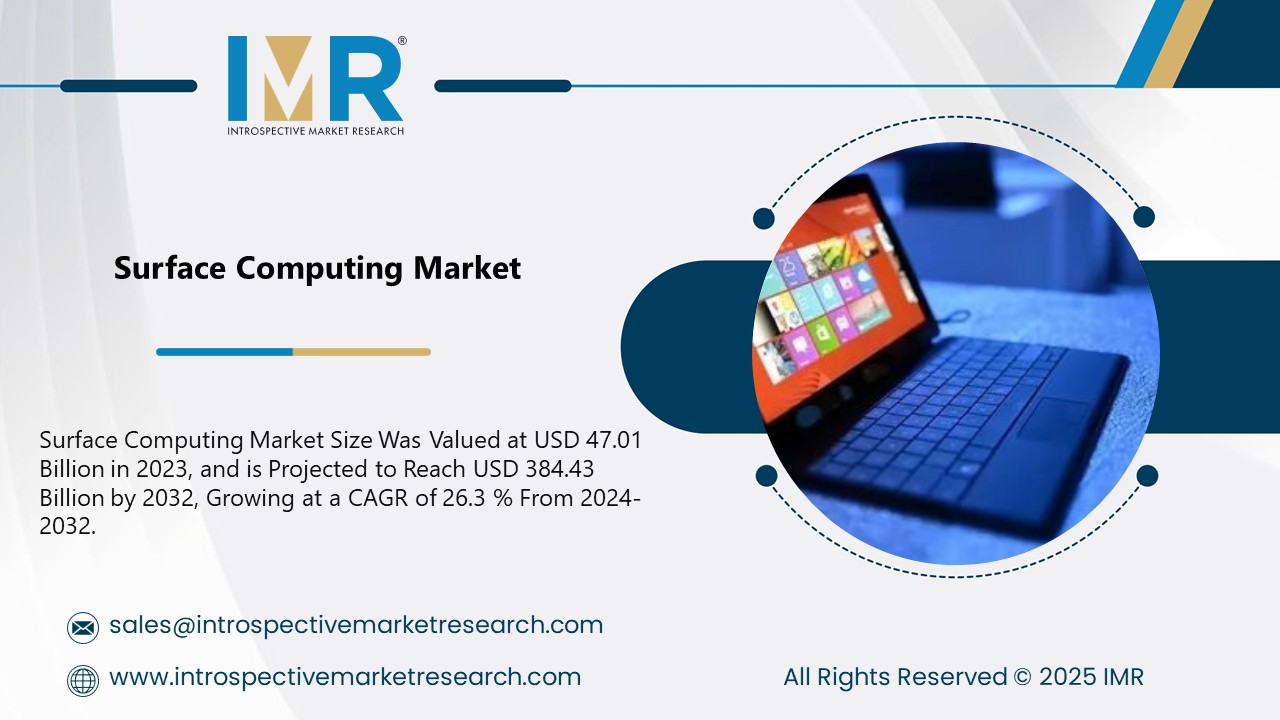
According to a new report published by Introspective Market Research, titled, Surface Computing Market by Technology, Component, Application, and End-User, The Global Surface Computing Market Size Was Valued at USD 47.01 Billion in 2023 and is Projected to Reach USD 384.43 Billion by 2032, Growing at a CAGR of 26.3%. The surface computing market refers to interactive computing devices that allow users to interact with digital content directly on a surface, such as a table, wall, or mirror, using natural gestures, touch, and sometimes real-world objects. These systems blend digital information with physical environments, moving beyond traditional screens to create immersive and collaborative experiences. Products range from interactive displays in retail and education to specialized tables in hospitality and control rooms, fundamentally changing how humans interface with technology and data.
Surface computing offers significant advantages over traditional computing methods by providing a more intuitive, multi-user, and immersive experience. Unlike conventional screens, surface computers enable direct manipulation of digital content, fostering natural interaction that can enhance collaboration, learning, and engagement. Its main uses span major industries including retail and hospitality for interactive displays, education for collaborative learning, healthcare for interactive patient engagement, and enterprise for dynamic presentation and data visualization, transforming passive viewing into active participation.
A primary growth driver for the surface computing market is the increasing demand for enhanced interactive experiences and collaborative environments across various sectors. As workplaces evolve towards more dynamic and team-oriented settings, and educational institutions seek engaging learning tools, surface computing provides intuitive platforms for shared digital interaction. Its ability to support multiple users simultaneously with natural gestures fosters greater engagement and productivity in brainstorming sessions, project reviews, and classroom activities, making it an attractive solution for organizations aiming to boost collaboration and user engagement.
A significant market opportunity lies in the expanding adoption of surface computing in smart retail environments and the development of intelligent, interactive public spaces. As retailers seek innovative ways to attract customers, enhance shopping experiences, and provide personalized information, interactive surfaces can transform storefronts, fitting rooms, and product displays. Beyond retail, smart cities can leverage interactive public surfaces for wayfinding, information dissemination, and community engagement, offering dynamic and accessible digital interfaces. This push towards highly interactive and context-aware physical spaces presents a lucrative avenue for innovation and deployment of surface computing technologies.
Surface Computing Market, Segmentation
The Surface Computing Market is segmented on the basis of Technology, Component, and Application.
Technology
- The Technology segment is further classified into Multitouch, Multi-user, Gesture Recognition, and Others. Among these, the Multitouch sub-segment accounted for the highest market share in 2023. Multitouch technology is fundamental to surface computing, allowing users to interact with digital content using multiple fingers or gestures simultaneously. This intuitive interface greatly enhances user experience by enabling natural interactions like pinching to zoom, rotating objects, and swiping through content, making the technology highly user-friendly and versatile across various applications, from consumer entertainment to professional design and collaborative work.
Component
- The Component segment is further classified into Hardware (Screens, Projectors, Sensors) and Software. Among these, the Hardware (Screens, Projectors, Sensors) sub-segment accounted for the highest market share in 2023. The hardware components, particularly the high-resolution interactive screens, advanced projection systems, and precise sensors, form the physical foundation of any surface computing solution. These elements are critical for capturing user input and displaying vivid, interactive content effectively. The continuous innovation in display technologies, touch sensitivity, and sensor accuracy directly drives the capabilities and performance of surface computing systems, making hardware the largest and most foundational component.
Some of The Leading/Active Market Players Are-
-
Microsoft Corporation (USA)
-
Ideum (USA)
-
Panasonic Corporation (Japan)
-
Samsung Electronics Co., Ltd. (South Korea)
-
LG Display Co., Ltd. (South Korea)
-
Planar Systems, Inc. (USA)
-
SMART Technologies ULC (Canada)
-
Hitachi, Ltd. (Japan)
-
Promethean World Ltd. (UK)
-
ELO Touch Solutions (USA)
-
ViewSonic Corporation (USA)
-
NEC Display Solutions (Japan)
-
3M Company (USA)
-
HP Inc. (USA)
-
Dell Technologies Inc. (USA)
Key Industry Developments
- News 1:In April 2023, Ideum unveiled a new line of ultra-large format interactive tables designed for museums and corporate experience centers, featuring enhanced multi-touch capabilities.This development aimed to provide more immersive and collaborative experiences in public and professional spaces, allowing multiple users to interact simultaneously with digital exhibits and data, fostering deeper engagement and learning.
- In July 2023, Microsoft announced updates to its Surface Hub line, integrating advanced AI features for improved meeting collaboration and remote participation.This enhancement focused on making hybrid work environments more seamless and productive, offering intelligent camera tracking, enhanced audio, and AI-powered transcription services to ensure all participants, remote or in-room, have an equitable and engaging experience.
Key Findings of the Study
-
Multitouch technology is the dominant interaction method.
-
Hardware components (screens, sensors) hold the largest market share.
-
Key growth drivers include demand for interactive and collaborative environments.
-
Market trends point towards smart retail integration and AI enhancements.
-
North America and Europe are significant regions, with Asia-Pacific emerging rapidly.