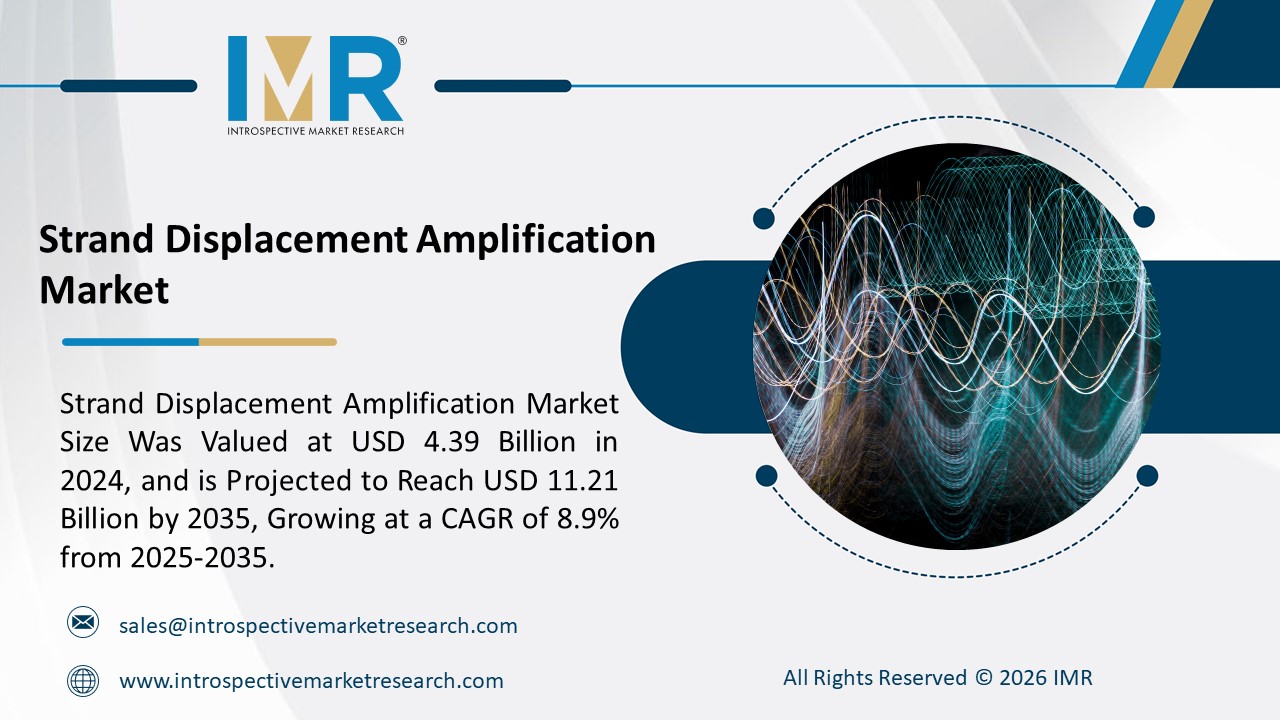
According to a new report published by Introspective Market Research, titled, “Strand Displacement Amplification Market by Product, Application, and End-User,” The Global Strand Displacement Amplification Market Size Was Valued at USD 4.39 Billion in 2024 and is Projected to Reach USD 11.21 Billion by 2035, Growing at a CAGR of 8.9% From 2025–2035.
The Strand Displacement Amplification (SDA) market encompasses an isothermal nucleic acid amplification technology that enables the rapid, exponential copying of specific DNA sequences at a constant temperature, eliminating the need for the thermal cycling required by traditional PCR. This includes kits, reagents, enzymes, and integrated instruments designed for SDA workflows. The core advantage of SDA over conventional PCR is its simplicity, speed, and suitability for point-of-care and resource-limited settings. By operating at a single temperature, it allows for simpler instrument design, faster time-to-result (often in 30-60 minutes), and the potential for integration into compact, portable diagnostic devices.
The paramount growth driver for the SDA market is the global strategic shift towards decentralized, point-of-care (POC) molecular diagnostics and the need for rapid, near-patient testing. The limitations of centralized lab-based PCR—long turnaround times, complex logistics, and high infrastructure costs—were exposed during the pandemic. This has accelerated demand for technologies like SDA that can deliver lab-quality molecular results in doctor's offices, clinics, emergency departments, and even community settings. SDA’s isothermal nature makes it inherently more compatible with simple, low-cost, portable devices ideal for POC use. This alignment with the powerful trend of diagnostic decentralization is the primary force propelling SDA from a niche technology into a mainstream diagnostic platform.
A significant market opportunity lies in the development of multiplexed SDA assays and fully integrated, sample-to-answer disposable devices for syndromic testing and home use. Current SDA tests often target single pathogens. There is a major opportunity in creating multiplex panels that can simultaneously detect a suite of related pathogens from a single sample (e.g., a respiratory panel for flu, RSV, and COVID-19). Furthermore, the highest-value opportunity is in engineering fully automated, cartridge-based systems that integrate sample preparation, SDA amplification, and detection into a single, hands-off disposable unit. Such "lab-in-a-cartridge" systems would enable true POC or even over-the-counter (OTC) home testing for various conditions, dramatically expanding the addressable market beyond traditional clinical labs.
Strand Displacement Amplification Market, Segmentation
The Strand Displacement Amplification Market is segmented on the basis of Product, Application, and End-User.
Product
The Product segment is further classified into Kits & Reagents, Instruments, and Software & Services. Among these, the Kits & Reagents sub-segment accounted for the highest market share in 2024. Kits and reagents dominate as they are the core consumable components used in every single SDA test. This includes the proprietary enzymes (polymerase, restriction enzyme), primers, nucleotides, and buffers required for the amplification reaction. Their recurring nature—each test requires a fresh kit—creates a continuous, high-volume revenue stream. As SDA adoption increases for both clinical diagnostics and research, the demand for these consumables grows proportionally, solidifying their position as the market's largest segment.
Application
The Application segment is further classified into Infectious Disease Diagnostics, Oncology Testing, Genetic Testing, and Others. Among these, the Infectious Disease Diagnostics sub-segment accounted for the highest market share in 2024. Infectious disease testing is the most established and largest application for SDA. Its clinical utility has been proven for sexually transmitted infections (STIs) like chlamydia and gonorrhea, where rapid, accurate results are critical for treatment. The ongoing global burden of infectious diseases, the demand for faster diagnostics to curb antibiotic overuse, and the technology's fit for POC STI clinics and low-resource settings make this the primary driver of current SDA adoption and revenue.
Some of The Leading/Active Market Players Are-
• Becton, Dickinson and Company (BD) (US)
• Hologic, Inc. (US) [through its Aptima assays]
• Abbott Laboratories (US)
• Qiagen N.V. (Netherlands)
• Thermo Fisher Scientific Inc. (US)
• Meridian Bioscience, Inc. (US)
• Eiken Chemical Co., Ltd. (Japan)
• Lucigen Corporation (US)
• and other active players.
Key Industry Developments
In February 2025, BD (Becton Dickinson) announced FDA submission for a new, fully automated point-of-care molecular diagnostics platform utilizing a proprietary isothermal SDA-like technology. The compact, cartridge-based system is designed for use in emergency departments and clinics to deliver results for multiple common infections in under 45 minutes, directly challenging traditional central lab models.
In March 2024, a partnership was announced between a major diagnostics company and a global health organization to co-develop a low-cost, instrument-free SDA test for tuberculosis (TB) detection in high-burden, low-resource countries. The test aims to use a colorimetric readout visible to the naked eye, eliminating the need for expensive detection instruments and bringing critical TB diagnosis closer to patients in remote settings.
Key Findings of the Study
• Kits & Reagents and Infectious Disease Diagnostics are the dominant market segments.
• North America holds the largest market share due to advanced healthcare infrastructure and high adoption of molecular diagnostics.
• The key growth driver is the accelerating shift towards decentralized, rapid point-of-care (POC) molecular testing.
• Major trends include development towards multiplex syndromic panels and fully integrated, cartridge-based sample-to-answer systems.