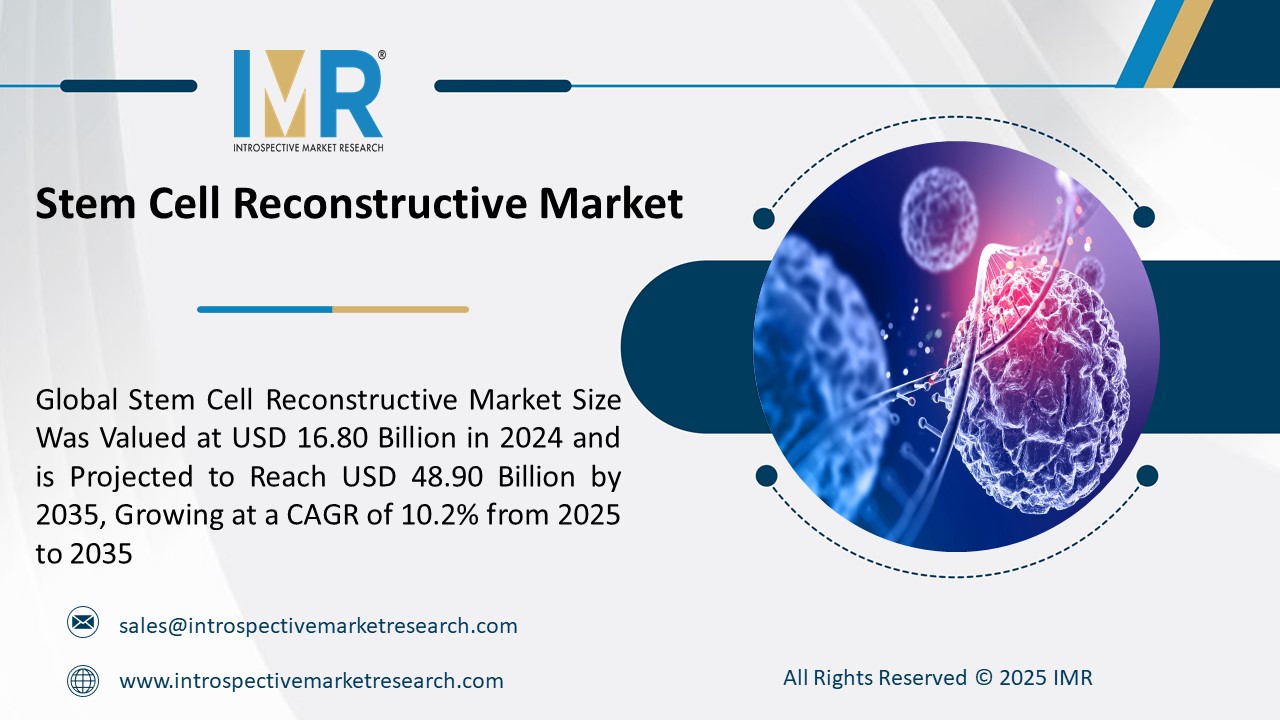
According to a new report published by Introspective Market Research, titled, Stem Cell Reconstructive Market by Cell Type, Application, and End User, the Global Stem Cell Reconstructive Market Size Was Valued at USD 16.80 Billion in 2024 and is Projected to Reach USD 48.90 Billion by 2035, Growing at a CAGR of 10.2% from 2025 to 2035.
The stem cell reconstructive market represents a rapidly advancing segment within regenerative medicine, focusing on the repair, replacement, and regeneration of damaged tissues and organs using stem cell–based therapies. These solutions offer significant advantages over traditional reconstructive procedures by promoting natural healing, reducing surgical invasiveness, and improving long-term functional and aesthetic outcomes. Stem cell reconstructive therapies are increasingly used across orthopedics, plastic and reconstructive surgery, wound care, and dermatology.
The market is witnessing strong momentum due to rising incidences of trauma, congenital defects, degenerative diseases, and chronic wounds worldwide. Stem cell–based reconstruction provides improved tissue integration, faster recovery times, and reduced risk of immune rejection, making it a preferred alternative to conventional grafts and implants.
Additionally, ongoing advancements in cell harvesting techniques, biomaterials, and tissue engineering, combined with increasing clinical validation, are strengthening market confidence. Favorable regulatory frameworks in developed regions and growing investments in regenerative medicine research are further accelerating the adoption of stem cell reconstructive solutions globally.
Market Segmentation
The Stem Cell Reconstructive Market is segmented into Cell Type, Application, and End User.
- By Cell Type, the market is categorized into Adult Stem Cells, Embryonic Stem Cells, and Induced Pluripotent Stem Cells.
- By Application, the market is categorized into Orthopedic Reconstruction, Wound Healing, Cosmetic & Aesthetic Reconstruction, and Dental Reconstruction.
- By End User, the market is categorized into Hospitals, Specialty Clinics, and Research & Academic Institutes.
Growth Driver
One of the primary growth drivers of the stem cell reconstructive market is the increasing prevalence of chronic diseases and trauma-related injuries globally. Rising cases of osteoarthritis, spinal disorders, burns, and complex wounds have created a strong demand for advanced reconstructive solutions. Stem cell–based therapies enable targeted tissue regeneration and functional restoration, reducing dependency on repeated surgeries. Additionally, growing awareness among patients and healthcare professionals regarding regenerative medicine benefits, coupled with improving clinical success rates, is driving the adoption of stem cell reconstructive procedures across developed and emerging healthcare systems.
Market Opportunity
The market presents significant growth opportunities through expanding applications in cosmetic and aesthetic reconstruction. Increasing demand for minimally invasive cosmetic procedures, combined with rising disposable incomes and growing acceptance of regenerative aesthetics, is opening new revenue streams for market players. Moreover, untapped opportunities in emerging economies, supported by improving healthcare infrastructure and medical tourism, are expected to fuel future growth. Continuous innovation in stem cell banking, personalized regenerative therapies, and bioengineered scaffolds further enhances the long-term market potential.
Detailed Segmentation
Stem Cell Reconstructive Market, Segmentation
The Stem Cell Reconstructive Market is segmented on the basis of Cell Type, Application, and End User.
Cell Type
The Cell Type segment is further classified into Adult Stem Cells, Embryonic Stem Cells, and Induced Pluripotent Stem Cells. Among these, the Adult Stem Cells sub-segment accounted for the highest market share in 2024. Adult stem cells are widely used due to their ethical acceptability, lower risk of tumor formation, and proven clinical applications. Their extensive use in orthopedic and wound reconstruction procedures continues to support their dominant position.
Application
The Application segment is further classified into Orthopedic Reconstruction, Wound Healing, and Cosmetic & Aesthetic Reconstruction. Among these, Orthopedic Reconstruction accounted for the highest market share in 2024. The dominance of this segment is attributed to the rising incidence of musculoskeletal disorders and the effectiveness of stem cell therapies in cartilage repair, bone regeneration, and joint reconstruction.
Some of The Leading/Active Market Players Are-
• Thermo Fisher Scientific (U.S.)
• Merck KGaA (Germany)
• Lonza Group (Switzerland)
• STEMCELL Technologies (Canada)
• Bio-Rad Laboratories (U.S.)
• Advanced Cell Technology (U.S.)
• Vericel Corporation (U.S.)
• Osiris Therapeutics (U.S.)
• Pluristem Therapeutics (Israel)
• Takeda Pharmaceutical Company (Japan)
• Sartorius AG (Germany)
• Regen BioPharma (U.S.)
• Cellular Biomedicine Group (China)
• Cytori Therapeutics (U.S.)
and other active players.
Key Industry Developments
In March 2024, a leading regenerative medicine company announced the successful completion of a Phase II clinical trial for a stem cell–based reconstructive therapy targeting complex orthopedic injuries.
The study demonstrated improved tissue regeneration, reduced recovery time, and enhanced patient outcomes, strengthening the commercial potential of stem cell reconstruction therapies.
In September 2024, a biotechnology firm expanded its stem cell manufacturing facility to support large-scale production for reconstructive applications.
This expansion aims to address the growing clinical demand while ensuring regulatory compliance and cost-efficient delivery of advanced stem cell therapies worldwide.
Key Findings of the Study
• Adult stem cells dominate the market due to proven safety and efficacy
• Orthopedic reconstruction remains the leading application segment
• North America leads the market, followed by Europe
• Rising trauma cases and chronic diseases drive market growth
• Technological advancements continue to shape future trends