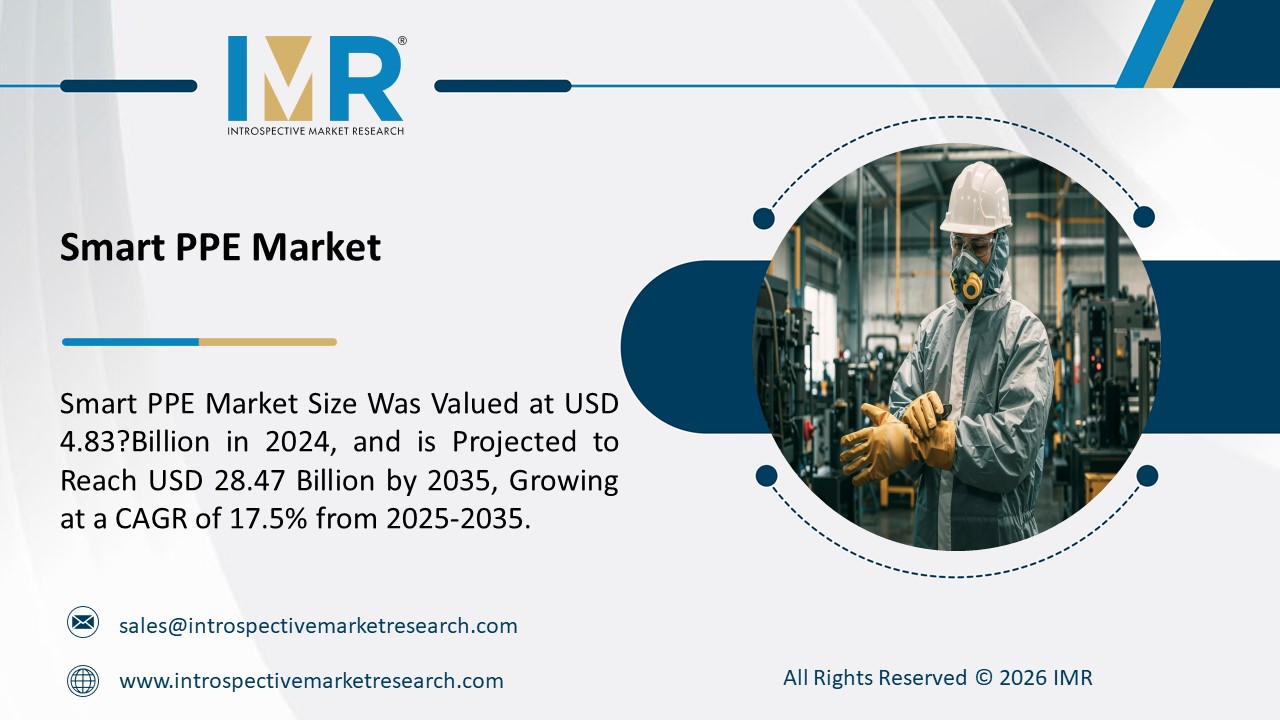
According to a new report published by Introspective Market Research, titled, “Smart PPE Market by Product, Technology, and End-User,” The Global Smart PPE Market Size Was Valued at USD 4.83 Billion in 2024 and is Projected to Reach USD 28.47 Billion by 2035, Growing at a CAGR of 17.5% From 2025–2035.
The Smart Personal Protective Equipment (PPE) market represents the next generation of worker safety, integrating advanced sensors, connectivity, and data analytics into traditional protective gear. This includes connected hard hats, smart safety glasses, wearable gas detectors, biometric-monitoring vests, and sensor-equipped gloves and footwear. The fundamental advantage of Smart PPE over conventional, passive gear is its proactive and predictive safety capability. Instead of just acting as a barrier, it continuously monitors the worker’s vital signs, environment, and location in real-time, alerting them and supervisors to imminent dangers like heat stress, hazardous gas exposure, falls, or proximity to dangerous machinery before an incident occurs.
The paramount growth driver for the Smart PPE market is the powerful convergence of stringent regulatory pressure for enhanced workplace safety and the compelling economic imperative for businesses to reduce accident-related costs. Governments and industry bodies worldwide are mandating higher safety standards and real-time monitoring in hazardous environments. Simultaneously, companies face staggering direct and indirect costs from workplace injuries including medical expenses, litigation, downtime, and increased insurance premiums. Smart PPE addresses both fronts by providing demonstrable, data-backed improvements in safety compliance and proactive risk mitigation. This creates a strong, ROI-driven business case for investment, moving Smart PPE from an experimental technology to an essential component of corporate risk management and operational strategy.
A pivotal market opportunity lies in the development of integrated, cloud-based safety platforms and the expansion into adjacent high-growth verticals. Beyond individual devices, the highest value is in platforms that aggregate data from an entire workforce's Smart PPE, applying Artificial Intelligence (AI) and analytics to predict trends, identify recurring hazards, and optimize safety protocols. Furthermore, expansion beyond traditional heavy industry into sectors like logistics & warehousing (for fatigue and ergonomic monitoring), healthcare (for staff safety and patient monitoring), and public safety (for first responders) represents a massive new addressable market. Companies that offer end-to-end solutions combining hardware, software, and actionable insights can capture recurring SaaS revenue, build long-term enterprise contracts, and become indispensable partners in their clients' safety ecosystems.
Smart PPE Market, Segmentation
The Smart PPE Market is segmented on the basis of Product, Technology, and End-User.
Product
The Product segment is further classified into Head Protection, Eye & Face Protection, Respiratory Protection, Protective Clothing, Hand Protection, and Others. Among these, the Head Protection sub-segment (smart hard hats/helmets) accounted for the highest market share in 2024. Smart helmets dominate because the head is a critical area for both impact protection and sensor integration. They can be equipped with a wide array of technologies: impact sensors to detect and report falls or strikes, thermal cameras for heat detection, augmented reality (AR) displays for instructions and data overlay, noise-canceling communication systems, and location beacons. Their central, visible position and capacity for multiple functionalities make them the flagship product and primary entry point for Smart PPE adoption across industries.
End-User
The End-User segment is further classified into Construction, Manufacturing, Oil & Gas, Chemicals, Healthcare, and Others. Among these, the Construction sub-segment accounted for the highest market share in 2024. The construction industry is the largest and most complex end-user due to its dynamic, high-risk work environments with multiple concurrent hazards falls, struck-by incidents, electrical risks, and environmental exposures. The transient nature of construction sites also necessitates robust real-time location and communication systems. The sheer size of the global construction workforce and the industry's acute focus on reducing its historically high injury rates make it the primary driver for scalable, durable, and multi-functional Smart PPE solutions.
Some of The Leading/Active Market Players Are-
• 3M Company (US)
• Honeywell International Inc. (US)
• MSA Safety Incorporated (US)
• DuPont de Nemours, Inc. (US)
• Ansell Limited (Australia)
• Dragerwerk AG & Co. KGaA (Germany)
• Bullard (US)
• Vuzix Corporation (US)
• DAQRI (US)
• Jabil Inc. (US)
• Intel Corporation (US)
• and other active players.
Key Industry Developments
In February 2024, Honeywell launched its new Connected Safety SaaS platform, designed to unify data from its entire portfolio of smart gas detectors, wearables, and area monitors. The platform uses predictive analytics to identify potential gas leak patterns and equipment maintenance needs, shifting safety management from reactive monitoring to proactive risk prevention.
In January 2024, a consortium led by construction giants partnered with tech firms to pilot next-generation exoskeletons integrated with Smart PPE sensors on large infrastructure projects. These wearable robots reduce physical strain while embedded sensors monitor worker posture, fatigue, and environmental conditions, aiming to prevent musculoskeletal injuries and heat stress, representing the convergence of human augmentation and connected safety.
Key Findings of the Study
• Smart Head Protection and the Construction end-user sector are the dominant market segments.
• North America is the leading regional market, driven by advanced regulatory frameworks and high-tech adoption.
• The dual drivers of regulatory mandates and the economic need to reduce workplace accidents fuel growth.
• Key trends include the rise of integrated SaaS safety platforms and expansion into logistics, healthcare, and public safety.