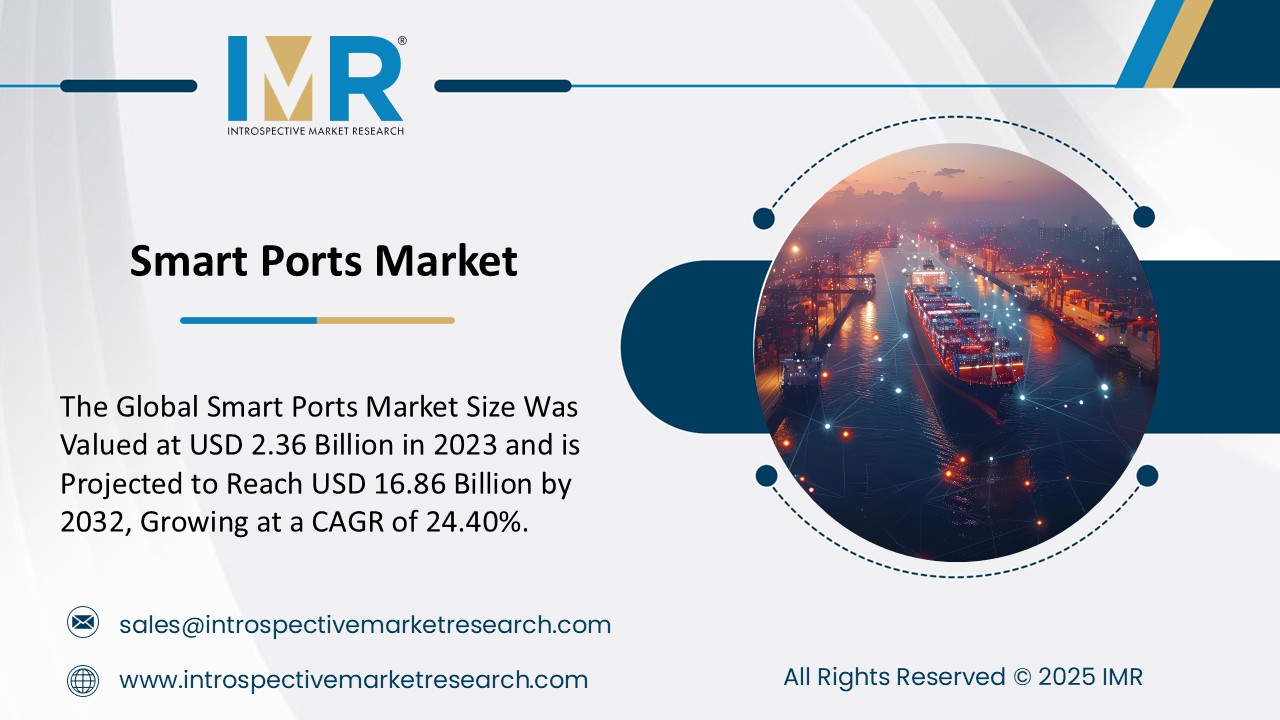
According to a new report published by Introspective Market Research, titled, “Smart Ports Market by Technology, Throughput Capacity, and Port Type, The Global Smart Ports Market Size Was Valued at USD 2.36 Billion in 2023 and is Projected to Reach USD 16.86 Billion by 2032, Growing at a CAGR of 24.40%.”The Smart Ports Market represents a transformative shift in the maritime sector, leveraging digital technologies like the Internet of Things (IoT), artificial intelligence (AI), blockchain, and advanced automation for the modernization of port operations. These ports use interconnected digital infrastructure to enable real-time information exchange, predictive maintenance, and optimized resource management, which translates to faster turnaround times and substantial operational efficiencies versus traditional ports.
Smart ports also enhance environmental sustainability by reducing carbon emissions through optimized vessel scheduling, energy-efficient infrastructure, and automated cargo handling. Their ability to offer improved security, safer operations, and cost efficiencies attract major shipping lines and logistics providers, and their adoption is growing rapidly in both developed and emerging maritime hubs worldwide.
The Smart Ports Market is segmented into Technology, Throughput Capacity, and Port Type.
By Technology, the market is categorized into IoT, Blockchain, Process Automation, and AI. By Throughput Capacity, the market is categorized into Extensively Busy, Moderately Busy, and Scarcely Busy Ports. By Port Type, the market is categorized into Seaports and Inland Ports.
A major growth driver for the Smart Ports Market is the surging global demand for efficient, high-capacity cargo handling—due to unprecedented growth in international trade and rising container volumes. Investments in smart technology are being prioritized to optimize port turnaround times, minimize congestion, and ensure the seamless flow of goods. Advanced IoT and automation tools allow ports to efficiently coordinate vessel movements, boost operational safety, and reduce unnecessary labor costs, creating a strong pull for continuous port digitalization.
Significant market opportunity arises from the deployment of AI-driven analytics and digital twins as well as the integration of smart energy solutions. As ports transition towards predictive maintenance, digital workflow orchestration, and data-driven performance benchmarking, operators are able to unlock new cost savings, sustainability gains, and service offerings. Additionally, government-backed initiatives and public-private partnerships supporting infrastructure modernization are opening untapped avenues in emerging regions such as Asia-Pacific and the Middle East.
Smart Ports Market, Segmentation
The Smart Ports Market is segmented on the basis of Technology, Throughput Capacity, and Port Type.
Technology
The Technology segment is further classified into IoT, Blockchain, Process Automation, and AI. Among these, the IoT sub-segment accounted for the highest market share in 2023, enabling real-time monitoring, predictive maintenance, and efficient cargo tracking. This segment’s rapid growth is attributed to the widespread adoption of connected sensors and devices that drive visibility, asset management, and transparency throughout the port ecosystem.
Throughput Capacity
The Throughput Capacity segment is classified into Extensively Busy, Moderately Busy, and Scarcely Busy Ports. Extensively Busy Ports dominated in 2023, handling the largest global share of container and bulk cargo traffic. These high-capacity ports have been the earliest adopters of smart port technologies, deploying advanced digital systems to manage high volumes, reduce operational complexity, and improve environmental footprints through automation and advanced analytics.
Some of The Leading/Active Market Players Are-
- ABB Ltd. (Switzerland)
- Siemens AG (Germany)
- IBM Corporation (U.S.)
- Cisco Systems, Inc. (U.S.)
- Huawei Technologies Co., Ltd. (China)
- Royal Dutch Shell (Netherlands/U.K.)
- KONGSBERG (Norway)
- General Electric (U.S.)
- Schneider Electric (France)
- Mitsubishi Electric (Japan)
- Navis (U.S.)
- Honeywell International Inc. (U.S.)
- Abu Dhabi Ports (U.A.E.)
- Trelleborg (Sweden)
- Kaleris (U.S.)
- Other active players.
Key Industry Developments
In March 2025, Singapore’s Maritime and Port Authority completed the deployment of a large-scale digital twin platform across its main terminals. This enables real-time monitoring of vessel movements, cargo operations, and port traffic through integrated sensor networks and AI, improving efficiency and safety. The digital twin program is now being referenced by other global trade hubs as a pivotal example of smart port transformation.
In July 2025, IBM and the Port of Rotterdam launched a next-generation port community system based on blockchain and IoT technologies. This system allows automated document processing, secure stakeholder collaboration, and traceable container flows, significantly reducing dwell times and manual errors and further scaling the impact of digitalization on port logistics.
Key Findings of the Study
- IoT and process automation are the dominant technology segments.
- Extensively busy ports and major seaports are leading adopters.
- Asia-Pacific remains the fastest-growing and largest regional market.
- Digital twins, AI, and blockchain are key trends driving efficiency and security.
- The market is witnessing rapid advancement supported by strong public-private partnerships and sustainability mandates.