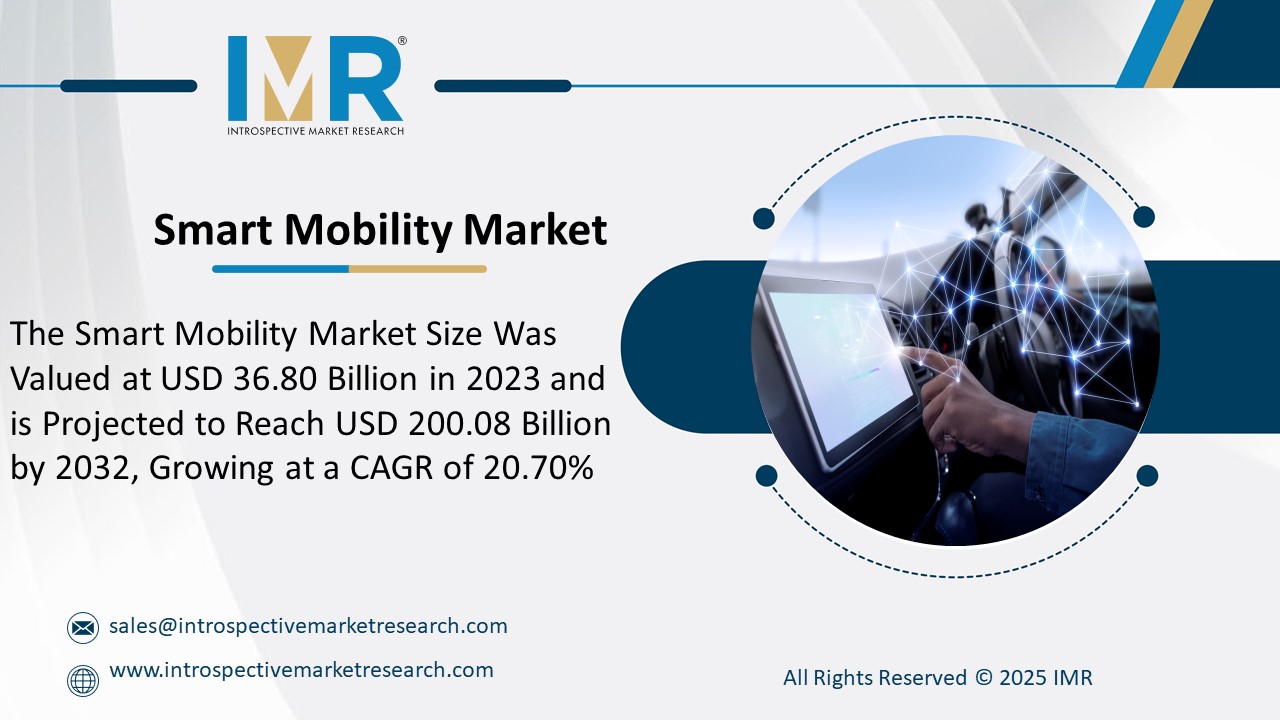
According to a new report published by Introspective Market Research, titled, Smart Mobility Market by Solution, Technology, and Application, The Global Smart Mobility Market Size Was Valued at USD 36.80 Billion in 2023 and is Projected to Reach USD 200.08 Billion by 2032, Growing at a CAGR of 20.70% The global smart mobility market is witnessing a transformative phase driven by rapid urbanization, growing environmental concerns, and the integration of advanced digital technologies into transportation systems. Smart mobility refers to innovative, technology-enabled solutions that optimize traffic management, enhance transportation efficiency, and promote sustainable mobility. These solutions include shared mobility, electric vehicles (EVs), connected infrastructure, and intelligent transportation systems (ITS).
The market is increasingly supported by government initiatives promoting low-carbon and energy-efficient transportation networks. Integration of data analytics, artificial intelligence (AI), and the Internet of Things (IoT) within smart mobility platforms enables real-time monitoring and better resource allocation. Moreover, the rising adoption of electric and autonomous vehicles, coupled with the need for congestion reduction, is accelerating market expansion worldwide.
The Smart Mobility Market is segmented into Solution, Technology, and Application. By Solution, the market is categorized into (Traffic Management, Parking Management, Mobility as a Service, Shared Mobility, and Others). By Technology, the market is categorized into (IoT, Big Data Analytics, Cloud Computing, Artificial Intelligence, and Others). By Application, the market is categorized into (Public Transport, Private Transport, Logistics, and Others).
A major growth driver for the smart mobility market is the increasing global emphasis on sustainable urban transportation. With cities facing mounting pressure to reduce greenhouse gas emissions and traffic congestion, governments and municipalities are investing heavily in smart mobility infrastructure. Advanced connected vehicle technologies, electric transportation, and data-driven decision-making are helping optimize mobility patterns and enhance urban livability, significantly boosting market demand.
The integration of smart mobility with next-generation connectivity and digital platforms presents a major market opportunity. The expansion of 5G networks, AI-driven route optimization, and autonomous mobility systems will revolutionize transportation ecosystems. Additionally, emerging economies in Asia-Pacific, Latin America, and the Middle East are adopting smart mobility frameworks to modernize urban transport, presenting lucrative growth prospects for solution providers and technology innovators.
Smart Mobility Market, Segmentation
The Smart Mobility Market is segmented on the basis of Solution, Technology, and Application.
Solution
The Solution segment is further classified into Traffic Management, Parking Management, Mobility as a Service (MaaS), Shared Mobility, and Others. Among these, the Shared Mobility sub-segment accounted for the highest market share in 2023. This dominance is attributed to the widespread adoption of ride-sharing, bike-sharing, and carpooling services in urban areas. Shared mobility solutions reduce traffic congestion, enhance cost efficiency, and align with sustainability goals, making them highly attractive to both consumers and policymakers.
Technology
The Technology segment is further classified into IoT, Big Data Analytics, Cloud Computing, Artificial Intelligence, and Others. Among these, the IoT sub-segment accounted for the highest market share in 2023. IoT enables real-time communication between vehicles, infrastructure, and users, improving safety, reducing travel times, and optimizing traffic flows. The integration of sensors and connected devices is driving IoT’s pivotal role in advancing smart mobility solutions.
Some of The Leading/Active Market Players Are-
- Siemens AG (Germany)
- Cisco Systems, Inc. (USA)
- TomTom N.V. (Netherlands)
- Robert Bosch GmbH (Germany)
- Hitachi, Ltd. (Japan)
- IBM Corporation (USA)
- Ford Motor Company (USA)
- Continental AG (Germany)
- Toyota Motor Corporation (Japan)
- Huawei Technologies Co., Ltd. (China)
- Uber Technologies, Inc. (USA)
- DENSO Corporation (Japan)
- other active players.
Key Industry Developments
-
In March 2025, Siemens AG announced the launch of an integrated urban mobility platform designed to optimize multimodal transportation systems.
The platform leverages real-time data analytics, AI, and IoT technologies to improve traffic efficiency and sustainability. It aims to support city authorities in managing congestion, reducing emissions, and enabling seamless travel experiences across multiple transport modes. - In June 2025, Toyota Motor Corporation partnered with SoftBank Corp. to expand its autonomous mobility services across Japan’s smart cities.
The collaboration focuses on combining Toyota’s vehicle technology with SoftBank’s IoT and AI capabilities to create autonomous shuttles and data-driven mobility ecosystems, enhancing accessibility and sustainability in urban transport networks.
Key Findings of the Study
- Shared mobility leads the market, driven by ride-sharing and carpooling adoption.
- IoT dominates the technology segment due to its real-time connectivity benefits.
- Asia-Pacific expected to record fastest growth amid smart city investments.
- Growing sustainability awareness and electrification accelerate market expansion.
- Integration of AI and autonomous systems presents major future potential.