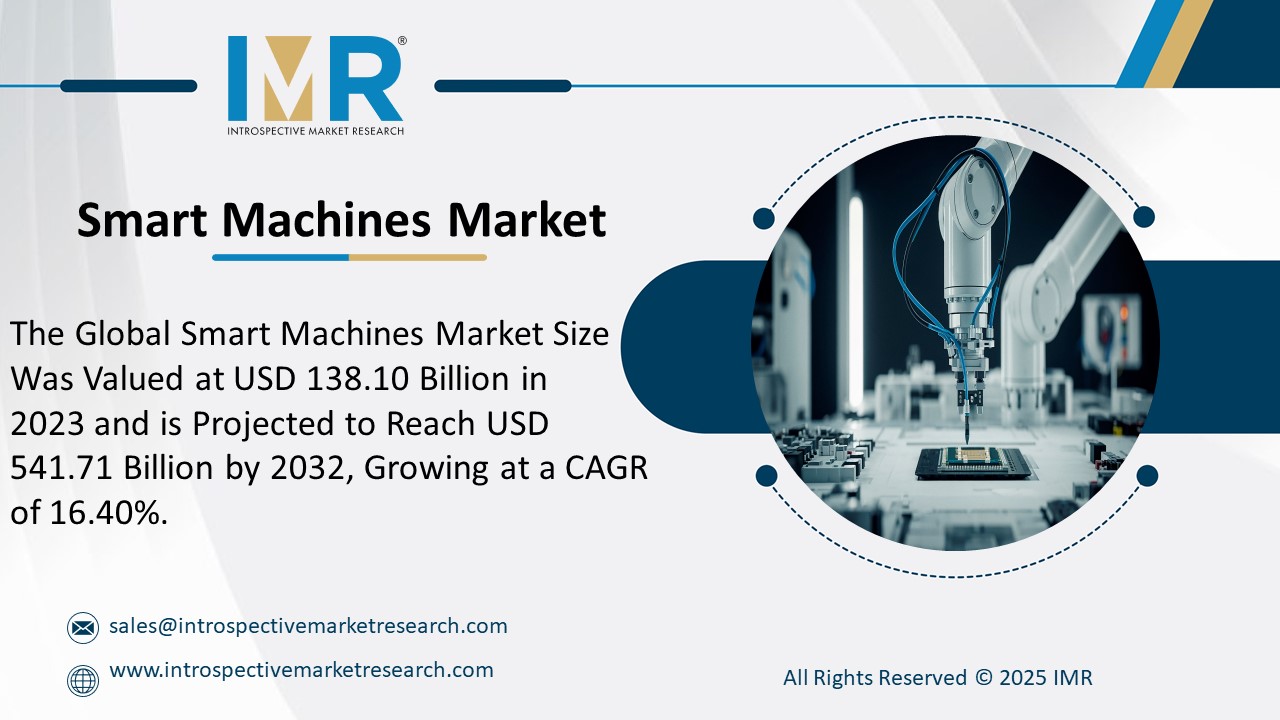
According to a new report published by Introspective Market Research, titled, Smart Machines Market by Component, Machine Type, and Application, The Global Smart Machines Market Size Was Valued at USD 138.10 Billion in 2023 and is Projected to Reach USD 541.71 Billion by 2032, Growing at a CAGR of 16.40%. The global Smart Machines Market is undergoing rapid expansion as industries increasingly adopt intelligent, autonomous systems that integrate artificial intelligence, machine learning, and connectivity to perform tasks with minimal human intervention. Smart machines include robots, autonomous vehicles, drones, and cognitive systems, which leverage data and algorithms to make decisions, optimize performance, and learn over time.
These machines offer advantages over traditional automation by being adaptive, context-aware, and capable of handling unstructured environments. In manufacturing, smart machines can self-optimize, perform predictive maintenance, and collaborate with humans on the shop floor. In sectors such as healthcare, logistics, and agriculture, they support automation with intelligence—conducting complex tasks like diagnostics, autonomous navigation, and real-time adjustments. The convergence of AI, IoT, big data, and advanced sensors is fueling their adoption across verticals.
As enterprises push toward Industry 4.0, demand for smart, flexible, and autonomous systems grows. Elevated labor costs, skill shortages, and the need for efficient operations are pushing manufacturers and service providers to invest heavily in smart machines. Additionally, innovations in hardware, algorithms, and edge computing are enabling cost efficiencies, making smart machines more accessible beyond large enterprises.
The Smart Machines Market is segmented into Component, Machine Type, and Application. By Component, the market is categorized into (Hardware, Software, Services).
By Machine Type, the market is categorized into (Autonomous Robots, Self-Driving Vehicles, Drones, Wearable Smart Devices, Others). By Application, the market is categorized into (Manufacturing, Transportation & Logistics, Healthcare, Consumer Electronics, Defense & Aerospace, Others).
A key growth driver for the smart machines market is the rising demand for automation and efficiency across industrial and service sectors. As organizations strive to reduce operational costs, improve productivity, and manage complex processes, smart machines offer adaptable, intelligent automation that surpasses rigid robotics. They can learn, adapt, and collaborate in dynamic settings—making them ideal for tasks in factories, warehouses, hospitals, and smart infrastructure. The push toward predictive maintenance, real-time decision-making, and connected operations accelerates their adoption.
A significant opportunity lies in software and AI-driven platforms that manage smart machines. As hardware becomes commoditized, value shifts toward intelligent software layers—algorithms that optimize workflows, coordinate fleets of machines, and enable autonomous behavior. Offering AI-as-a-service, orchestration platforms, and digital twins can create new revenue streams. Companies that provide these integrated software solutions—rather than just physical machines—can capture a larger share of the overall ecosystem.
Smart Machines Market, Segmentation
The Smart Machines Market is segmented on the basis of Component, Machine Type, and Application.
Component
The Component segment is further classified into Hardware, Software, and Services. Among these, the Hardware sub-segment accounted for the highest market share in 2024. Hardware includes sensors, actuators, processors, and embedded systems and remains essential across all smart machine types. Without optimized physical components, intelligent behavior cannot be realized, making hardware the foundation of the smart machine ecosystem.
Machine Type
The Machine Type segment is further classified into Autonomous Robots, Self-Driving Vehicles, Drones, Wearable Smart Devices, and Others. Among these, Autonomous Robots accounted for the highest market share in 2024. These include industrial robots, service robots, and collaborative robots enhanced with intelligence. Their broad applicability in manufacturing, logistics, health, and retail drives their dominance, supported by demand for flexible automation and adaptive performance.
Some of The Leading/Active Market Players Are-
- Google, Inc. (USA)
- Microsoft Corporation (USA)
- IBM Corporation (USA)
- Apple Inc. (USA)
- Rethink Robotics (USA)
- BAE Systems (UK)
- Creative Virtual Ltd. (UK)
- Digital Reasoning Systems, Inc. (USA)
- Boston Dynamics (USA)
- Tesla, Inc. (USA)
- DJI Innovations (China)
- SoftBank Robotics (Japan)
- NVIDIA Corporation (USA)
- Siemens AG (Germany)
- ABB Ltd. (Switzerland)
- and other active players.
Key Industry Developments
-
In March 2025, NVIDIA unveiled its new AI accelerator chip designed specifically to power edge-deployed smart machines.
This launch enables lower-latency inference and more sophisticated onboard intelligence in robots, drones, and autonomous systems. By pushing advanced computation closer to the device, it reduces reliance on cloud connectivity and enhances autonomy in remote or industrial settings. - In September 2024, Boston Dynamics partnered with Siemens to integrate intelligent robotics solutions into smart factories.
This collaboration combines Boston Dynamics’ mobile robot platforms with Siemens’ industrial automation software, enabling robots that can perceive, plan, and perform tasks in dynamic factory environments. It accelerates the deployment of fully autonomous production lines powered by smart machines.
Key Findings of the Study
- Hardware is the dominant component segment given its foundational role.
- Autonomous robots lead in machine types due to broad industrial applicability.
- Manufacturing is a key application driving demand.
- Efficiency, adaptability, and predictive capabilities are major growth drivers.
- Software platforms and AI orchestration represent the next frontier of opportunity.