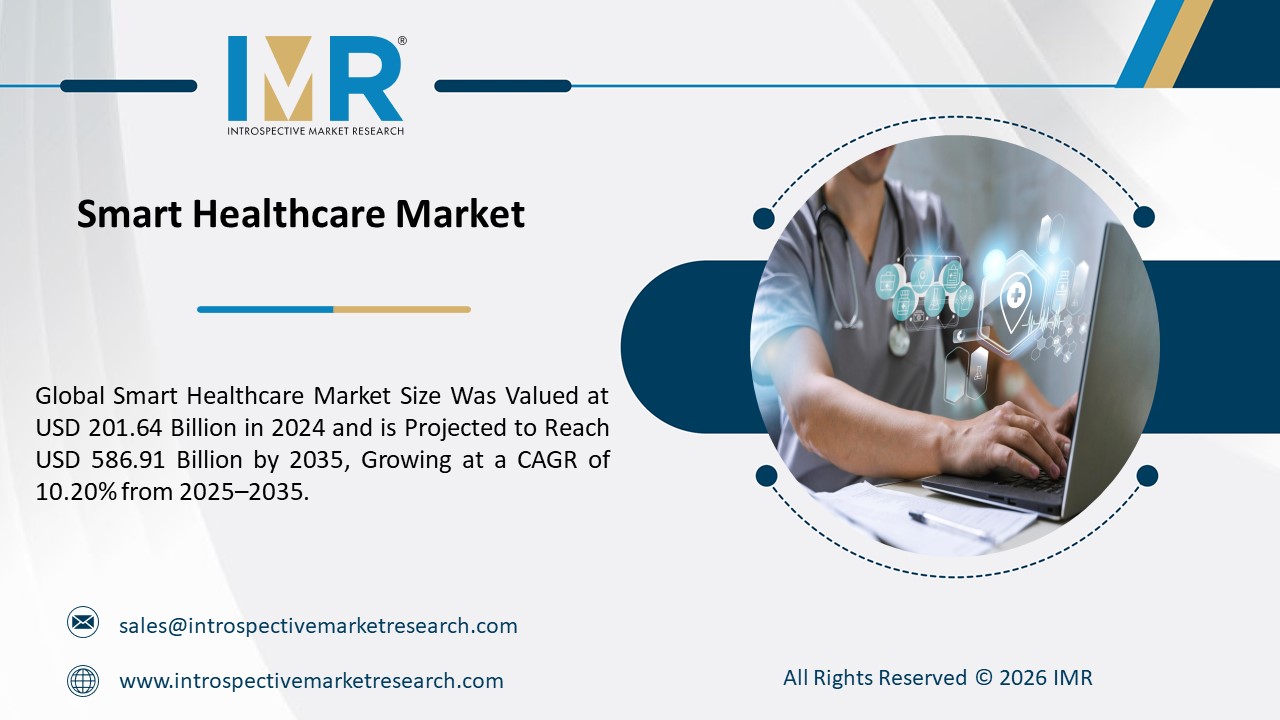
According to a new report published by Introspective Market Research, titled, Smart Healthcare Market by Component, Application, and End User, The Global Smart Healthcare Market Size Was Valued at USD 201.64 Billion in 2024 and is Projected to Reach USD 586.91 Billion by 2035, Growing at a CAGR of 10.20% from 2025–2035.
The smart healthcare market encompasses the integration of advanced digital technologies such as artificial intelligence (AI), Internet of Things (IoT), big data analytics, cloud computing, and wearable devices into healthcare systems to improve patient outcomes, operational efficiency, and cost-effectiveness. Smart healthcare solutions enable real-time monitoring, predictive analytics, and personalized treatment, transforming traditional reactive healthcare models into proactive and preventive care frameworks.
Compared to conventional healthcare systems, smart healthcare offers enhanced accuracy, faster decision-making, improved patient engagement, and optimized resource utilization. These solutions are widely used across hospitals, clinics, home healthcare settings, and research institutions for applications such as remote patient monitoring, telehealth, electronic health records (EHR), and clinical decision support systems.
The growing burden of chronic diseases, aging populations, and increasing demand for value-based care are accelerating the adoption of smart healthcare technologies globally. Governments and private stakeholders are also investing heavily in digital health infrastructure, further supporting market expansion.
Market Segmentation
The Smart Healthcare Market is segmented into Component, Application, and End User.
- By Component, the market is categorized into Hardware, Software, and Services.
- By Application, the market is categorized into Telemedicine, Remote Patient Monitoring, Electronic Health Records, Medical Imaging, and Others.
- By End User, the market is categorized into Hospitals & Clinics, Home Healthcare, and Others.
Growth Driver
One of the primary growth drivers of the smart healthcare market is the increasing prevalence of chronic diseases such as diabetes, cardiovascular disorders, and respiratory conditions. These conditions require continuous monitoring and long-term care, which traditional healthcare systems often struggle to provide efficiently. Smart healthcare technologies, including wearable devices and remote patient monitoring solutions, enable continuous data collection and real-time health tracking. This allows healthcare providers to intervene early, reduce hospital readmissions, and improve overall patient outcomes. As healthcare systems globally shift toward preventive and patient-centric care models, the demand for smart healthcare solutions continues to rise significantly.
Market Opportunity
A major market opportunity lies in the rapid expansion of smart healthcare solutions in emerging economies. Countries in Asia-Pacific, Latin America, and the Middle East are increasingly investing in digital health infrastructure to improve healthcare accessibility and quality. The growing penetration of smartphones, improved internet connectivity, and supportive government initiatives for digital health adoption are creating favorable conditions for market growth. Additionally, the integration of AI and machine learning in diagnostics and treatment planning presents significant opportunities for innovation, enabling market players to offer advanced, scalable, and cost-effective smart healthcare solutions.
Detailed Segmentation
Smart Healthcare Market, Segmentation
The Smart Healthcare Market is segmented on the basis of Component, Application, and End User.
Component
The Component segment is further classified into Hardware, Software, and Services. Among these, the Software sub-segment accounted for the highest market share in 2024. Smart healthcare software solutions, including EHR systems, data analytics platforms, and AI-powered clinical decision support tools, play a critical role in managing and interpreting vast volumes of healthcare data. Their ability to enhance interoperability, improve clinical workflows, and support evidence-based decision-making has driven widespread adoption across healthcare facilities. Continuous advancements in cloud-based platforms and AI integration further strengthen the dominance of this sub-segment.
Application
The Application segment is further classified into Telemedicine, Remote Patient Monitoring, Electronic Health Records, Medical Imaging, and Others. Among these, the Remote Patient Monitoring sub-segment accounted for the highest market share in 2024. The increasing need for continuous patient monitoring outside traditional clinical settings has fueled demand for remote monitoring solutions. These applications enable healthcare providers to track vital signs in real time, manage chronic diseases effectively, and reduce hospitalization costs. The growing acceptance of home-based care and advancements in wearable technologies continue to support strong growth in this segment.
Some of The Leading/Active Market Players Are-
• Medtronic plc (Ireland)
• Philips Healthcare (Netherlands)
• GE HealthCare (United States)
• Siemens Healthineers (Germany)
• Cisco Systems, Inc. (United States)
• IBM Corporation (United States)
• Oracle Corporation (United States)
• Honeywell International Inc. (United States)
• Cerner Corporation (United States)
• Qualcomm Technologies, Inc. (United States)
• Allscripts Healthcare Solutions (United States)
• Epic Systems Corporation (United States)
• Apple Inc. (United States)
• Samsung Electronics Co., Ltd. (South Korea)
• Microsoft Corporation (United States)
and other active players.
Key Industry Developments
In March 2024, a leading global healthcare technology provider launched an AI-powered remote patient monitoring platform designed to enhance chronic disease management.
The platform integrates wearable devices with advanced analytics to deliver real-time insights to clinicians, enabling early intervention, improved patient adherence, and reduced hospital readmissions.
In September 2024, a major technology company partnered with a hospital network to implement cloud-based electronic health record systems across multiple facilities.
This collaboration aims to improve data interoperability, streamline clinical workflows, and enhance patient data security, supporting the broader adoption of smart healthcare solutions.
Key Findings of the Study
• Software and remote patient monitoring are dominant market segments
• North America leads the market, followed by Europe
• Rising chronic diseases are a key growth driver
• AI and IoT integration are major market trends
• Emerging economies present high growth potential