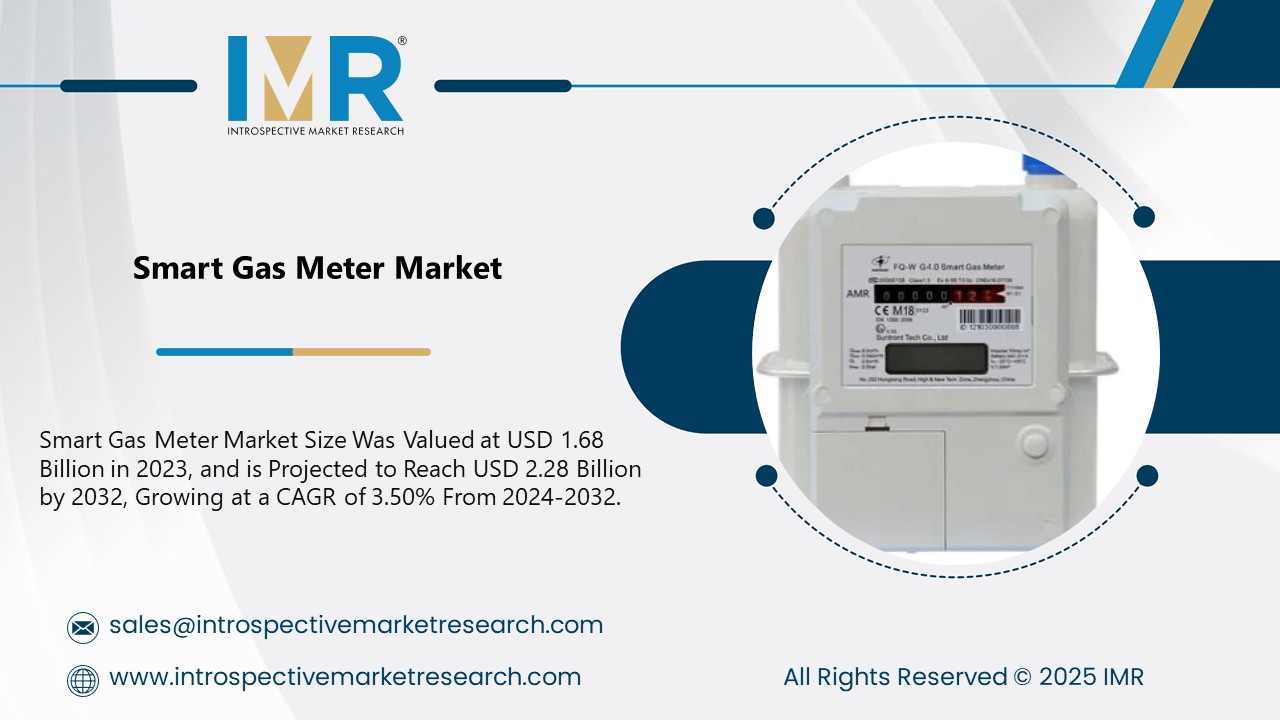
According to a new report published by Introspective Market Research, titled, Smart Gas Meter Market by Type, Component, Technology, and End-User, The Global Smart Gas Meter Market Size Was Valued at USD 1.68 Billion in 2023 and is Projected to Reach USD 2.28 Billion by 2032, Growing at a CAGR of 3.50%. The Smart Gas Meter Market involves the deployment of advanced metering infrastructure (AMI) for natural gas consumption, replacing traditional mechanical gas meters. These smart devices are equipped with communication modules that allow for two-way communication between the utility provider and the meter, enabling automatic data collection, remote meter readings, and real-time monitoring of gas usage. This technology provides unprecedented insights into consumption patterns, facilitating better resource management and billing accuracy.
Smart gas meters offer numerous advantages over conventional meters, including the elimination of manual meter reading, reduced operational costs for utilities, improved billing accuracy, and enhanced safety through remote leak detection and shut-off capabilities. They empower consumers with detailed usage data, promoting energy conservation and informed decision-making. Major end-user industries include residential, commercial, and industrial sectors, all benefiting from optimized gas distribution and consumption monitoring.
One key growth driver for the Smart Gas Meter Market is the increasing global emphasis on energy efficiency and sustainable resource management. Governments and regulatory bodies worldwide are implementing policies and initiatives to reduce carbon emissions and optimize energy consumption. Smart gas meters play a crucial role in achieving these goals by providing granular data on gas usage, which helps both utility providers and consumers identify areas for efficiency improvements and reduce waste. The push for a greener future, coupled with regulatory mandates for smart grid modernization, is significantly propelling the adoption of these advanced metering solutions.
A significant market opportunity for the Smart Gas Meter Market lies in the widespread replacement of aging traditional gas infrastructure in developed economies. Many countries still rely on legacy mechanical meters that are prone to inefficiencies, manual reading errors, and lack the advanced features required for modern grid management. The ongoing need to upgrade this infrastructure to improve reliability, reduce non-revenue gas, and integrate with smart city initiatives presents a substantial growth avenue. Utility companies are increasingly investing in smart meter rollouts to modernize their networks, enhance service delivery, and capitalize on the long-term operational benefits.
Smart Gas Meter Market, Segmentation
The Smart Gas Meter Market is segmented on the basis of Type, Component, Technology, and End-User.
Type
- The Type segment is further classified into Diaphragm Gas Meter, Rotary Gas Meter, and Ultrasonic Gas Meter. Among these, the Diaphragm Gas Meter sub-segment accounted for the highest market share in 2023. Smart diaphragm gas meters are widely used, particularly in residential and small commercial applications, due to their proven reliability, accuracy, and cost-effectiveness for measuring low-pressure gas flows. The integration of communication modules into these well-established meter types allows for smart functionalities while maintaining a familiar and trusted measurement mechanism, making them a preferred choice for large-scale deployments.
Component
- The Component segment is further classified into Hardware and Software. Among these, the Hardware sub-segment accounted for the highest market share in 2023. The hardware component primarily includes the smart gas meters themselves, along with communication modules, sensors, and other physical infrastructure necessary for data collection and transmission. The initial investment in the physical meters and associated communication equipment forms a significant portion of the overall market, as these devices are the foundation of any smart metering system and require substantial deployment efforts.
Some of The Leading/Active Market Players Are-
- Honeywell International Inc. (USA)
- Siemens AG (Germany)
- Schneider Electric SE (France)
- Landis+Gyr AG (Switzerland)
- Itron Inc. (USA)
- Apator S.A. (Poland)
- Sensus (Xylem Inc.) (USA)
- Diehl Metering (Germany)
- Elster GmbH (Honeywell) (Germany)
- EDMI Limited (Singapore)
- Zenner International GmbH & Co. KG (Germany)
- AEM S.A. (Romania)
- Flonidan A/S (Denmark)
- Metron-Farnier (USA)
- Jian An Group (China)
- and other active players.
Key Industry Developments
- In September 2023, Landis+Gyr announced a new partnership with a major European utility to deploy 500,000 smart gas meters across their service territory. This significant rollout aimed to modernize the utility's infrastructure, improve operational efficiency, and provide customers with greater insight into their gas consumption. The collaboration underscored the ongoing trend of large-scale smart meter deployments driven by utility modernization programs.
- In June 2023, Itron Inc. launched its new "Gas IQ" solution, an advanced analytics platform designed to help utilities leverage data from smart gas meters to detect anomalies, predict equipment failures, and optimize network performance. This development highlighted the increasing focus on software and data analytics to extract maximum value from smart metering data, moving beyond basic billing to proactive grid management and enhanced safety.
Key Findings of the Study
- Diaphragm gas meters maintain dominance due to their reliability in residential and small commercial applications.
- Hardware components represent the largest market share, driven by extensive meter deployment.
- The global push for energy efficiency and sustainability is a primary growth driver.
- Replacement of aging infrastructure in developed regions presents a key market opportunity.
- Advancements in analytics and software solutions are a significant market trend.