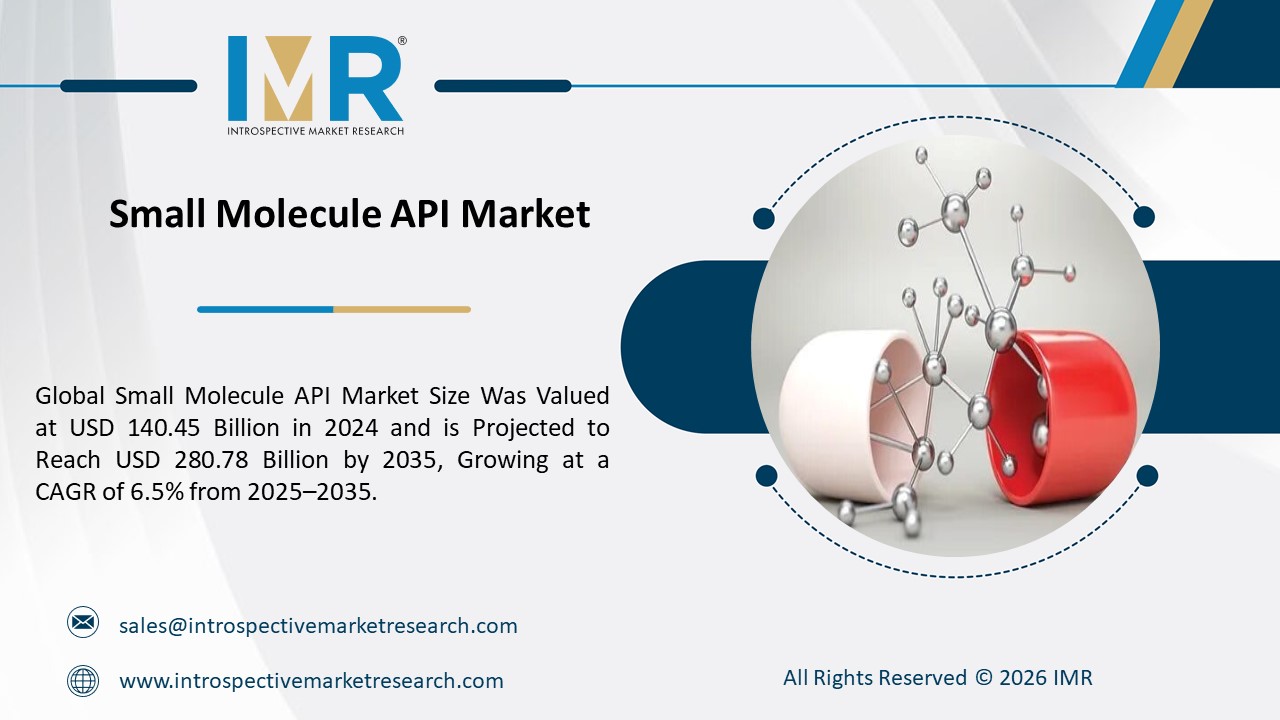
According to a new report published by Introspective Market Research, titled, “Small Molecule API Market by Type, Manufacturing Method, and Application,” The Global Small Molecule API Market Size Was Valued at USD 140.45 Billion in 2024 and is Projected to Reach USD 280.78 Billion by 2035, Growing at a CAGR of 6.5% from 2025–2035.
The Small Molecule Active Pharmaceutical Ingredient (API) market plays a critical role in the global pharmaceutical value chain, as small molecule APIs form the backbone of a majority of approved drugs worldwide. These chemically synthesized compounds are widely used in the treatment of chronic and acute conditions, including cardiovascular diseases, oncology, infectious diseases, and central nervous system disorders. Compared to biologics, small molecule APIs offer advantages such as ease of manufacturing, oral bioavailability, cost-effectiveness, and long-established regulatory pathways.
The market continues to benefit from the sustained demand for generic drugs, expanding pharmaceutical manufacturing capacities, and the rising global disease burden. Advances in synthetic chemistry, process optimization, and continuous manufacturing technologies are further enhancing production efficiency and scalability. In addition, the growing focus on affordable medicines across emerging economies is accelerating demand for high-quality small molecule APIs.
Market Segmentation
The Small Molecule API Market is segmented into Type, Manufacturing Method, and Application.
- By Type, the market is categorized into Synthetic APIs and Semi-synthetic APIs.
- By Manufacturing Method, the market is categorized into Captive Manufacturing and Contract Manufacturing.
- By Application, the market is categorized into Cardiovascular, Oncology, CNS & Neurology, Anti-infective, and Other Therapeutic Areas.
Growth Driver
One of the primary growth drivers of the Small Molecule API market is the increasing demand for generic pharmaceuticals worldwide. As patents for several blockbuster drugs continue to expire, pharmaceutical companies are focusing on cost-effective generic drug development to maintain market competitiveness. Small molecule APIs are integral to this trend due to their lower development costs, established manufacturing processes, and faster regulatory approvals. Governments and healthcare providers are also promoting generics to reduce healthcare expenditure, particularly in emerging markets, further supporting sustained market growth over the forecast period.
Market Opportunity
A major market opportunity lies in the outsourcing of API manufacturing to contract development and manufacturing organizations (CDMOs). Pharmaceutical companies are increasingly partnering with specialized API manufacturers to reduce capital expenditure, improve supply chain resilience, and focus on core competencies such as drug discovery and marketing. Emerging economies, particularly in Asia-Pacific, offer significant opportunities due to skilled labor availability, cost advantages, and supportive regulatory reforms. Additionally, the adoption of green chemistry and continuous manufacturing presents new avenues for innovation and differentiation among API producers.
Detailed Segmentation
Small Molecule API Market, Segmentation
The Small Molecule API Market is segmented on the basis of Type, Manufacturing Method, and Application.
Type
The Type segment is further classified into Synthetic APIs and Semi-synthetic APIs. Among these, the Synthetic APIs sub-segment accounted for the highest market share in 2024. Synthetic APIs dominate due to their broad applicability across therapeutic areas, scalability of chemical synthesis, and cost efficiency. These APIs are extensively used in high-volume generic drugs and benefit from well-established production technologies and global regulatory acceptance.
Manufacturing Method
The Manufacturing Method segment is further classified into Captive Manufacturing and Contract Manufacturing. Among these, the Contract Manufacturing sub-segment accounted for the highest market share in 2024. The growth of this sub-segment is driven by increasing outsourcing trends, rising complexity of synthesis, and the need for flexible production capacities. Contract manufacturers offer end-to-end services, regulatory compliance, and faster time-to-market, making them preferred partners for pharmaceutical companies.
Some of The Leading/Active Market Players Are-
- Pfizer Inc. (United States)
- Teva Pharmaceutical Industries Ltd. (Israel)
- Novartis AG (Switzerland)
- Sun Pharmaceutical Industries Ltd. (India)
- Dr. Reddy’s Laboratories Ltd. (India)
- Aurobindo Pharma Ltd. (India)
- Cipla Ltd. (India)
- Viatris Inc. (United States)
- BASF SE (Germany)
- Lonza Group AG (Switzerland)
- Boehringer Ingelheim GmbH (Germany)
- AbbVie Inc. (United States)
- Cambrex Corporation (United States)
- and other active players.
Key Industry Developments
In March 2024, several global API manufacturers expanded their small molecule production capacities to address growing generic drug demand.
These expansions focused on improving synthesis efficiency, meeting regulatory standards, and strengthening supply chain security for essential medicines across developed and emerging markets.
In September 2024, leading pharmaceutical companies increased investments in sustainable and green API manufacturing technologies.
These initiatives aim to reduce environmental impact, optimize resource utilization, and comply with evolving environmental regulations while maintaining high-quality API output.
Key Findings of the Study
-
Synthetic APIs and contract manufacturing remain dominant segments.
-
Asia-Pacific leads the market due to strong manufacturing capabilities.
-
Rising generic drug demand is a key growth driver.
-
Outsourcing and sustainable manufacturing are major market trends.