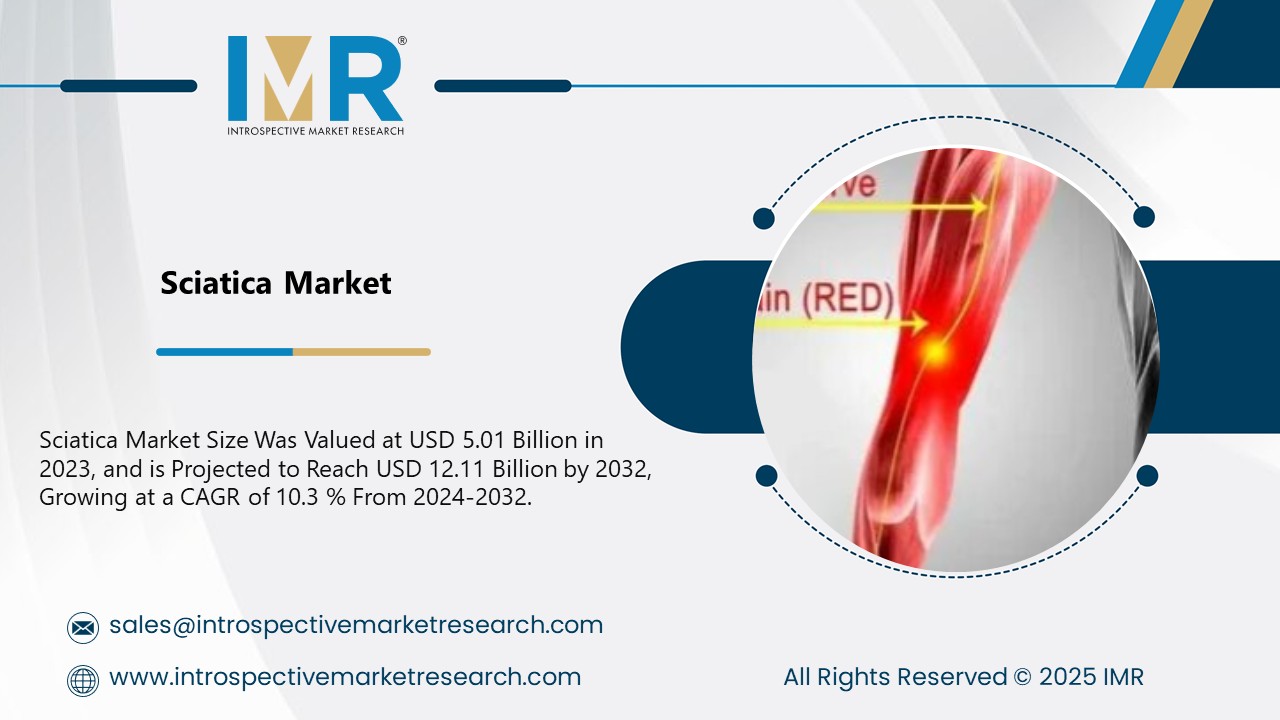
According to a new report published by Introspective Market Research, titled, Sciatica Market by Type, Treatment, Diagnosis, End-User, and Distribution Channel, The Global Sciatica Market Size Was Valued at USD 5.01 Billion in 2023 and is Projected to Reach USD 12.11 Billion by 2032, Growing at a CAGR of 10.3%. The sciatica market encompasses a broad range of diagnostic tools, treatments, and therapeutic interventions aimed at managing and alleviating the symptoms associated with sciatica. Sciatica is a common condition characterized by pain radiating along the sciatic nerve, which runs from the lower back down one or both legs. Products and services in this market include pharmaceuticals (pain relievers, anti-inflammatories), physical therapy, surgical procedures, and alternative therapies such as acupuncture and chiropractic care. These offerings provide significant advantages over unmanaged pain, improving patient quality of life and functionality.
The main uses of products and services within the sciatica market span across various healthcare settings. Hospitals, specialty clinics, rehabilitation centers, and pain management facilities are key environments where sciatica is diagnosed and treated. Furthermore, the market caters to individual consumers through over-the-counter medications and at-home physical therapy devices. With a global aging population and increasing sedentary lifestyles, the demand for effective sciatica management solutions is continuously expanding across these diverse end-user segments.
One key growth driver for the sciatica market is the increasing prevalence of risk factors such as an aging population and sedentary lifestyles. As individuals age, degenerative changes in the spine, such as herniated discs and spinal stenosis, become more common, directly contributing to the incidence of sciatica. Furthermore, modern lifestyles involving prolonged sitting and lack of physical activity can weaken core muscles and put undue stress on the lower back, exacerbating the condition. This demographic shift and lifestyle trend are significantly boosting the demand for diagnostic and therapeutic interventions for sciatica globally.
A significant market opportunity exists in the development and adoption of advanced non-pharmacological and non-invasive treatment options for sciatica. While pharmaceuticals and surgery remain vital, there is a growing patient preference for therapies that offer relief without the side effects of drugs or the risks associated with surgery. Innovations in physical therapy devices, wearable technology for pain management, neuromodulation techniques, and personalized rehabilitation programs represent a substantial untapped potential. Focusing on holistic and patient-centric approaches can attract a broader patient base and reduce long-term healthcare costs.
Sciatica Market, Segmentation
The Sciatica Market is segmented on the basis of Type, Treatment, Diagnosis, End-User, and Distribution Channel.
Treatment
The Treatment segment is further classified into Medication, Physical Therapy, Surgery, and Alternative Therapies. Among these, the Medication sub-segment accounted for the highest market share in 2023. Medication is often the first line of defense against sciatica pain, primarily involving non-steroidal anti-inflammatory drugs (NSAIDs), muscle relaxants, and neuropathic pain medications. Its widespread adoption is due to its immediate pain relief capabilities, accessibility, and relatively lower cost compared to other treatments. Patients often rely on medication to manage acute pain episodes, providing symptomatic relief while other longer-term treatments are pursued.
End-User
The End-User segment is further classified into Hospitals, Specialty Clinics, Ambulatory Surgical Centers, and Others. Among these, the Hospitals sub-segment accounted for the highest market share in 2023. Hospitals represent the dominant end-user segment due to their comprehensive infrastructure, which includes advanced diagnostic imaging facilities (MRI, CT scans), specialist physicians (orthopedics, neurologists, pain management), and the capacity for both conservative and surgical interventions. Patients with severe or complex sciatica cases often seek treatment in hospitals, where integrated care pathways ensure thorough diagnosis and multidisciplinary management, making them central to the sciatica treatment landscape.
Some of The Leading/Active Market Players Are-
- Pfizer Inc. (USA)
- Johnson & Johnson (USA)
- Novartis AG (Switzerland)
- Bayer AG (Germany)
- Eli Lilly and Company (USA)
- Astellas Pharma Inc. (Japan)
- AbbVie Inc. (USA)
- Teva Pharmaceutical Industries Ltd. (Israel)
- Medtronic plc (Ireland)
- Boston Scientific Corporation (USA)
- Abbott Laboratories (USA)
- Zimmer Biomet Holdings, Inc. (USA)
- Stryker Corporation (USA)
- Halyard Health, Inc. (USA)
- Baxter International Inc. (USA)
- and other active players.
Key Industry Developments
- In February 2023, Medtronic plc received FDA approval for an expanded indication of its spinal cord stimulator system for chronic low back and leg pain, including intractable sciatica. This development allowed for wider application of neuromodulation therapy, offering a non-opioid solution for patients with persistent sciatica pain. The approval emphasized the growing shift towards advanced, less invasive pain management technologies.
- In September 2022, a leading pharmaceutical company launched a new non-opioid analgesic specifically formulated for neuropathic pain associated with sciatica. This product aimed to address the critical need for effective pain relief without the risks of addiction and side effects often associated with opioid use. The launch represented a significant step in providing safer and more sustainable pain management options for sciatica patients.
Key Findings of the Study
- Medication remains the primary treatment approach for immediate sciatica pain relief.
- Hospitals dominate the end-user segment due to comprehensive care facilities.
- An aging population and sedentary lifestyles are key drivers of market growth.
- Emerging trends include non-pharmacological therapies and personalized treatment plans.