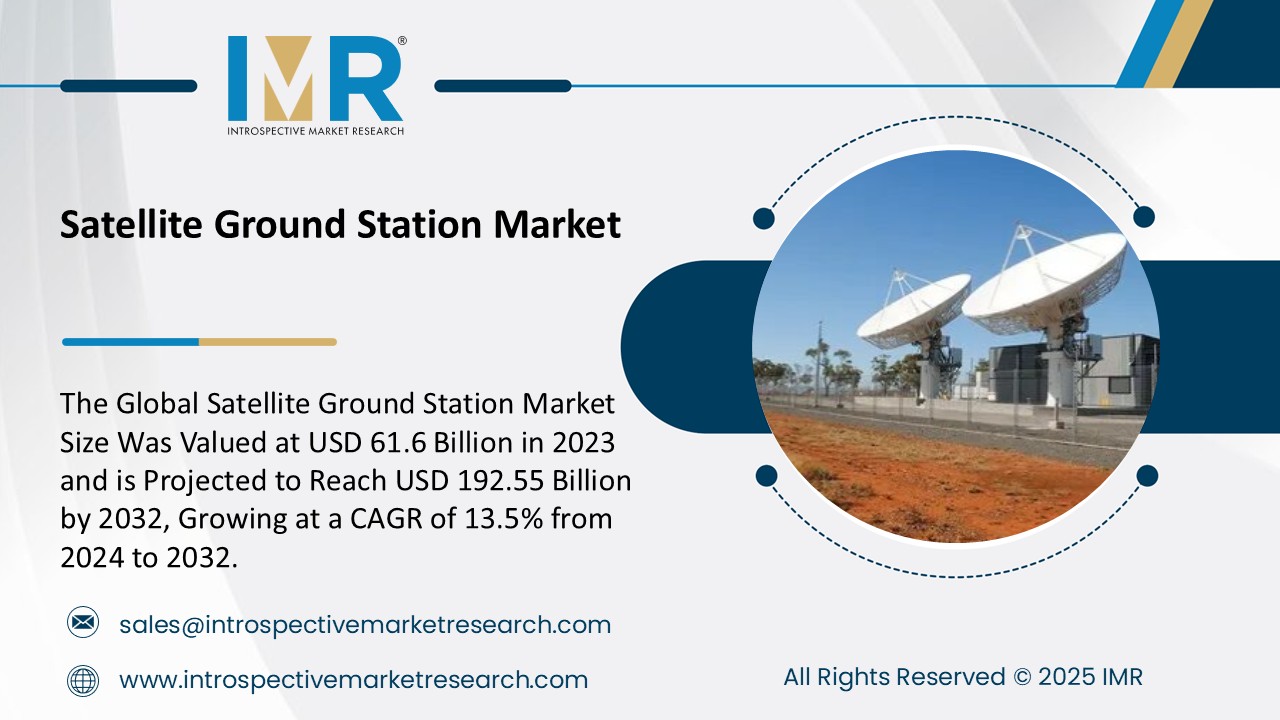
According to a new report published by Introspective Market Research, titled, Satellite Ground Station Market by Platform, Function, End?User, and Region, The Global Satellite Ground Station Market Size Was Valued at USD 61.6?Billion in 2023 and is Projected to Reach USD 192.55?Billion by 2032, Growing at a CAGR of 13.5% from 2024 to 2032. The Satellite Ground Station Market is undergoing substantial growth as global reliance on satellite communications, Earth observation, navigation, and space research intensifies. Ground stations serve as the terrestrial hubs that link satellites to networks on Earth by handling telemetry, tracking, command (TT&C) and data transfer. Modern ground stations incorporate high?precision antennas, RF subsystems, signal processing, and software platforms to manage increasing data flows.
Compared with older systems, next?generation ground stations leverage digital signal processing, software-defined radios, and automation to improve flexibility, reduce latency, and enable remote operability. These features make them better suited for handling a surge in satellite launches, large constellations (especially in LEO), and high-throughput data applications. The ground stations are indispensable in commercial, governmental, and defense sectors for tasks like broadband connectivity, satellite imagery, IoT backhaul, and mission control.
As more nations and private firms launch satellite programs—and as demands for broadband coverage, remote sensing, and navigation expand—the infrastructure to support continuous satellite connectivity is becoming a critical investment area. The shift toward “Ground Station as a Service (GSaaS)” models and virtualized operations further accelerates demand across the value chain.
The Satellite Ground Station Market is segmented into Platform, Function, and End?User. By Platform, the market is categorized into (Fixed, Portable, Mobile). By Function, the market is categorized into (Communication, Earth Observation, Navigation, Space Research, Others). By End?User, the market is categorized into (Commercial, Government, Defense, Others).
One of the most significant growth drivers for the Satellite Ground Station Market is the proliferation of Low Earth Orbit (LEO) satellite constellations delivering broadband, IoT connectivity, and Earth observation services. As operators deploy large numbers of satellites, the need for dense, agile ground station networks capable of handling high-frequency passes, low-latency data downlinks, and rapid handovers becomes critical. These demands spur investments in new ground sites, scalable backhaul, and automated operations to support the real-time traffic and operational complexity of these constellations.
A major market opportunity lies in the increasing adoption of “Ground Station as a Service (GSaaS)” or virtual / cloud?based ground station platforms. Rather than owning infrastructure, satellite operators—especially smaller or startup firms—can outsource ground station capabilities on a usage-based model. This lowers entry barriers, accelerates deployment timelines, and enables scalable operations. Coupled with advances in software-defined ground infrastructure and distributed station networks, GSaaS offers a compelling growth path across commercial, institutional, and newspace segments.
Satellite Ground Station Market, Segmentation
The Satellite Ground Station Market is segmented on the basis of Platform, Function, and End?User.
Platform
The Platform segment is further classified into Fixed, Portable, and Mobile. Among these, the Fixed sub?segment accounted for the highest market share in 2023. Fixed ground stations offer stable, high-throughput connectivity, large antennas, robust infrastructure, and continuous operations—making them the backbone for communication, Earth observation, and mission-critical satellite control. Their reliability and capacity make them preferred in commercial and governmental deployments over more flexible but lower-capacity portable or mobile stations.
Function
The Function segment is further classified into Communication, Earth Observation, Navigation, Space Research, and Others. Among these, the Communication sub?segment accounted for the highest market share in 2023. Communication ground stations handle the bulk of satellite data traffic from broadband, satellite TV, and backhaul services. With growing demand for global connectivity, especially in remote or underserved regions, communication functions drive the largest share of ground station deployments and upgrades.
Some of The Leading/Active Market Players Are–
- Mitsubishi Electric Corporation (Japan)
- Raytheon Technologies (USA)
- Lockheed Martin Corporation (USA)
- Airbus SE (Netherlands)
- Safran Defense & Space (France)
- Thales Group (France)
- L3Harris Technologies (USA)
- Viasat, Inc. (USA)
- SES S.A. (Luxembourg)
- Intelsat S.A. (Luxembourg)
- Kratos Defense & Security Solutions (USA)
- Gilat Satellite Networks (Israel)
- Orbit Communications Systems (Israel)
- …and other active players.
Key Industry Developments
In January 2025, Amazon’s Project Kuiper expanded its ground station network by announcing additional AWS ground station hubs to support its LEO broadband constellation.
This expansion will bolster Kuiper’s ability to manage high?volume data traffic and low-latency communication as it scales. The additional ground hubs enhance coverage, reduce latency, and enable robust handovers between satellite beams, strengthening Amazon’s position in global satellite internet deployment.
In April 2025, a major space agency (e.g. India’s ISRO) completed integration of new ground stations to support real-time satellite docking and servicing missions.
This development underscores the role of ground infrastructure in advanced space operations. The upgraded facilities incorporate real-time telemetry, command, and high-bandwidth data relay to facilitate docking maneuvers, in-orbit repairs, and servicing of satellites—enhancing mission flexibility and sustainability.
Key Findings of the Study
- Fixed platforms dominate due to reliability and capacity demands.
- Communication is the leading ground station function, driven by data traffic volume.
- GSaaS offers scalable, cost-effective access especially for newspace operators.
- Proliferation of LEO constellations is a major growth driver.
- North America and Europe continue to lead regional deployment and investment.