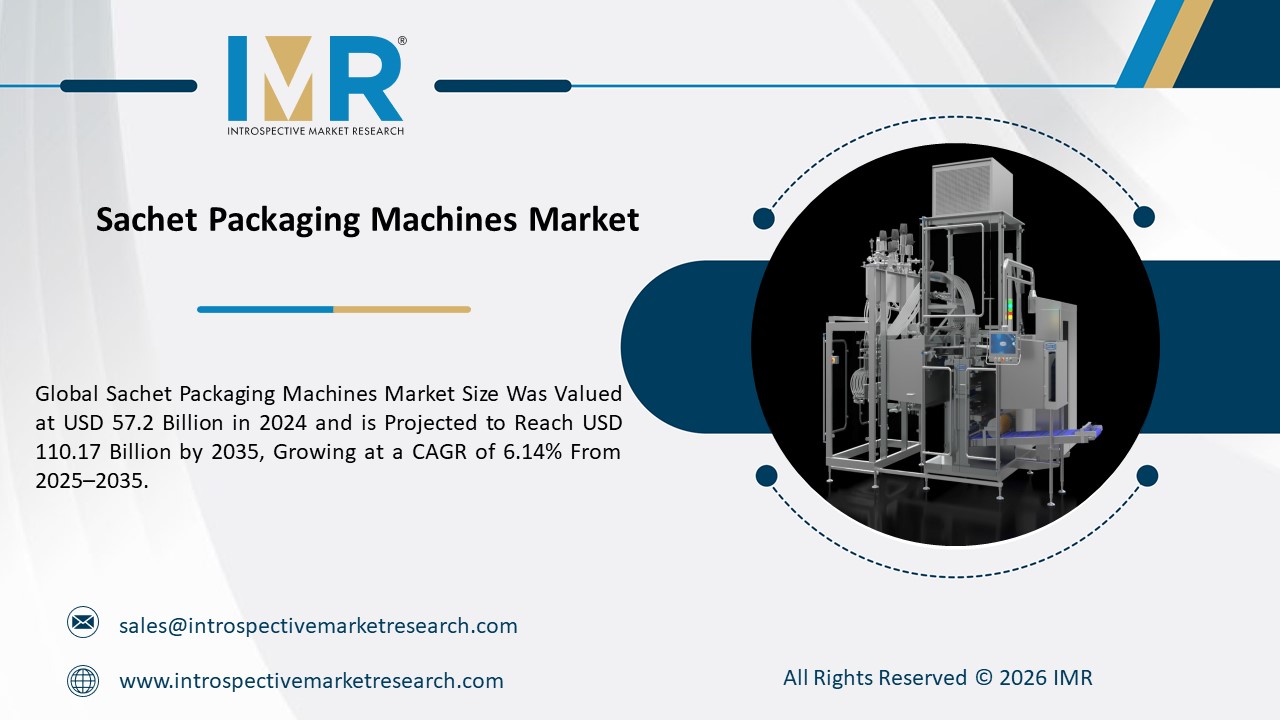
“According to a new report published by Introspective Market Research, titled, Sachet Packaging Machines Market by Type, Application, and End-Use Industry, The Global Sachet Packaging Machines Market Size Was Valued at USD 57.2 Billion in 2024 and is Projected to Reach USD 110.17 Billion by 2035, Growing at a CAGR of 6.14% From 2025–2035.”
The sachet packaging machines market comprises automated and semi-automated equipment designed to pack small quantities of products into flexible sachets or pouches. These machines are widely used for packaging powders, granules, liquids, and pastes, offering precise filling, sealing, and labeling in high-speed production environments. Compared to traditional bulk or rigid packaging systems, sachet packaging machines provide cost efficiency, reduced material usage, and enhanced convenience for end users.
Sachet packaging has gained significant traction across industries such as food & beverages, pharmaceuticals, personal care, and household products. The growing preference for single-use, affordable, and portable packaging formats has strengthened demand for sachets, particularly in emerging economies. Additionally, advancements in machine automation, digital controls, and multi-lane configurations have improved productivity and reduced operational downtime.
Moreover, the rise of organized retail, e-commerce distribution, and on-the-go consumption habits has accelerated the adoption of sachet packaging machines. Manufacturers are increasingly focusing on energy-efficient designs and compatibility with sustainable packaging materials, further supporting market expansion over the forecast period.
Market Segmentation
The Sachet Packaging Machines Market is segmented into Type, Application, and End-Use Industry.
- By Type, the market is categorized into Vertical Form Fill Seal (VFFS), Horizontal Form Fill Seal (HFFS), and Rotary Machines.
- By Application, the market is categorized into Powder, Liquid, Granule, and Paste.
- By End-Use Industry, the market is categorized into Food & Beverages, Pharmaceuticals, Personal Care & Cosmetics, Chemicals, and Others.
Growth Driver
One of the key growth drivers of the sachet packaging machines market is the rising demand for single-serve and convenient packaging solutions. Changing consumer lifestyles, urbanization, and increasing disposable incomes have boosted the consumption of small-sized packaged products. Sachets offer affordability and ease of distribution, especially in price-sensitive markets. As a result, manufacturers are investing in high-speed, flexible sachet packaging machines to meet growing production volumes while maintaining accuracy and cost efficiency, significantly driving market growth.
Market Opportunity
A major market opportunity lies in the integration of smart technologies and sustainable packaging compatibility. The adoption of Industry 4.0 features such as IoT-enabled monitoring, predictive maintenance, and automated quality inspection is creating new avenues for machine manufacturers. Additionally, increasing regulations and consumer awareness regarding environmental sustainability are encouraging the use of biodegradable and recyclable packaging materials. Sachet packaging machines that can efficiently handle eco-friendly films are expected to witness strong demand, presenting lucrative growth opportunities.
Detailed Segmentation
Sachet Packaging Machines Market, Segmentation
The Sachet Packaging Machines Market is segmented on the basis of Type, Application, and End-Use Industry.
Type
The Type segment is further classified into Vertical Form Fill Seal (VFFS), Horizontal Form Fill Seal (HFFS), and Rotary Machines. Among these, the Vertical Form Fill Seal (VFFS) sub-segment accounted for the highest market share in 2024. VFFS machines are widely preferred due to their compact design, high-speed operation, and versatility in handling different product forms. Their cost-effectiveness and ease of integration into existing production lines make them highly suitable for mass production across food, pharmaceutical, and personal care industries.
Application
The Application segment is further classified into Powder, Liquid, and Granule. Among these, the Powder sub-segment accounted for the highest market share in 2024. Powder sachet packaging is extensively used for products such as spices, coffee, nutritional supplements, and pharmaceutical formulations. The growing demand for portion-controlled and hygienically packed powdered products has increased the adoption of specialized powder sachet packaging machines with advanced dosing and sealing capabilities.
Some of The Leading/Active Market Players Are-
• Bosch Packaging Technology (Germany)
• IMA Group (Italy)
• Syntegon Technology (Germany)
• Coesia Group (Italy)
• MULTIVAC (Germany)
• Nichrome Packaging Solutions (India)
• Mespack (Spain)
• Viking Masek (USA)
• KHS Group (Germany)
• ProMach Inc. (USA)
• Fuji Machinery (Japan)
• Tetra Pak (Switzerland)
• Winpak Ltd. (Canada)
• Marchesini Group (Italy)
• ULMA Packaging (Spain)
and other active players.
Key Industry Developments
In March 2024, a leading packaging machinery manufacturer launched a next-generation sachet packaging machine with enhanced automation and digital control systems.
The new system offers improved accuracy, reduced material wastage, and real-time performance monitoring, enabling manufacturers to optimize production efficiency and minimize downtime across high-volume packaging operations.
In October 2024, a major industry player announced the expansion of its sachet packaging machine manufacturing facility in Asia.
This expansion aims to strengthen regional supply capabilities, cater to growing demand from food and pharmaceutical sectors, and support faster delivery timelines while enhancing after-sales service infrastructure.
Key Findings of the Study
• VFFS machines dominate the market due to cost efficiency and versatility
• Powder applications hold the largest share across industries
• Asia-Pacific leads the market, driven by high consumer demand and manufacturing growth
• Rising demand for single-serve packaging is a key growth driver
• Automation and sustainability are major emerging market trends