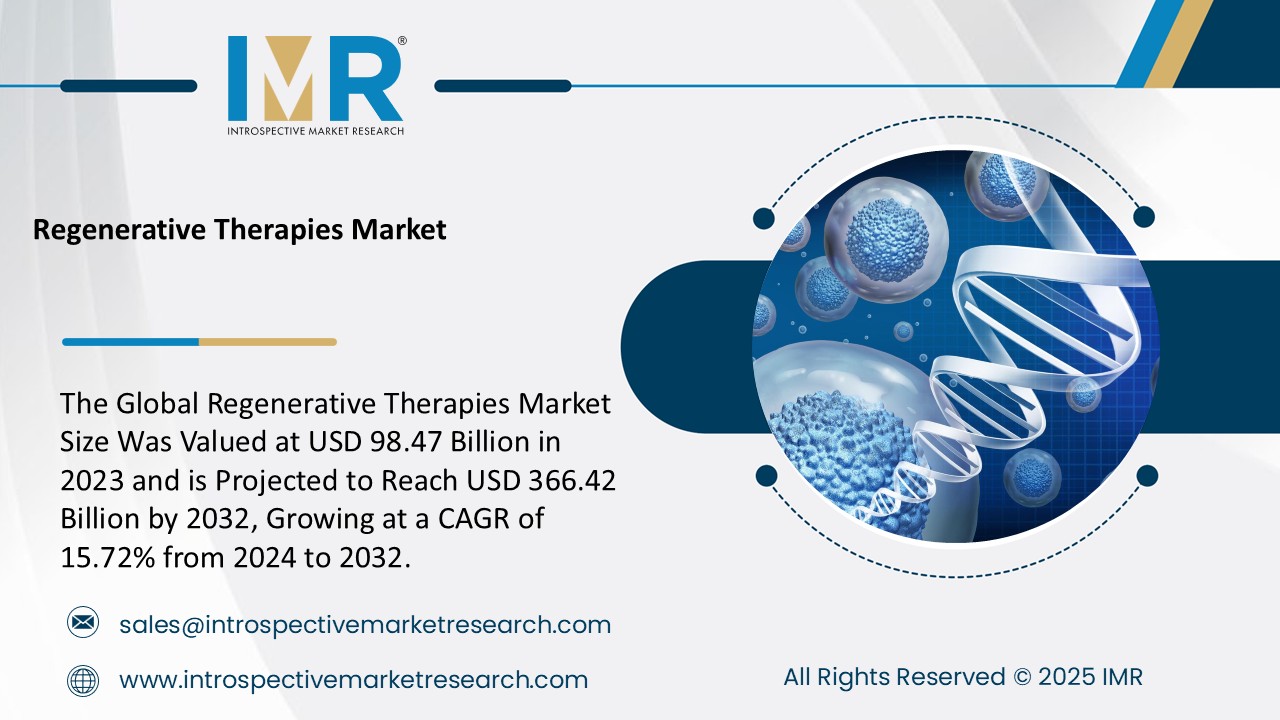
According to a new report published by Introspective Market Research, titled, Regenerative Therapies Market by Therapy Type, Indication, End?User, and Region, The Global Regenerative Therapies Market Size Was Valued at USD 98.47 Billion in 2023 and is Projected to Reach USD 366.42 Billion by 2032, Growing at a CAGR of 15.72% from 2024 to 2032. Regenerative therapies involve medical treatments that restore or replace damaged tissues, organs, or cells by harnessing the body’s own healing mechanisms. These include cell therapies, gene therapies, tissue engineering, and biologics. Their advantages over conventional treatments lie in their potential for long-lasting benefits, reduced need for lifelong supportive care, and ability to address underlying causes rather than just symptoms.
Conventional therapies such as small?molecule drugs or traditional surgeries often treat symptoms or slow progression of disease. Regenerative therapies promise deeper healing—by regenerating tissue, correcting genetic defects, or enabling functional recovery. These therapies are being applied across a wide range of indications including cardiovascular diseases, neurodegenerative disorders, orthopedic injuries, and wound healing.
Major end?users include hospitals, biotechnology firms, research institutes, and specialty clinics. Advances in cell manufacturing, gene editing technologies (like CRISPR), scaffold design, and regulatory accreditations are enabling faster development and commercialization of regenerative therapies globally. With rising healthcare expenditure, aging populations, and unmet medical needs, demand is accelerating in both developed and emerging economies.
The Regenerative Therapies Market is segmented into Therapy Type, Indication, and End?User. By Therapy Type, the market is categorized into (Cell Therapy, Gene Therapy, Tissue Engineering, Other Biologics). By Indication, the market is categorized into (Cardiovascular Disorders, Neurodegenerative Diseases, Orthopedic Injuries, Wound Healing, Others). By End?User, the market is categorized into (Hospitals, Clinics & Specialty Centres, Research Institutes, Managed Care Providers).
A key growth driver in the Regenerative Therapies Market is the rising burden of chronic and degenerative diseases globally, especially in aging populations. Conditions such as osteoarthritis, Alzheimer’s, cardiovascular disease, and diabetes result in tissue and organ damage that traditional treatments can only partially manage. Regenerative therapies, including stem cell?based treatments, gene therapies, and engineered tissues, offer the potential not only to halt disease progression but to repair or replace damaged biological structures. This disease burden is encouraging governments, private investors, and pharma/biotech companies to channel funding, expand clinical trial activity, and accelerate regulatory pathways, which in turn drives broader adoption of advanced therapies.
One of the major opportunities in the Regenerative Therapies Market lies in improving cell and gene therapy scalability and reducing costs through advances in manufacturing technologies. As therapies move from small trial batches to industrial production, innovations in bioprocessing, automation, and allogeneic (“off?the?shelf”) solutions are becoming essential. Additionally, regulatory harmonization and clearer reimbursement frameworks across regions are lowering barriers to entry in markets that were previously slow to adopt. Firms that invest in scalable production, demonstrate long?term safety and efficacy, and navigate regulatory landscapes effectively will be well positioned to capture substantial portions of unmet need across indications.
Regenerative Therapies Market, Segmentation
The Regenerative Therapies Market is segmented on the basis of Therapy Type, Indication, and End?User.
Therapy Type
The Therapy Type segment is further classified into Cell Therapy, Gene Therapy, Tissue Engineering, and Other Biologics. Among these, the Cell Therapy sub?segment accounted for the highest market share in 2023. Cell therapies are leading because of their relative maturity: multiple cell?based products have already achieved regulatory approvals or advanced clinical development for indications such as hematological disorders, immunologic diseases, and wound repair. Their effectiveness in delivering living cells that can integrate and restore function, along with increasing standardization in cell sourcing, preservation, and processing, contribute to their leading position.
Indication
The Indication segment is further classified into Cardiovascular Disorders, Neurodegenerative Diseases, Orthopedic Injuries, Wound Healing, and Others. Among these, Orthopedic Injuries sub?segment accounted for the highest market share in 2023. The demand stems from high incidence of musculoskeletal issues due to aging populations, sports injuries, and degenerative disorders. Regenerative therapies like stem cell injections, scaffold?assisted cartilage repair, and biologic implants are increasingly integrated into orthopedic treatment protocols, offering faster recovery, reduced morbidity, and improved functional outcomes compared to substitution surgeries alone.
Some of The Leading/Active Market Players Are–
- Novartis AG (Switzerland)
- Pfizer, Inc. (USA)
- Bayer AG (Germany)
- Amgen, Inc. (USA)
- Gilead Sciences, Inc. (USA)
- Organogenesis Holdings, Inc. (USA)
- Mesoblast Ltd. (Australia)
- Stryker Corporation (USA)
- Thermo Fisher Scientific, Inc. (USA)
- Smith & Nephew PLC (UK)
- Osiris Therapeutics, Inc. (USA)
- Medtronic PLC (Ireland / USA)
- Vericel Corporation (USA)
- …and other active players.
Key Industry Developments
In April 2024, Regeneron announced a collaboration with Mammoth Biosciences to co?develop CRISPR?based gene editing therapies targeting various diseases.
Regeneron will combine its delivery platform expertise with Mammoth’s CRISPR methods to create therapies that can reach tissues beyond the liver. This deal involves an upfront investment and equity funding, along with milestone payments linked to therapy development and commercialization. It reflects the industry’s increasing emphasis on precise gene editing and expanding therapeutic reach, especially into previously hard?to?treat organs. The collaboration aims to accelerate time?to?clinic for several high?impact indications and offer potential for durable, curative treatments.
In September 2025, Bayer moved its experimental stem cell therapy for Parkinson’s disease into Phase III clinical trials.
Developed by Bayer’s cell therapy division, this treatment transforms human stem cells into dopamine?producing nerve cells to address neural degeneration in Parkinson’s. Early trial phases showed favorable safety and integration of transplanted cells into brain tissue. Bayer is also investing heavily in cell therapy manufacturing infrastructure to scale production. This step marks a critical milestone, as Phase III trials could lead to eventual regulatory approval and commercial deployment for a disease with few curative options.
Key Findings of the Study
- Cell Therapy leads the therapy type segment owing to greater maturity and regulatory progress.
- Orthopedic Injuries dominate the indication segment, driven by high unmet need.
- High CAGR of 15.72% reflects accelerating adoption and investment globally.
- Advances in scalable manufacturing and clearer reimbursement present major opportunities.
- Regulatory partnerships and clinical milestones (e.g. Phase III trials) bolster market confidence.