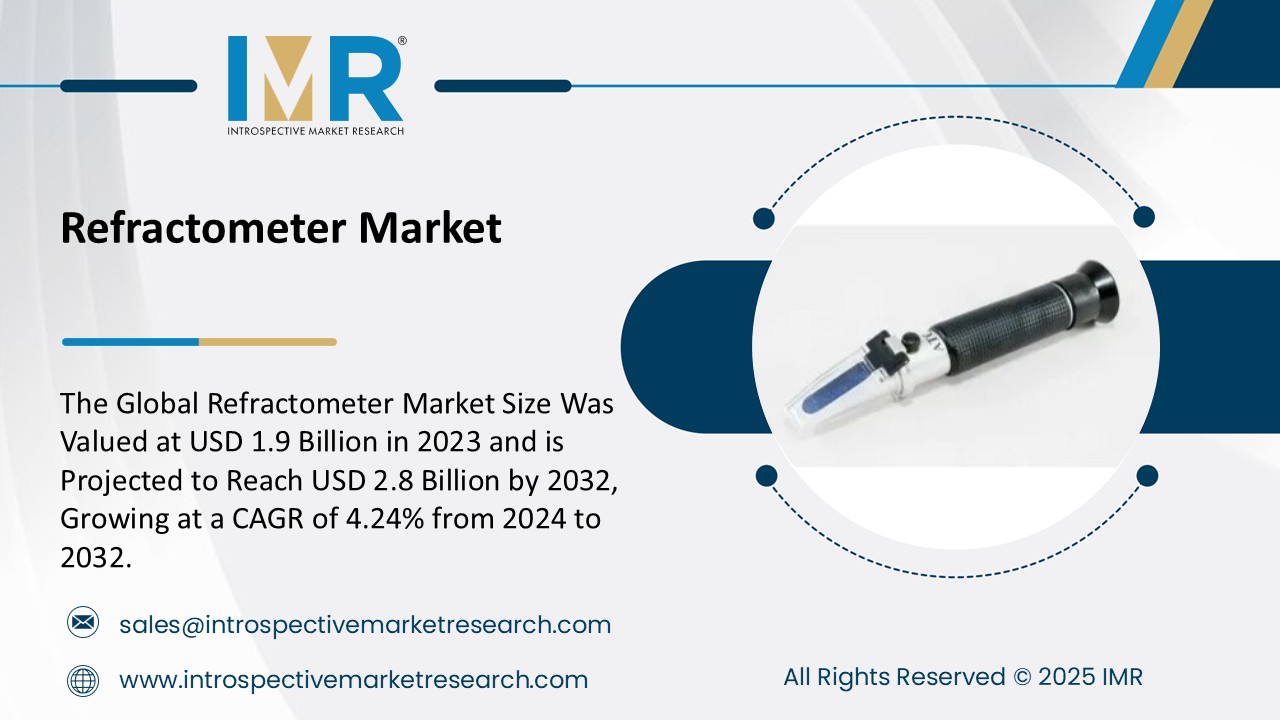
According to a new report published by Introspective Market Research, titled, Global Refractometer Market by Product Type, Application, and End-User, The Global Refractometer Market Size Was Valued at USD 1.9 Billion in 2023 and is Projected to Reach USD 2.8 Billion by 2032, Growing at a CAGR of 4.24% from 2024 to 2032. The Global Refractometer Market is expanding steadily as industries increasingly rely on precise measurement tools for quality control and material analysis. Refractometers are optical devices used to determine the refractive index of liquids or solids, which helps in identifying concentration, purity, or specific gravity of a substance. These instruments are widely employed in sectors such as food and beverage, pharmaceuticals, chemicals, and petrochemicals to ensure product integrity and regulatory compliance.
Modern digital and automatic refractometers offer several advantages over traditional manual types, including faster readings, higher accuracy, temperature compensation, and ease of use. With the growing emphasis on process automation and inline quality monitoring, the demand for advanced refractometers is surging. Moreover, the rise in research and development activities in biotechnology and material sciences has increased the use of laboratory refractometers across academia and commercial labs.
The Global Refractometer Market is segmented into Product Type, Application, and End-User. By Product Type, the market is categorized into (Traditional Handheld Refractometers, Digital Handheld Refractometers, Laboratory Refractometers, Inline Process Refractometers). By Application, the market is categorized into (Food and Beverage, Pharmaceuticals, Chemicals, Petrochemicals, Others). By End-User, the market is categorized into (Industrial, Research and Academic, Commercial Laboratories, Others).
One of the key drivers for the Global Refractometer Market is the growing demand for quality assurance in the food and beverage industry. Refractometers are essential for measuring sugar content, salinity, and concentration in products such as juices, sauces, dairy, and alcoholic beverages. Regulatory pressures and consumer expectations for product consistency are pushing manufacturers to adopt more accurate and digital refractometers, which help reduce product recalls and enhance operational efficiency.
A significant market opportunity lies in the integration of refractometers into automated process control systems. With Industry 4.0 and smart manufacturing becoming standard across various sectors, the demand for inline refractometers that offer real-time data analytics and remote monitoring is expected to grow. These systems not only improve production speed but also ensure continuous quality monitoring without manual intervention, offering cost and time savings.
Global Refractometer Market, Segmentation
The Global Refractometer Market is segmented on the basis of Product Type, Application, and End-User.
Product Type
The Product Type segment is further classified into Traditional Handheld Refractometers, Digital Handheld Refractometers, Laboratory Refractometers, and Inline Process Refractometers. Among these, the Laboratory Refractometers sub-segment accounted for the highest market share in 2023. These instruments are widely used in laboratories for precise and repeatable measurements, especially in pharmaceutical, chemical, and research applications. Their accuracy, adaptability to different substances, and advanced data handling capabilities have made them a preferred choice in quality-sensitive environments.
Application
The Application segment is further classified into Food and Beverage, Pharmaceuticals, Chemicals, Petrochemicals, and Others. Among these, the Food and Beverage sub-segment accounted for the highest market share in 2023. Refractometers play a critical role in measuring sugar content (Brix), acidity, and salinity during food processing. The segment benefits from rising global demand for processed food and beverages, increased consumer focus on quality, and stringent food safety regulations across developed and developing markets.
Some of The Leading/Active Market Players Are–
- Anton Paar GmbH (Austria)
- KRÜSS GmbH (Germany)
- A.KRÜSS Optronic GmbH (Germany)
- Atago Co., Ltd. (Japan)
- Thermo Fisher Scientific (USA)
- Reichert Technologies (USA)
- Mettler-Toledo International Inc. (Switzerland)
- MISCO Refractometer (USA)
- Hanna Instruments Inc. (USA)
- Schmidt + Haensch GmbH & Co. (Germany)
- Rudolph Research Analytical (USA)
- …and other active players.
Key Industry Developments
In February 2024, Anton Paar launched its new series of digital refractometers integrated with real-time temperature compensation and Ethernet connectivity.
This product series aims to support automation in food processing and pharmaceuticals by enabling real-time quality monitoring and seamless data transfer across smart factory systems.
In June 2024, Atago Co., Ltd. announced a strategic collaboration with a biotechnology firm to co-develop specialized refractometers for fermentation-based bioprocessing.
This partnership aims to offer customized devices for measuring fermentation levels and nutrient concentrations in bio-manufacturing, boosting adoption in precision fermentation and biopharma sectors.
Key Findings of the Study
- Laboratory refractometers dominated the market due to their use in pharma and research labs.
- The food and beverage segment led in application due to quality control needs.
- Asia-Pacific is an emerging market driven by industrial growth and F&B demand.
- Real-time data integration and automation offer new growth opportunities.