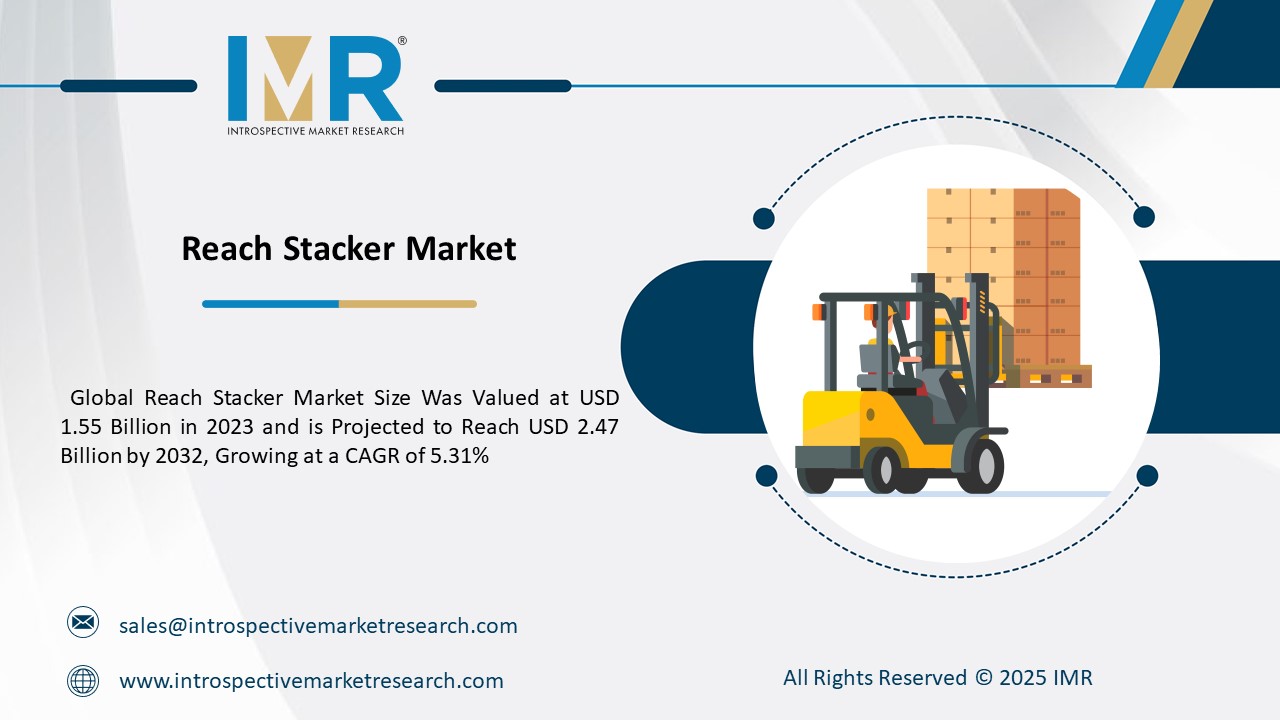
According to a new report published by Introspective Market Research, titled, Reach Stacker Market by Maximum Capacity, Propulsion Type, and Application, The Global Reach Stacker Market Size Was Valued at USD 1.55 Billion in 2023 and is Projected to Reach USD 2.47 Billion by 2032, Growing at a CAGR of 5.31%.The Reach Stacker Market continues to expand globally owing to the rapid growth of international trade, port modernization, and the increasing movement of containerized cargo. Reach stackers are heavy-duty industrial vehicles designed for handling intermodal containers in shipping terminals, logistics yards, and rail depots. Owing to their versatility, high load capacity, and operational efficiency, reach stackers are extensively used for stacking containers, transporting heavy materials, and streamlining cargo management processes in congested port environments.
The adoption of reach stackers offers distinct performance advantages compared to conventional forklifts and cranes. These machines provide superior mobility, space optimization, and lifting agility, enhancing operational safety and cost-effectiveness. Moreover, the integration of digital technology, automation controls, and sustainable propulsion systems such as hybrid and electric variants is revolutionizing container handling operations worldwide. As environmental sustainability and energy efficiency take precedence, manufacturers are investing in low-emission, high-torque machines equipped with telematics and IoT-based monitoring systems.
The Reach Stacker Market is segmented into Maximum Capacity, Propulsion Type, and Application.
-
By Maximum Capacity: Below 30 Tons, 30–45 Tons, and Above 45 Tons.
-
By Propulsion Type: Internal Combustion Engine, Hybrid, and Electric.
-
By Application: Ports and Terminals, Intermodal Yards, Logistics & Warehousing, and Industrial Applications.
One of the key drivers of the Reach Stacker Market is the rising globalization of trade coupled with increased containerized shipping activities. Global port operators and logistics firms are adopting reach stackers to optimize cargo handling speed and improve efficiency in constrained spaces. Additionally, the expansion of intermodal logistics networks, combined with increased investments in port infrastructure and automation, is driving consistent demand for reliable and high-performance material handling equipment. These factors, together with ongoing technical upgrades and fleet modernization efforts, are boosting market adoption.
The adoption of electric and hybrid reach stackers presents a major market opportunity. As governments and port authorities implement stricter emission standards, the need for energy-efficient, low-emission handling equipment is rising. Manufacturers are developing next-generation machines powered by lithium-ion batteries and hybrid propulsion systems, providing enhanced fuel savings, reduced noise, and environmental compliance. Furthermore, the integration of IoT-enabled fleet management and autonomous operation technologies enables predictive maintenance and remote monitoring, paving the way for smarter, safer, and more sustainable logistics operations.
Reach Stacker Market, Segmentation
The Reach Stacker Market is segmented on the basis of Maximum Capacity, Propulsion Type, and Application.
Maximum Capacity
The Maximum Capacity segment is further classified into Below 30 Tons, 30–45 Tons, and Above 45 Tons. Among these, the 30–45 Tons sub-segment accounted for the highest market share in 2023. This capacity range offers optimal performance for most port and logistics operations, balancing fuel economy with lifting capabilities. It is widely used in container handling across seaports and rail terminals due to its flexibility and compatibility with both standard and high-cube containers.
Propulsion Type
The Propulsion Type segment is classified into Internal Combustion Engine, Hybrid, and Electric. Among these, the Hybrid sub-segment dominated the market in 2023, owing to its ability to combine fuel-driven power with electric efficiency. Hybrid reach stackers significantly reduce fuel consumption and emissions while maintaining comparable lifting strength, making them a preferred choice in regions emphasizing sustainable operations across port and logistics infrastructure.
Some of The Leading Market Players Are
- Konecranes Plc (Finland)
- Cargotec Corporation (Kalmar) (Finland)
- Hyster-Yale Materials Handling, Inc. (United States)
- CVS Ferrari S.p.A. (Italy)
- Liebherr Group (Switzerland)
- SANY Group (China)
- Hyster Company (United States)
- Toyota Material Handling (Japan)
- Taylor Machine Works Inc. (United States)
- Terex Corporation (United States)
- Hoist Liftruck Mfg., LLC (United States)
- Dalian Forklift Co., Ltd. (China)
- Kion Group AG (Germany)
- Komatsu Ltd. (Japan)
- ZPMC – Shanghai Zhenhua Heavy Industries Co., Ltd. (China)
- Other active players.
Key Industry Developments
- In February 2025, Kalmar introduced its new electric reach stacker with modular lithium-ion battery systems and regenerative braking, delivering a 40% reduction in total operating costs compared to diesel models.The product launch is part of Kalmar’s global strategy to lead the decarbonization of port equipment and strengthen its electric container handling portfolio.
- In August 2024, Konecranes expanded its EcoLifting reach stacker series by introducing hybrid models integrated with AI-driven control systems for optimized energy utilization.The innovation supports customers in reducing carbon footprint while improving operational precision and reliability for high-capacity container terminals.
Key Findings of the Study
- The 30–45 Tons segment dominates the market due to widespread port and intermodal use.
- Hybrid reach stackers are emerging as the fastest-growing propulsion category globally.
- Asia-Pacific leads market growth, driven by cargo volume expansion in China, India, and Southeast Asia.
- Technological innovation, electrification, and AI-enabled automation continue shaping market evolution.