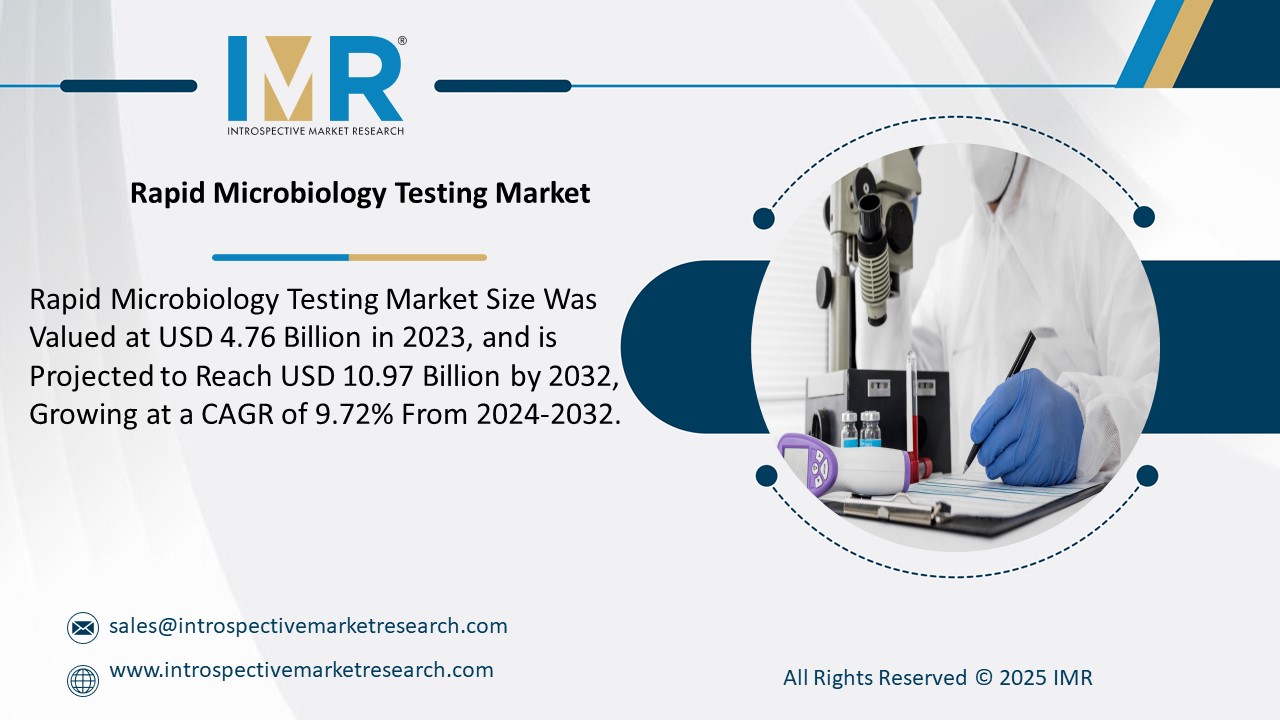
According to a new report published by Introspective Market Research, titled, Rapid Microbiology Testing Market by Product, Application, and End User, the Global Rapid Microbiology Testing Market Size Was Valued at USD 4.76 Billion in 2023 and is Projected to Reach USD 10.97 Billion by 2032, Growing at a CAGR of 9.72%.
The Rapid Microbiology Testing Market represents one of the most dynamic sectors within the global diagnostics and biotechnology industries. This market encompasses advanced technologies designed to deliver quick, reliable, and accurate microbial detection results—dramatically reducing the time required compared to traditional culture-based methods. Rapid microbiology testing is widely adopted in industries such as pharmaceuticals, food and beverage, healthcare, cosmetics, and environmental monitoring to ensure safety, quality, and compliance with regulatory standards. These methods provide significant advantages over conventional microbiological techniques, including reduced turnaround time, enhanced sensitivity, real-time monitoring capabilities, and cost-effectiveness. Growing concerns over microbial contamination, coupled with an increasing focus on quality control and sterility assurance, are driving the adoption of rapid microbiology testing across multiple end-user segments globally.
A major growth driver for the Rapid Microbiology Testing Market is the increasing demand for faster and more accurate diagnostic solutions in healthcare and pharmaceutical production. Traditional microbial testing methods require several days for results, which delays decision-making in critical applications such as infection diagnosis and product release. Rapid testing methods, on the other hand, allow early detection and quantification of microorganisms in a fraction of the time. This not only improves patient outcomes but also enhances production efficiency and quality assurance processes across industries. A key market opportunity lies in the integration of automation and AI-based analytical platforms in rapid microbiology testing systems. As laboratories and production units move toward digital transformation, there is growing potential for automated, data-driven systems that can detect microbial contamination in real-time with minimal human intervention. This trend is particularly strong in pharmaceutical manufacturing and clinical diagnostics, where smart testing systems help reduce labor costs, improve throughput, and ensure data traceability—offering lucrative growth potential for market players.
Detailed Segmentation
Rapid Microbiology Testing Market, Segmentation
The Rapid Microbiology Testing Market is segmented on the basis of Product, Application, and End User.
Product
- The Product segment is further classified into Instruments, Reagents & Kits, and Consumables. Among these, the Reagents & Kits sub-segment accounted for the highest market share in 2023. The increasing adoption of ready-to-use kits and reagents in both clinical and industrial testing has driven this segment’s dominance. These kits provide enhanced reliability, faster results, and ease of use, making them an integral part of high-throughput microbiology workflows across laboratories and manufacturing sites.
Application
- The Application segment is further classified into Clinical Disease Diagnosis, Pharmaceutical & Biotechnology Testing, Food & Beverage Testing, Environmental Testing, and Cosmetics Testing. Among these, the Clinical Disease Diagnosis sub-segment accounted for the highest market share in 2023. Rising cases of infectious diseases, increased emphasis on hospital infection control, and growing awareness about early disease detection have fueled demand for rapid microbiological methods in clinical laboratories worldwide.
Some of The Leading/Active Market Players Are
- Thermo Fisher Scientific Inc. (United States)
- Bio-Rad Laboratories, Inc. (United States)
- Becton, Dickinson and Company (United States)
- Merck KGaA (Germany)
- Danaher Corporation (United States)
- Charles River Laboratories (United States)
- bioMérieux SA (France)
- Neogen Corporation (United States)
- Rapid Micro Biosystems, Inc. (United States)
- Lonza Group Ltd. (Switzerland)
- Sartorius AG (Germany)
- QuidelOrtho Corporation (United States)
- Don Whitley Scientific Limited (United Kingdom)
- TSI Incorporated (United States)
- and other active players.
Key Industry Developments
- In June 2024, Thermo Fisher Scientific launched a next-generation rapid microbial detection system integrating automated sample preparation and cloud-based data analytics. This innovation aims to accelerate contamination testing in pharmaceutical and biotechnology industries, reducing turnaround times from days to hours while improving compliance with global regulatory standards.
- In March 2024, bioMérieux SA introduced its new VIDAS® Rapid Pathogen Detection Platform, designed for food and environmental testing. The platform enhances sensitivity and allows high-throughput microbial detection for food manufacturers, addressing the growing global demand for food safety assurance and contamination control.
Key Findings of the Study
- The Reagents & Kits segment dominated the market in 2023.
- Clinical Disease Diagnosis led the application segment.
- North America emerged as the leading regional market.
- Rising demand for faster diagnostic tools and automation in testing drives growth.
- Adoption of AI-integrated microbiology platforms presents major future opportunities.