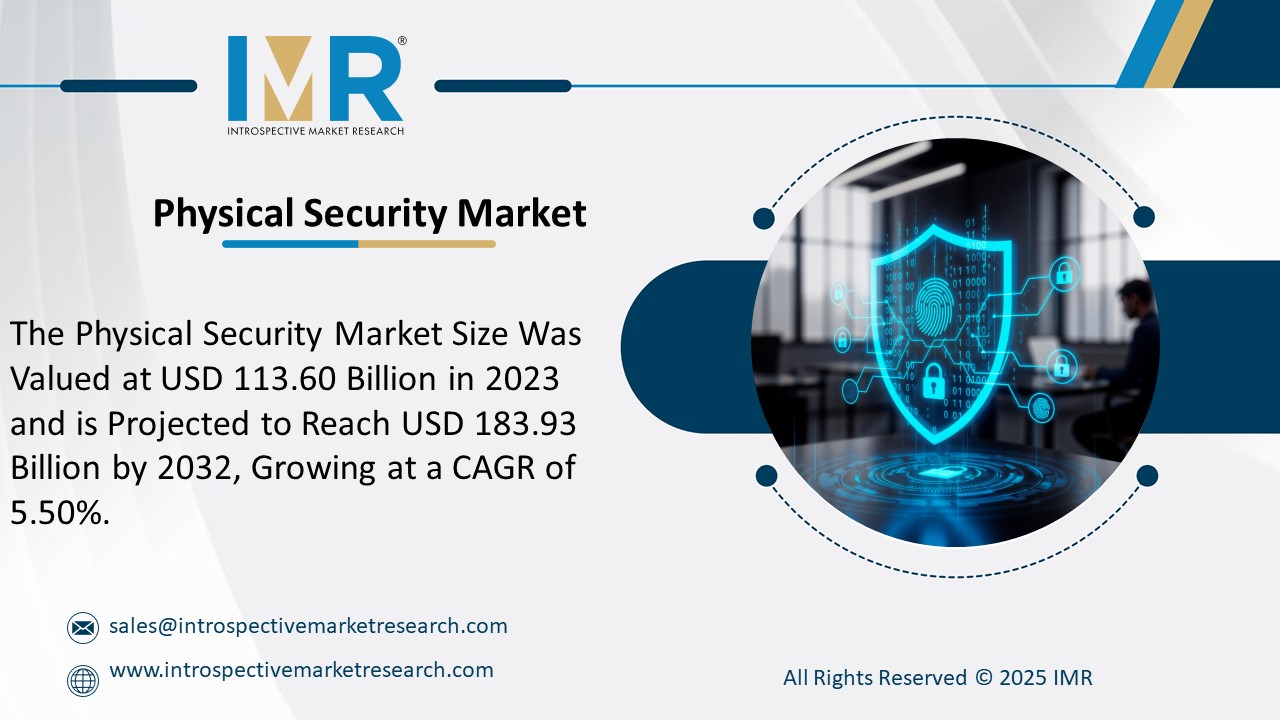
According to a new report published by Introspective Market Research, titled, Physical Security Market by Component, Type, and End-User, The Global Physical Security Market Size Was Valued at USD 113.60 Billion in 2023 and is Projected to Reach USD 183.93 Billion by 2032, Growing at a CAGR of 5.50%. The Physical Security Market comprises hardware, software, and services designed to protect people, assets, and facilities from unauthorized access, intrusion, theft, vandalism, fire, and related threats. Systems include video surveillance, access control, intrusion detection, perimeter security, fire & life safety, and monitoring services. Compared to isolated security measures (locks, alarms), integrated physical security solutions offer real-time visibility, automation, and centralized control, enhancing situational awareness and responsiveness.
Demand is being driven by rising security concerns across public infrastructure, smart cities, transport, commercial spaces, and critical infrastructure. As threats become more sophisticated, organizations require layered, interoperable solutions that coordinate across systems, detect anomalies, prioritize alerts, and facilitate efficient responses. Regulatory mandates and risk management further push adoption of modern security architectures.
The Physical Security Market is segmented into Component, Type, and End-User. By Component, the market is categorized into (Hardware, Software, Services). By Type, the market is categorized into (Video Surveillance Systems, Access Control Systems, Intrusion Detection & Prevention, Fire & Life Safety, Perimeter Security). By End-User, the market is categorized into (Commercial / Industrial, Government / Infrastructure, Transportation & Logistics, Healthcare, Retail & Hospitality).
A primary growth driver is the rising complexity of threat environments and the need for integrated security infrastructures. Traditional security silos struggle to scale or respond rapidly; in contrast, integrated physical security systems enable orchestration across Video, Access Control, Intrusion, Fire, and Perimeter systems. Organizations seek unified platforms that can correlate events, reduce duplicate alarms, enable forensic analysis, and automate response workflows. This consolidation and intelligence-driven approach to security is fueling investments in next-generation physical security solutions globally.
One compelling opportunity lies in the convergence of physical security with cybersecurity and IoT. As facilities become smarter and more connected, physical systems generate vast data streams. Vendors that can embed analytics, threat correlation, anomaly detection, and cross-domain intelligence (physical + cyber) can offer high value. Moreover, cloud deployment, remote monitoring, and AI-augmented systems open new business models (Security-as-a-Service) and recurring revenue streams. The increasing adoption of smart buildings and connected infrastructure further amplifies this opportunity.
Physical Security Market, Segmentation
The Physical Security Market is segmented on the basis of Component, Type, and End-User.
Component
The Component segment is further classified into Hardware, Software, and Services. Among these, the Hardware sub-segment accounted for the highest market share in 2024. Hardware—such as cameras, sensors, access control devices, intrusion detectors, and fire panels—forms the foundation of all installations. Its upfront capital requirement and replacement cycles maintain its dominance in total revenues.
Type
The Type segment is further classified into Video Surveillance Systems, Access Control Systems, Intrusion Detection & Prevention, Fire & Life Safety, and Perimeter Security. Among these, the Video Surveillance Systems sub-segment accounted for the highest market share in 2024. Video surveillance remains the most deployed physical security discipline due to its visibility, deterrence, recording capability, and continuous advancements in resolution, analytics, and networked architecture.
Some of The Leading/Active Market Players Are-
- Hikvision (China)
- Honeywell International (USA)
- Bosch Security Systems (Germany)
- Axis Communications (Sweden)
- Johnson Controls (USA)
- Genetec (Canada)
- Cisco Systems (USA)
- ADT (USA)
- Dahua Technology (China)
- Siemens (Germany)
- other active players.
Key Industry Developments
- In April 2025, MCA, Inc. acquired Presidio’s Physical Security Integration business to strengthen its systems integration capabilities.
This expansion brings end-to-end integration services for physical security systems under MCA, enabling more cohesive deployment of video, access control, intrusion, and monitoring solutions. By absorbing Presidio’s consultancy and field integration expertise, MCA aims to enhance turnkey offerings and accelerate deployment cycles for enterprise clients. - In January 2025, Spot AI launched its Remote Security Agent—an AI-enhanced solution combining smart cameras and cloud analytics for retail environments.
The Remote Security Agent is designed to replace or augment in-store security personnel by offering video-based anomaly detection, perimeter monitoring, and adaptive response alerts. With embedded AI, the system reduces reliance on manual surveillance and offers scalable security coverage across distributed retail outlets.
Key Findings of the Study
- Hardware is the leading component due to high capital demand and replacement cycles
- Video Surveillance dominates among types, driven by analytics and visibility needs
- Commercial, government, and infrastructure sectors are key end users
- Convergence with IoT and cyber security is a major growth opportunity
- Leading players include Hikvision, Honeywell, Bosch, Axis, Johnson Controls