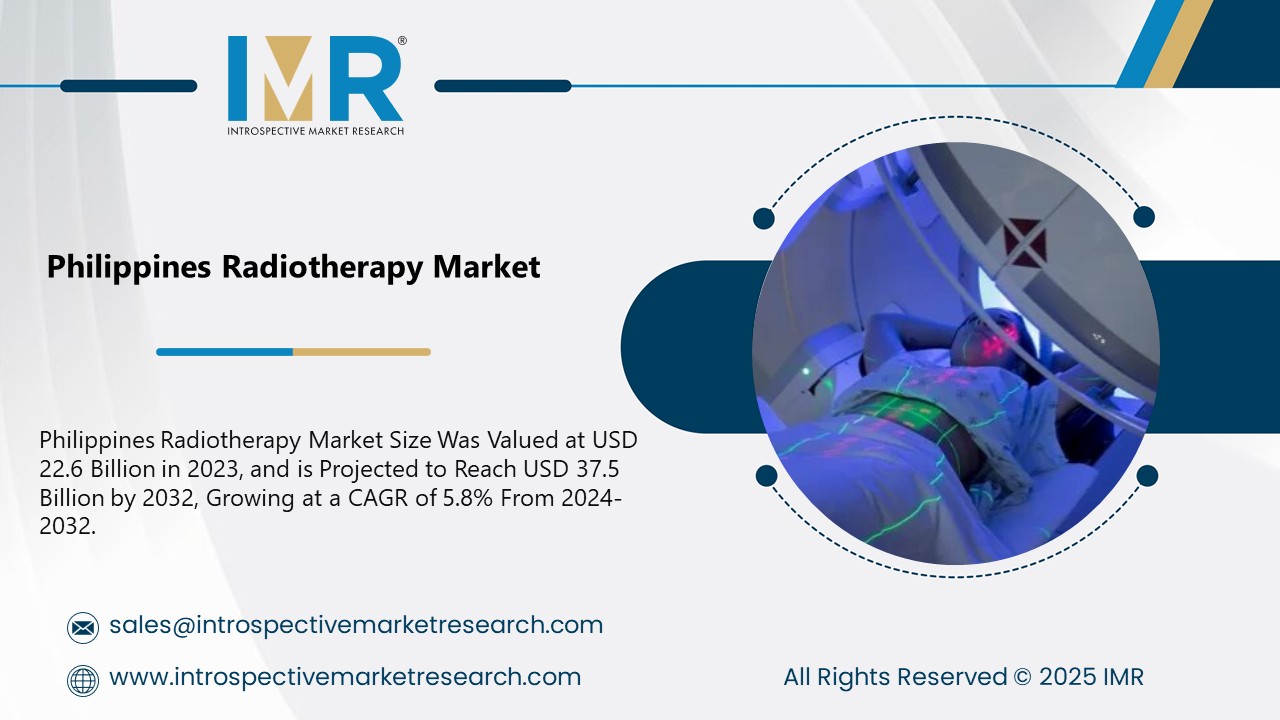
According to a new report published by Introspective Market Research, titled, Philippines Radiotherapy Market by Type (External Beam Radiotherapy, Internal Radiotherapy), Application (Prostate Cancer, Breast Cancer, Lung Cancer, Colorectal Cancer, Head & Neck Cancer, and Others), and End-user (Hospitals, Cancer Research Institutes), The Global Philippines Radiotherapy Market Size Was Valued at USD 22.6 Billion in 2023 and is Projected to Reach USD 37.5 Billion by 2032, Growing at a CAGR of 5.8%. The Philippines Radiotherapy Market encompasses the provision of radiation therapy services and technologies for the treatment of various cancers across the archipelago. Radiotherapy is a crucial component of cancer treatment, utilizing high-energy radiation to shrink tumors and kill cancer cells. This market includes a range of advanced equipment, from linear accelerators (LINACs) for external beam radiation to brachytherapy devices for internal radiation. As cancer incidence continues to rise in the Philippines, the demand for effective and accessible radiotherapy services is growing significantly.
Radiotherapy offers distinct advantages over traditional surgical interventions for certain cancer types, often preserving organs and functions, reducing recovery times, and being applicable to inoperable tumors. It can be used as a primary treatment, neoadjuvant therapy (before surgery), or adjuvant therapy (after surgery) to prevent recurrence. Key industries utilizing radiotherapy services are primarily the healthcare sector, specifically hospitals, specialized cancer centers, and research institutes, which are continuously investing in advanced radiotherapy technologies to improve patient outcomes and expand treatment options for the growing cancer patient population.
One key growth driver for the Philippines Radiotherapy Market is the escalating incidence of various cancer types across the country. Lifestyle changes, environmental factors, and an aging population are contributing to a rising burden of cancer cases, including common forms like breast, lung, colorectal, and prostate cancer. This increasing patient pool directly translates into a higher demand for effective cancer therapies, with radiotherapy being a foundational and often indispensable component of multi-modal treatment plans. The growing number of diagnoses necessitates expanded access to and investment in advanced radiation oncology services.
A significant market opportunity lies in the expansion of public-private partnerships (PPPs) and government initiatives aimed at increasing access to radiotherapy services in underserved regions of the Philippines. Currently, advanced cancer treatment facilities are often concentrated in major urban centers, leaving rural and remote populations with limited access. PPPs can facilitate the establishment of new radiotherapy centers, upgrade existing ones, and provide specialized training for oncologists and radiographers. Government support through funding, policy incentives, and infrastructure development can bridge this access gap, making life-saving radiotherapy more available nationwide.
Philippines Radiotherapy Market, Segmentation
The Philippines Radiotherapy Market is segmented on the basis of Type, Application, and End-user.
Type
- The Type segment is further classified into External Beam Radiotherapy and Internal Radiotherapy. Among these, the External Beam Radiotherapy sub-segment accounted for the highest market share in 2023. External beam radiotherapy (EBRT) is the most common form of radiation treatment, delivered by a machine called a linear accelerator (LINAC) that directs high-energy radiation beams at the tumor from outside the body. Its dominance is due to its wide applicability across various cancer types, technological advancements (like IMRT and SBRT), and its established presence in most radiotherapy centers, making it the primary method for a vast majority of patients undergoing radiation treatment.
Application
- The Application segment is further classified into Prostate Cancer, Breast Cancer, Lung Cancer, Colorectal Cancer, Head & Neck Cancer, and Others. Among these, the Breast Cancer sub-segment accounted for the highest market share in 2023. Breast cancer is one of the most prevalent cancers among women globally and in the Philippines, necessitating widespread use of radiotherapy as a standard part of treatment, particularly after lumpectomy, to reduce recurrence risk. The high incidence, established treatment protocols, and significant patient population requiring adjuvant radiotherapy contribute to breast cancer holding the largest share in the application segment.
Some of The Leading/Active Market Players Are-
- Varian Medical Systems, Inc. (USA)
- Elekta AB (Sweden)
- Accuray Incorporated (USA)
- Ion Beam Applications S.A. (IBA) (Belgium)
- Brainlab AG (Germany)
- Mevion Medical Systems (USA)
- RaySearch Laboratories AB (Sweden)
- GE Healthcare (USA)
- Siemens Healthineers AG (Germany)
- Philips Healthcare (Netherlands)
- Hitachi, Ltd. (Japan)
- Shinva Medical Instrument Co. Ltd. (China)
- Theragenics (Philippines)
- St. Luke's Medical Center (Philippines)
- Makati Medical Center (Philippines)
- and other active players.
Key Industry Developments
- In September 2023, a major private hospital group in Metro Manila announced the installation of a new state-of-the-art linear accelerator (LINAC) with advanced features like IMRT and IGRT. This investment aims to enhance their cancer treatment capabilities.This development signifies a growing trend among leading healthcare providers in the Philippines to adopt cutting-edge radiotherapy technologies. Such upgrades improve treatment precision, reduce side effects, and offer more effective outcomes for cancer patients, aligning with global standards of care.
- In June 2023, the Philippine Department of Health (DOH) outlined plans for establishing additional regional cancer centers, including provisions for radiotherapy units, to address disparities in cancer care access. This initiative reflects a governmental commitment to expanding healthcare infrastructure.This governmental push is crucial for decentralizing cancer care and making radiotherapy more accessible to patients outside of major urban centers. By investing in regional facilities, the DOH aims to alleviate the burden on existing centers and provide more equitable access to life-saving treatments across the archipelago.
Key Findings of the Study
- External Beam Radiotherapy holds the dominant market share due to its wide applicability.
- Breast Cancer applications lead the market, driven by high incidence and treatment protocols.
- The escalating incidence of various cancers is a primary growth driver.
- Expansion through public-private partnerships offers a significant market opportunity.
- Investment in advanced LINACs and government initiatives for regional expansion are key market trends.