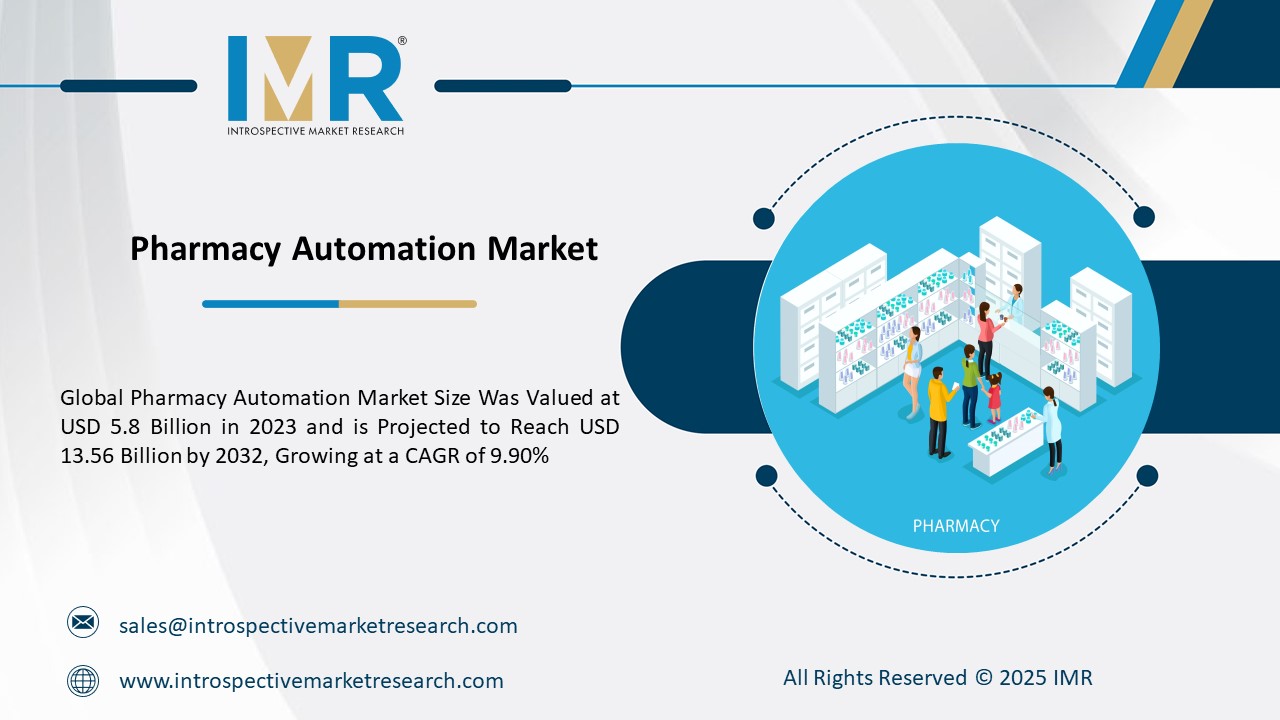
According to a new report published by Introspective Market Research, titled, Pharmacy Automation Market by Product Type, End User, and Function, The Global Pharmacy Automation Market Size Was Valued at USD 5.8 Billion in 2023 and is Projected to Reach USD 13.56 Billion by 2032, Growing at a CAGR of 9.90%.The Pharmacy Automation Market is experiencing significant growth globally, fueled by increasing demand for operational efficiency, medication accuracy, and enhanced patient safety across healthcare systems. Pharmacy automation refers to the use of automated devices and software to handle tasks such as medication dispensing, packaging, labeling, storage, and inventory management. These solutions minimize human error, reduce labor costs, and streamline pharmaceutical workflows in hospitals, retail pharmacies, and long-term care facilities.
As healthcare systems worldwide face increasing medication volumes and workforce shortages, automation offers a viable solution to ensure precise dispensing, compliance with regulations, and improved patient outcomes. The integration of technologies such as Artificial Intelligence (AI), Internet of Things (IoT), and cloud analytics is further transforming pharmacy operations, enabling real-time drug tracking, predictive inventory control, and telepharmacy services. These advancements are elevating efficiency while maintaining transparency and accuracy in complex medication management environments.
The Pharmacy Automation Market is segmented into Product Type, End User, and Function
-
By Product Type: Automated Medication Dispensing Systems, Automated Packaging/Labeling Systems, Automated Storage and Retrieval Systems, Tabletop Tablet Counters, and Others.
-
By End User: Hospitals, Retail Pharmacies, Long-Term Care Facilities, and Mail-Order Pharmacies.
-
By Function: Dispensing, Packaging, Storage, Labeling, and Inventory Management.
A major growth driver for the Pharmacy Automation Market is the rising need to reduce medication errors and improve workflow efficiency in pharmacies. With growing prescription volumes, manual systems are proving insufficient in maintaining accuracy and speed. Automation technologies, including robotic dispensing units and barcoding systems, provide error-free, high-speed operations while ensuring regulatory compliance. Additionally, the aging population and rising prevalence of chronic diseases are driving the need for faster and more reliable pharmaceutical dispensing processes across facilities.
The growing adoption of telepharmacy and remote prescription fulfillment represents a significant market opportunity. With digital health gaining momentum, pharmacies are increasingly deploying advanced automation to enable remote dispensing, real-time monitoring, and contactless service delivery. The integration of AI and predictive analytics allows pharmacies to better anticipate patient needs, optimize medication inventory, and enhance patient engagement. Moreover, emerging economies are presenting new installation opportunities as governments invest in smart healthcare infrastructure and digital transformation.
Pharmacy Automation Market, Segmentation
The Pharmacy Automation Market is segmented on the basis of Product Type, End User, and Function.
Product Type
The Product Type segment is further classified into Automated Medication Dispensing Systems, Automated Packaging/Labeling Systems, Automated Storage and Retrieval Systems, Tabletop Tablet Counters, and Others. Among these, the Automated Medication Dispensing Systems sub-segment accounted for the highest market share in 2023. These systems are increasingly used across hospitals and retail pharmacies due to their ability to dispense accurate doses, improve inventory control, and streamline prescription management. The growing trend of decentralized pharmacies and integration with Electronic Health Records (EHR) further accelerates adoption.
End User
The End User segment is further classified into Hospitals, Retail Pharmacies, Long-Term Care Facilities, and Mail-Order Pharmacies. The Hospital sub-segment dominated the market in 2023 due to increasing automation adoption in inpatient environments to improve accuracy in medication preparation and reduce pharmacist workload. The continual rise in drug dispensing volumes and emphasis on patient safety standards from accrediting agencies have established hospitals as the primary adopters of automated pharmacy systems.
Some of The Leading Market Players Are
- BD (Becton, Dickinson and Company) (United States)
- Omnicell, Inc. (United States)
- Swisslog Healthcare (Switzerland)
- Cerner Corporation (United States)
- Baxter International Inc. (United States)
- ScriptPro LLC (United States)
- Capsa Healthcare (United States)
- McKesson Corporation (United States)
- AmerisourceBergen Corporation (United States)
- Talyst Systems LLC (United States)
- Yuyama Co., Ltd. (Japan)
- ARxIUM, Inc. (Canada)
- Kirby Lester (United States)
- KUKA AG (Germany)
- CareFusion (United States)
- Other active players.
Key Industry Developments
- In May 2025, Omnicell partnered with Microsoft to launch an AI-enabled pharmacy automation platform that integrates predictive analytics for medication inventory management.This collaboration is designed to enhance efficiency in healthcare facilities through cloud-based automation, supporting precision inventory allocation and real-time forecasting capabilities.
- In January 2025, BD (Becton, Dickinson and Company) unveiled its next-generation automated dispensing cabinet with integrated RFID and IoT sensors for real-time medication tracking.The innovation reflects the company’s focus on connectivity and visibility in dispensing operations, enhancing compliance and patient safety in hospital settings.
Key Findings of the Study
- Automated Medication Dispensing Systems lead the global market by product type.
- Hospitals dominate as the primary end user due to stringent safety and efficiency requirements.
- Integration of AI, IoT, and cloud-based analytics drives innovation in automation technologies.
- North America remains the leading region, with rapid expansion in Asia-Pacific due to infrastructure investments.