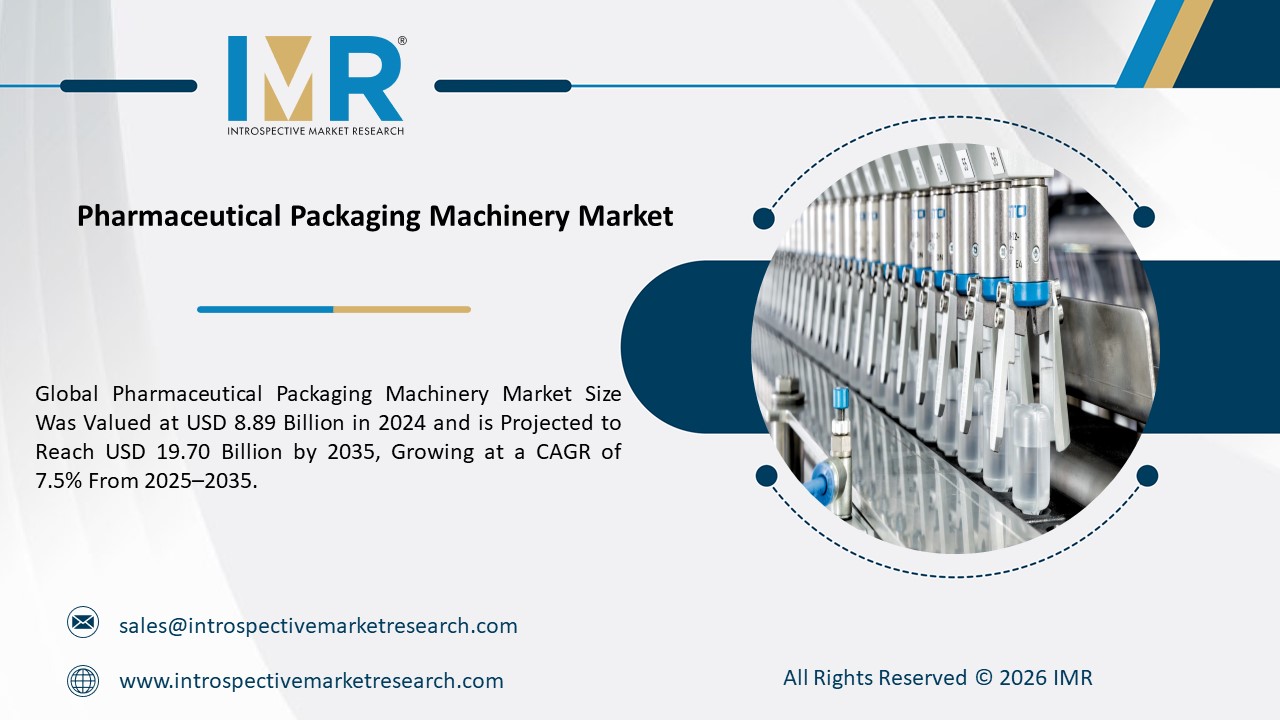
According to a new report published by Introspective Market Research, titled, Pharmaceutical Packaging Machinery Market by Product Type, Packaging Type, and End User, The Global Pharmaceutical Packaging Machinery Market Size Was Valued at USD 8.89 Billion in 2024 and is Projected to Reach USD 19.70 Billion by 2035, Growing at a CAGR of 7.5% From 2025–2035.
The pharmaceutical packaging machinery market comprises advanced equipment used for packaging pharmaceutical products such as tablets, capsules, syrups, injectables, and biologics. These machines ensure product safety, dosage accuracy, contamination prevention, and regulatory compliance across primary, secondary, and tertiary packaging formats. Compared to traditional manual or semi-automatic systems, modern pharmaceutical packaging machinery offers higher precision, faster throughput, reduced human intervention, and improved traceability.
The market is witnessing strong growth due to increasing pharmaceutical production, rising demand for safe and tamper-evident packaging, and the global expansion of generic and branded drug manufacturing. Technological advancements such as automation, robotics, and smart packaging integration are further enhancing operational efficiency and quality assurance.
Additionally, strict regulatory standards imposed by health authorities, along with the growing adoption of unit-dose and blister packaging, are encouraging pharmaceutical manufacturers to invest in advanced packaging solutions. Emerging markets are also contributing significantly due to expanding healthcare infrastructure and rising medicine consumption.
Market Segmentation
The Pharmaceutical Packaging Machinery Market is segmented into Product Type, Packaging Type, and End User.
- By Product Type, the market is categorized into Blister Packaging Machines, Bottle Filling & Capping Machines, Cartoning Machines, Labeling Machines, and Others.
- By Packaging Type, the market is categorized into Primary Packaging, Secondary Packaging, and Tertiary Packaging.
- By End User, the market is categorized into Pharmaceutical Manufacturing Companies, Contract Packaging Organizations, and Biotechnology Companies.
Growth Driver
One of the key growth drivers of the pharmaceutical packaging machinery market is the rapid increase in global pharmaceutical production. Rising prevalence of chronic diseases, expanding aging populations, and growing demand for generic drugs have significantly boosted drug manufacturing volumes. To handle high production loads while maintaining quality and regulatory compliance, pharmaceutical companies are increasingly adopting automated and high-speed packaging machinery. These systems reduce operational errors, improve consistency, and support large-scale manufacturing, thereby driving sustained market growth.
Market Opportunity
A major market opportunity lies in the adoption of smart and sustainable packaging machinery. Integration of digital technologies such as IoT-enabled monitoring, serialization, and track-and-trace systems is creating new growth avenues for machinery manufacturers. Additionally, growing emphasis on eco-friendly packaging materials is driving demand for machinery compatible with recyclable and biodegradable materials. Emerging economies in Asia-Pacific, Latin America, and the Middle East also present strong opportunities due to increasing pharmaceutical investments and expanding local drug manufacturing capacities.
Detailed Segmentation
Pharmaceutical Packaging Machinery Market, Segmentation
The Pharmaceutical Packaging Machinery Market is segmented on the basis of Product Type, Packaging Type, and End User.
Product Type
The Product Type segment is further classified into Blister Packaging Machines, Bottle Filling & Capping Machines, and Cartoning Machines. Among these, the Blister Packaging Machines sub-segment accounted for the highest market share in 2024. This dominance is attributed to widespread use of blister packs for tablets and capsules due to their superior protection, dosage accuracy, and tamper-evident features. Blister packaging machines also support high-speed operations and comply with stringent pharmaceutical regulations, making them a preferred choice globally.
Packaging Type
The Packaging Type segment is further classified into Primary Packaging, Secondary Packaging, and Tertiary Packaging. Among these, the Primary Packaging sub-segment accounted for the highest market share in 2024. Primary packaging machinery plays a critical role in direct product protection, ensuring drug stability and patient safety. Increasing demand for innovative primary packaging formats such as prefilled syringes and unit-dose packs continues to drive this segment’s growth.
Some of The Leading/Active Market Players Are-
- Bosch Packaging Technology (Germany)
- IMA Group (Italy)
- Marchesini Group (Italy)
- Uhlmann Group (Germany)
- Syntegon Technology (Germany)
- Optima Packaging Group (Germany)
- Coesia Group (Italy)
- Romaco Group (Germany)
- ProMach (USA)
- Körber AG (Germany)
- MG2 Srl (Italy)
- ACG Worldwide (India)
- Multivac Group (Germany)
- and other active players.
Key Industry Developments
In March 2024, a leading packaging machinery manufacturer launched a new fully automated blister packaging line designed for high-speed pharmaceutical production.
The system integrates robotics and digital inspection technologies to enhance efficiency, reduce downtime, and ensure compliance with serialization and traceability regulations.
In September 2024, a major global pharmaceutical equipment provider expanded its manufacturing facility in Asia to meet rising regional demand.
This expansion aims to strengthen local supply chains, reduce delivery timelines, and support growing pharmaceutical production in emerging markets.
Key Findings of the Study
-
Blister packaging machines dominate the product type segment
-
Primary packaging holds the largest market share
-
Europe and Asia-Pacific are leading regions
-
Automation and regulatory compliance drive growth
-
Smart and sustainable packaging is a key market trend