
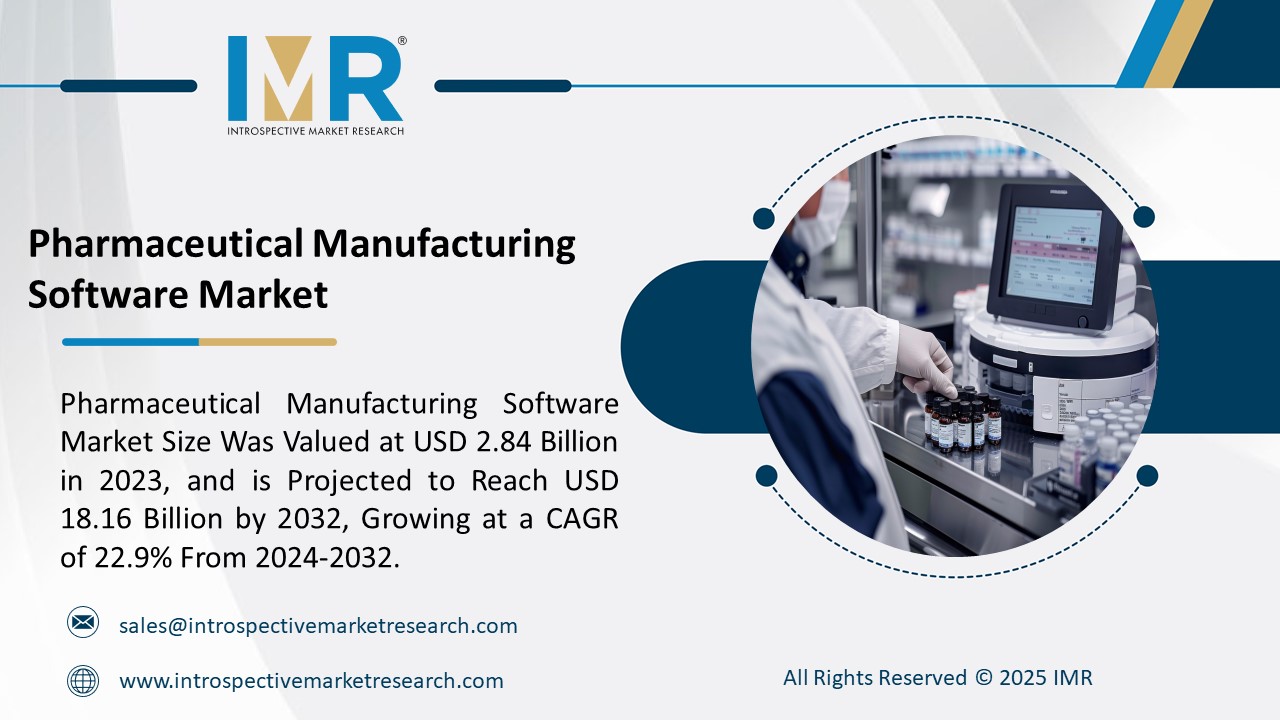
According to a new report published by Introspective Market Research, titled, “Pharmaceutical Manufacturing Software Market by Deployment Mode, Application, and End-User, The Global Pharmaceutical Manufacturing Software Market Size Was Valued at USD 2.84 Billion in 2023 and is Projected to Reach USD 18.16 Billion by 2032, Growing at a CAGR of 22.9%. The global Pharmaceutical Manufacturing Software Market is witnessing robust growth, driven by the increasing adoption of digital solutions to streamline complex production processes, ensure compliance, and enhance product quality. These software solutions provide pharmaceutical companies with advanced tools for managing production scheduling, inventory, quality control, and regulatory documentation making operations more efficient and cost-effective.
Unlike traditional manual and paper-based systems, pharmaceutical manufacturing software offers real-time data monitoring, predictive analytics, and automation features that reduce human error and improve consistency. The integration of AI, IoT, and cloud technologies within manufacturing environments has revolutionized how pharmaceutical products are developed and produced.
Moreover, the rising demand for personalized medicine, coupled with stringent regulatory standards by the FDA and EMA, is compelling manufacturers to implement advanced software systems to maintain data integrity, traceability, and quality assurance throughout the production cycle.
One of the key growth drivers for the Pharmaceutical Manufacturing Software Market is the increasing regulatory compliance pressure in the pharmaceutical sector. As drug manufacturing becomes more complex, regulatory agencies demand greater transparency and documentation at every stage of production. Pharmaceutical manufacturing software enables automated compliance reporting, ensures data integrity, and provides electronic batch records that streamline audits and inspections. This compliance advantage is prompting more manufacturers to digitize their production systems, significantly driving market expansion.
A major opportunity lies in the integration of Artificial Intelligence (AI) and Machine Learning (ML) within pharmaceutical manufacturing software. These technologies are increasingly being used to predict equipment failures, optimize production scheduling, and enhance quality assurance. As the industry moves toward smart manufacturing, vendors that provide AI-enabled, cloud-based, and scalable software platforms will gain a competitive edge. This opens significant opportunities for innovation and long-term growth across both developed and emerging markets.
Pharmaceutical Manufacturing Software Market, Segmentation
The Pharmaceutical Manufacturing Software Market is segmented on the basis of Deployment Mode, Application, and End-User.
Deployment Mode
-
The Deployment Mode segment is further classified into On-Premise, Cloud-Based, and Hybrid. Among these, the Cloud-Based sub-segment accounted for the highest market share in 2023.
- Cloud-based solutions are gaining popularity due to their scalability, cost-effectiveness, and remote accessibility. They allow pharmaceutical firms to store and manage vast amounts of data securely while enabling real-time monitoring of manufacturing operations across global locations. Additionally, they facilitate seamless integration with ERP systems, making them ideal for both large and small-scale manufacturers.
Application
-
The Application segment is further classified into Production Management, Quality Management, Inventory Management, and Compliance Management. Among these, the Quality Management sub-segment accounted for the highest market share in 2023.
- The growing focus on maintaining product consistency and adhering to international quality standards has driven the adoption of quality management modules. These tools help automate inspection workflows, track deviations, and maintain complete audit trails, ensuring compliance with Good Manufacturing Practices (GMP).
Some of The Leading/Active Market Players Are:
- MasterControl, Inc. (U.S.)
- SAP SE (Germany)
- Dassault Systèmes SE (France)
- Siemens AG (Germany)
- Honeywell International Inc. (U.S.)
- Rockwell Automation, Inc. (U.S.)
- Emerson Electric Co. (U.S.)
- Sparta Systems, Inc. (U.S.)
- Oracle Corporation (U.S.)
- ABB Ltd. (Switzerland)
- POMS Corporation (U.S.)
- Werum IT Solutions GmbH (Germany)
- Yokogawa Electric Corporation (Japan)
- Aspen Technology, Inc. (U.S.)
- And other active players.
Key Industry Developments
-
In March 2024, MasterControl launched a next-generation Manufacturing Excellence Solution to enhance real-time visibility into shop-floor operations and accelerate batch record reviews. This innovation aims to minimize manual data entry and improve regulatory compliance for pharmaceutical manufacturers globally.
- In June 2024, Siemens and SAP announced a strategic collaboration to integrate digital twin capabilities into pharmaceutical manufacturing. The integration will enable manufacturers to simulate, monitor, and optimize their production processes in real time, improving both efficiency and product quality.
Key Findings of the Study
- Cloud-based deployment dominated the market in 2023.
- North America held the largest regional share due to strong digital infrastructure and regulatory enforcement.
- Rising demand for AI-driven manufacturing analytics is propelling growth.
- Increased focus on regulatory compliance is a major growth catalyst.
- Strategic collaborations between software providers and pharma manufacturers are shaping market dynamics.





