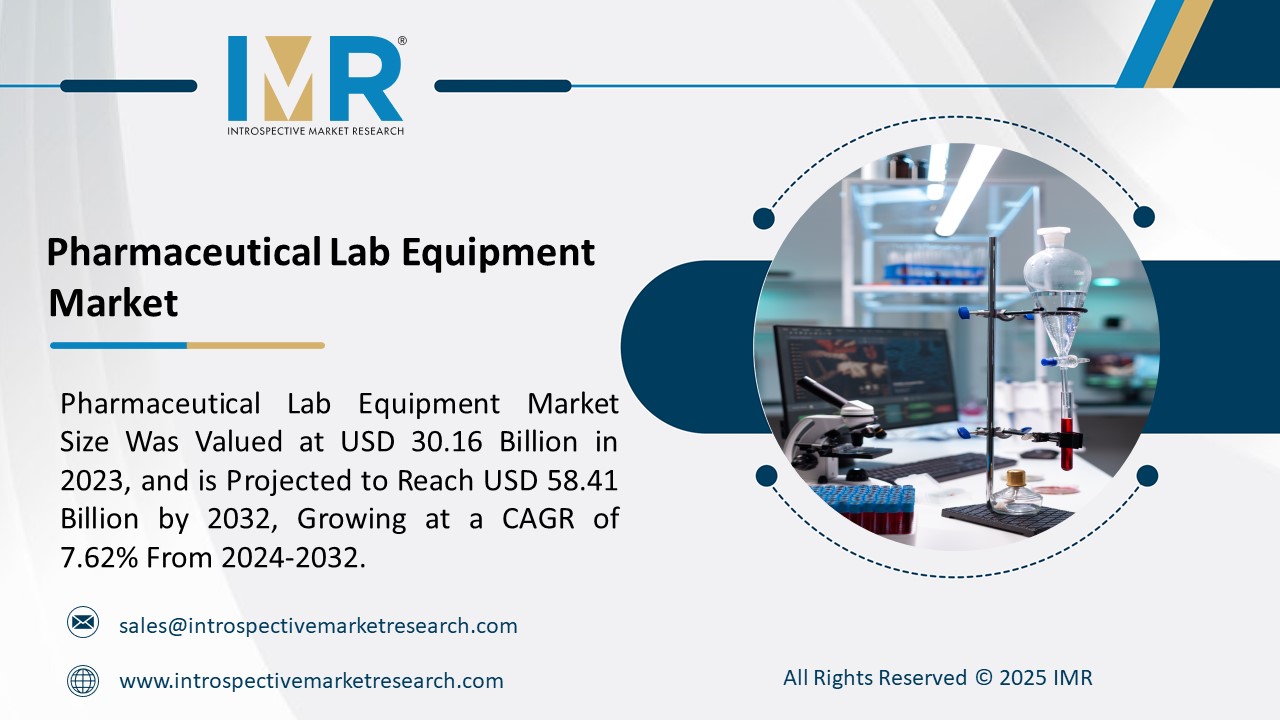
According to a new report published by Introspective Market Research, titled, Pharmaceutical Lab Equipment Market by Product Type, Application, and End User, The Global Pharmaceutical Lab Equipment Market Size Was Valued at USD 30.16 Billion in 2023 and is Projected to Reach USD 58.41 Billion by 2032, Growing at a CAGR of 7.62%. The pharmaceutical lab equipment market is a crucial segment of the global healthcare and life sciences industry, supporting the development, analysis, and manufacturing of drugs. Laboratory equipment such as chromatography systems, spectrophotometers, centrifuges, incubators, and analytical instruments play an essential role in ensuring accurate research outcomes, high-quality drug formulations, and compliance with regulatory standards.
Compared to traditional manual methods, modern pharmaceutical lab equipment offers improved efficiency, precision, automation, and reproducibility, which are critical in drug discovery, toxicology testing, and clinical trial processes. Increasing investments in R&D, coupled with advancements in biotechnology and molecular diagnostics, are driving the adoption of these solutions across pharmaceutical and biopharmaceutical companies, research laboratories, and academic institutes worldwide.
One of the key growth drivers of the pharmaceutical lab equipment market is the surge in pharmaceutical R&D spending worldwide. With rising demand for innovative therapies for chronic and rare diseases, pharmaceutical and biotechnology firms are heavily investing in laboratory infrastructure. Advanced lab equipment ensures accuracy, reproducibility, and compliance with regulatory standards, which are vital for gaining drug approvals. Additionally, the increasing focus on biologics and precision medicine requires high-end equipment for cell culture, molecular testing, and protein analysis, further boosting demand.
A major market opportunity lies in the integration of automation and digital technologies in laboratory equipment. The growing adoption of smart lab solutions, including AI-driven analytics, robotics, and IoT-enabled instruments, is transforming drug discovery and development processes. These technologies not only enhance efficiency and reduce errors but also enable real-time data monitoring and predictive insights. Emerging markets in Asia-Pacific and Latin America, with expanding pharmaceutical manufacturing hubs and government-backed R&D initiatives, present significant opportunities for industry players to expand their footprint.
Pharmaceutical Lab Equipment Market, Segmentation
Product Type
-
The Product Type segment is further classified into Chromatography Systems, Spectroscopy Instruments, Centrifuges, Microscopes, Incubators, and Others. Among these, the Chromatography Systems sub-segment accounted for the highest market share in 2023. Widely used for drug testing, purification, and analysis, chromatography systems are indispensable in pharmaceutical research and quality control. Their ability to separate, identify, and quantify compounds with high accuracy makes them a preferred choice in drug discovery, stability testing, and regulatory compliance processes.
Application
-
The Application segment is further classified into Drug Discovery, Clinical Diagnostics, Quality Control, and Research & Development. Among these, the Drug Discovery sub-segment accounted for the highest market share in 2023. The increasing demand for new therapies, coupled with rising investments in genetic and molecular research, has strengthened the use of advanced lab equipment in drug discovery. These instruments play a pivotal role in pre-clinical studies, toxicology testing, and molecular profiling, making them vital for developing safe and effective pharmaceutical products.
Some of The Leading/Active Market Players Are-
- Agilent Technologies, Inc. (U.S.)
- Thermo Fisher Scientific, Inc. (U.S.)
- Shimadzu Corporation (Japan)
- PerkinElmer, Inc. (U.S.)
- Bruker Corporation (U.S.)
- Merck KGaA (Germany)
- Waters Corporation (U.S.)
- Danaher Corporation (U.S.)
- Sartorius AG (Germany)
- Eppendorf AG (Germany)
- Bio-Rad Laboratories, Inc. (U.S.)
- Hitachi High-Tech Corporation (Japan)
- HORIBA Scientific (Japan)
- GE Healthcare (U.K.)
- F. Hoffmann-La Roche Ltd. (Switzerland)
- other active players.
Key Industry Developments
-
In February 2024, Thermo Fisher Scientific introduced a new range of AI-powered chromatography systems aimed at improving pharmaceutical quality control.
The new systems are designed to deliver higher accuracy, real-time analytics, and improved compliance with global regulatory standards, strengthening the company’s leadership in the lab equipment segment. - In June 2024, Agilent Technologies expanded its spectroscopy portfolio by launching next-generation UV-Vis spectrophotometers for pharmaceutical research.
The new instruments are optimized for drug discovery and clinical testing, offering faster analysis times and enhanced data accuracy, thereby addressing the growing demand for efficient laboratory solutions.
Key Findings of the Study
- Chromatography Systems and Drug Discovery dominated the market in 2023.
- North America led the market, while Asia-Pacific is expected to witness the fastest growth.
- Rising R&D spending and biologics development are driving demand.
- AI, robotics, and smart lab automation are emerging as key trends.