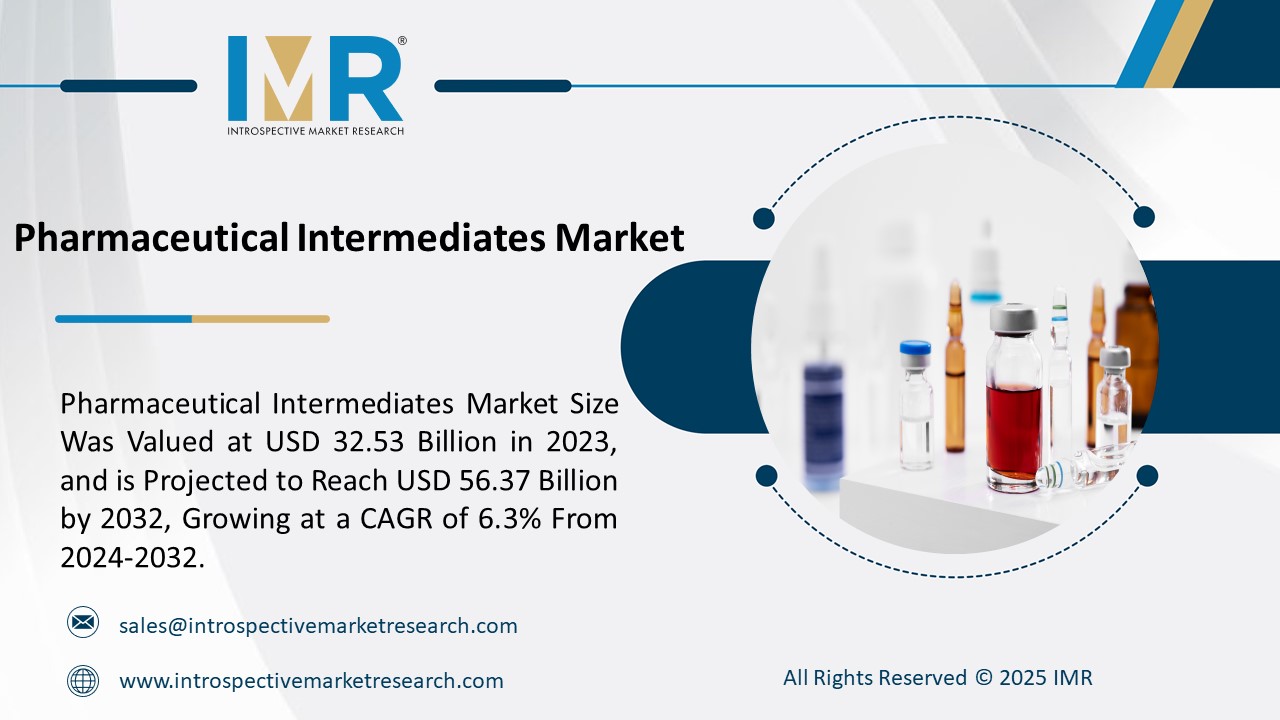
According to a new report published by Introspective Market Research, titled, Pharmaceutical Intermediates Market by Product Type, Application, and End User, The Global Pharmaceutical Intermediates Market Size Was Valued at USD 32.53 Billion in 2023 and is Projected to Reach USD 56.37 Billion by 2032, Growing at a CAGR of 6.3%. The pharmaceutical intermediates market plays a vital role in the global healthcare and life sciences industry. Pharmaceutical intermediates are chemical compounds used as building blocks in the manufacturing of active pharmaceutical ingredients (APIs) and finished drugs. They offer high precision and reliability in drug formulation, making them indispensable in the production of antibiotics, analgesics, antipyretics, and other therapeutic solutions.
Compared to traditional alternatives, pharmaceutical intermediates provide advantages such as higher purity levels, consistent quality, and cost-effective large-scale production. The rising prevalence of chronic diseases, growing investment in research and development (R&D), and increased demand for novel drugs are fueling the adoption of pharmaceutical intermediates across the globe. Key industries such as biotechnology, chemical manufacturing, and contract research organizations (CROs) are among the primary users driving this market forward.
One of the key growth drivers of the pharmaceutical intermediates market is the rising global demand for innovative drugs and therapies. With the increasing prevalence of cancer, cardiovascular diseases, and diabetes, pharmaceutical companies are investing heavily in drug discovery and development. Pharmaceutical intermediates are crucial in this process as they enable the efficient synthesis of APIs, which accelerates time-to-market for new medicines. Furthermore, growing collaborations between pharmaceutical manufacturers and CROs are boosting large-scale production and distribution of intermediates worldwide.
An emerging opportunity for the pharmaceutical intermediates market lies in the expansion of the biopharmaceutical sector. With the rapid advancement of biologics, biosimilars, and personalized medicine, the demand for high-quality intermediates is expected to rise significantly. The integration of advanced manufacturing technologies such as continuous flow chemistry and green synthesis is opening new avenues for eco-friendly, cost-efficient production. This presents a lucrative opportunity for manufacturers to expand their portfolios and strengthen their position in the global pharmaceutical supply chain.
Pharmaceutical Intermediates Market, Segmentation
Product Type
-
The Product Type segment is further classified into Bulk Drug Intermediates, Custom Intermediates, and Others. Among these, the Bulk Drug Intermediates sub-segment accounted for the highest market share in 2023. Bulk drug intermediates are widely used in the mass production of antibiotics, antipyretics, and cardiovascular drugs, owing to their cost-effectiveness and scalability. Their extensive applications in both branded and generic drug production make them the most dominant sub-segment in the market.
Application
-
The Application segment is further classified into Antibiotics, Antipyretics, Analgesics, and Others. Among these, the Antibiotics sub-segment accounted for the highest market share in 2023. Antibiotics remain the cornerstone of global healthcare, particularly in combating infectious diseases. The rising incidence of bacterial infections, coupled with increasing antibiotic resistance, is driving the continuous demand for advanced antibiotic drug development, thereby fueling the growth of pharmaceutical intermediates in this sub-segment.
Some of The Leading/Active Market Players Are-
-
BASF SE (Germany)
- Lonza Group (Switzerland)
- Cambrex Corporation (U.S.)
- Evonik Industries AG (Germany)
- Albemarle Corporation (U.S.)
- Aceto Corporation (U.S.)
- Midas Pharma GmbH (Germany)
- Sanofi S.A. (France)
- Vertellus Holdings LLC (U.S.)
- Ganesh Group of Industries (India)
- Dishman Carbogen Amcis Ltd. (India)
- Jubilant Pharmova Ltd. (India)
- Aurobindo Pharma Ltd. (India)
- Zhejiang Huahai Pharmaceutical Co., Ltd. (China)
- Pfizer Inc. (U.S.)
and other active players.
Key Industry Developments
-
In April 2024, BASF SE announced an expansion of its pharmaceutical intermediates production facility in Germany to strengthen supply chain resilience and meet growing global demand.
The expansion project includes the integration of advanced process technologies to enhance capacity, reduce environmental footprint, and cater to increasing demand for antibiotics and cardiovascular drug intermediates. - In September 2024, Lonza Group partnered with a leading biopharmaceutical company to supply custom intermediates for biologics manufacturing.
This collaboration aims to accelerate the development of novel therapies by leveraging Lonza’s expertise in high-quality intermediate production and innovative continuous flow chemistry solutions.
Key Findings of the Study
-
Bulk Drug Intermediates and Antibiotics dominated the market in 2023.
- North America and Asia-Pacific are the leading regions in revenue and production.
- Rising prevalence of chronic and infectious diseases is a major driver.
- Biopharmaceutical expansion and advanced synthesis technologies are key trends.